 Regular readers will know that this member of The Meeple Guild, in genera,l loves abstract strategy games.
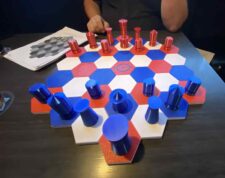
So getting my hands on what is basically a prototype edition – 3D printed – copy of the new abstract strategy game Hexeh was rather exciting, and from the moment the box arriv,ed I admit I wanted to love this one.
So let’s dive in and see The Meeple Guild’s reaction to what is essentially a fresh take on chess.
In fact, Richie Ortiz, co-designer along with Mitchell Jasper, said there were thoughts of chess in the creation of Hexeh.
“The main thing I was trying to achieve while creating Hexeh was to give the world a game that actually rivals chess,” he said. “Of course, there are games out there that are very strategic, 1v1, etc., but none of those games ever had the same vibes as ches,s in my opinion. I wanted something that would challenge the mind, have rich complexity, while being approachable to the masses. Hexeh combines the strategic depth of chess with the speed and energy of party games.”
We start with the unboxing, and while remembering this is a prototype, this one looks very modern with pieces in blue and red. They are also nicely chun,ky which is great as you are moving them around the board. I admit I have had thoughts of removing the felt, drilling a hole in each piece to allow hot-gluing a one-ounce fishing weight in them for a weighted feel, but that may come with a production set too.
The board here is hexagonal, which was really the gem of the game’s creation, said Ortiz via email.
“Before my first son was born three years ago, I was gazing at a piece of art that my wife made for his nursery,” he said. “It was a pattern that involved three colours of hexagons, and after looking at it for a while, I realized that there was a lot of potential in that pattern for the next big strategy game. I created a board of 86 hexagons configured inside a rectangle, but something didn’t feel quite right about that. Then I realized that the hexagons should just be arranged in a larger hexagon! It started with 91 spaces, then turned into 61 spaces, and finally, 37 spaces would be the final version. On each of those boards, I had different arrangements of guards, prowlers, travellers, wizards, and empresses (more on these later).
“After bringing version three to a local chess club to test it out, I realized that Hexeh was taking as long, if not longer, than traditional games of chess. I thought to myself, Chess is complicated already, and is sometimes unapproachable and isolating, especially amongst larger groups of people.” So, making the board into 37 spaces (version 4) became the answer to that problem. On this final version of the board, Hexeh games average less than half the moves of chess games, therefore making Hexeh much more approachable and much less isolating since the games don’t take as long. So, artwork on the wall made by my ever-creative wife turned into what will hopefully be the start of something incredible.”
Now hexagonal chess is not new — Władyslaw Gliński created one of interest way back in 1936 – but there are relatively few, so in that Hexeh comes across as fresh.
As for the piece array, Ortiz and Jasper did an interesting job of it – incorporating a lot of new ideas rather than relying on familiar chess pieces. I like that approach. It’s why I really like the near unknown Odin’s Rune Chess from Gary K. Gifford in 2005 – the Forest Ox piece being capable of two captures on a turn.
In Hexe, everything is just a bit different, except the Emperor,whoh is basically the King with the same limited movement.
Guards are essentially pawns, but they do move one space in any direction, although they can capture only forward. That they can retreat is neat, but offensively, they have limited value.
Prowlers are sort of Hexeh’s knights, or more aptly, a horse from Xiangqi, since prowlers don’t jump intervening pieces in their moves.
Travellers are sort of bishops, but on the hex board, follow the space colours, meaning they are tricky. You really need to be aware of them. They can also slide to a different colour as needed – neat – but can capture on the colour change too. It gives an already powerful piece a sort of double ability in a single movmovend prevents threats from a guard moving in close,a s it is easily taken. The double ability is my least liked aspect of the rules.
The Wizard is the most divergent form of regular chess pieces, as it can literally bounce off the outer edge and keep going, making it another one that you need to be constantly aware of.
It all seems so fine at this point.
But, play-wise, The Meeple Guild has really struggled with whether we like Hexeh or not.
To start with, you don’t have to announce ‘check’, and with the new piece movement, it is often ‘well, I didn’t see that coming’.
And again with the movements, games are short, to the point of feeling rather unfulfilling more often than they should.
That said, our dislikes are what the designers wanted.
“To me, the best element of the game is the fact that capturing the empress is the way you win. This means there are no checks, so if you don’t see a threat on your empress, that’s just part of the game,” said Ortiz. “This to me creates a heightened level of fun and tension all at the same time.”
Too often, we might counter that it creates frustration and a desire to play Hive.
What does this game offer that others don’t?
Jasper added, “Hexeh solves so many problems that strategy games usually have. It’s fast instead of dragging on. It’s deep without being overwhelming. It stays fresh and doesn’t get repetitive. And it’s easy to teach, even with unique mechanics.”
He’s right on the learning curve. Despite the varied pieces, it comes easily – especially if you play chess.
On the speed factor, it’s a little less clear if it’s a good thing to be quick.
This is one you buy because you want a different chess experience, and that experience still typically means a longer play session.
If all you want is a quicker abstract strategy gam,– well, a myriad of those exist already.
In the end, our little troupe goes from one noting ‘this is just not fun’ to ‘it’s brutally too fast’ to scowls of wanting to like it more than we do.
There’s a game here to be sure, but we remain confused as to how good it is. Check it out at hexehgame.com
About Author
Calvin Daniels is a Saskatchewan-born, self-taught journalist. He is currently Editor of Yorkton This Week, with 35-years in the newspaper business.

Hexeh revamps ‘chess’ in major way
So getting my hands on what is basically a prototype edition – 3D printed – copy of the new abstract strategy game Hexeh was rather exciting, and from the moment the box arriv,ed I admit I wanted to love this one.
So let’s dive in and see The Meeple Guild’s reaction to what is essentially a fresh take on chess.
In fact, Richie Ortiz, co-designer along with Mitchell Jasper, said there were thoughts of chess in the creation of Hexeh.
“The main thing I was trying to achieve while creating Hexeh was to give the world a game that actually rivals chess,” he said. “Of course, there are games out there that are very strategic, 1v1, etc., but none of those games ever had the same vibes as ches,s in my opinion. I wanted something that would challenge the mind, have rich complexity, while being approachable to the masses. Hexeh combines the strategic depth of chess with the speed and energy of party games.”
We start with the unboxing, and while remembering this is a prototype, this one looks very modern with pieces in blue and red. They are also nicely chun,ky which is great as you are moving them around the board. I admit I have had thoughts of removing the felt, drilling a hole in each piece to allow hot-gluing a one-ounce fishing weight in them for a weighted feel, but that may come with a production set too.
The board here is hexagonal, which was really the gem of the game’s creation, said Ortiz via email.
“Before my first son was born three years ago, I was gazing at a piece of art that my wife made for his nursery,” he said. “It was a pattern that involved three colours of hexagons, and after looking at it for a while, I realized that there was a lot of potential in that pattern for the next big strategy game. I created a board of 86 hexagons configured inside a rectangle, but something didn’t feel quite right about that. Then I realized that the hexagons should just be arranged in a larger hexagon! It started with 91 spaces, then turned into 61 spaces, and finally, 37 spaces would be the final version. On each of those boards, I had different arrangements of guards, prowlers, travellers, wizards, and empresses (more on these later).
“After bringing version three to a local chess club to test it out, I realized that Hexeh was taking as long, if not longer, than traditional games of chess. I thought to myself, Chess is complicated already, and is sometimes unapproachable and isolating, especially amongst larger groups of people.” So, making the board into 37 spaces (version 4) became the answer to that problem. On this final version of the board, Hexeh games average less than half the moves of chess games, therefore making Hexeh much more approachable and much less isolating since the games don’t take as long. So, artwork on the wall made by my ever-creative wife turned into what will hopefully be the start of something incredible.”
Now hexagonal chess is not new — Władyslaw Gliński created one of interest way back in 1936 – but there are relatively few, so in that Hexeh comes across as fresh.
As for the piece array, Ortiz and Jasper did an interesting job of it – incorporating a lot of new ideas rather than relying on familiar chess pieces. I like that approach. It’s why I really like the near unknown Odin’s Rune Chess from Gary K. Gifford in 2005 – the Forest Ox piece being capable of two captures on a turn.
In Hexe, everything is just a bit different, except the Emperor,whoh is basically the King with the same limited movement.
Guards are essentially pawns, but they do move one space in any direction, although they can capture only forward. That they can retreat is neat, but offensively, they have limited value.
Prowlers are sort of Hexeh’s knights, or more aptly, a horse from Xiangqi, since prowlers don’t jump intervening pieces in their moves.
Travellers are sort of bishops, but on the hex board, follow the space colours, meaning they are tricky. You really need to be aware of them. They can also slide to a different colour as needed – neat – but can capture on the colour change too. It gives an already powerful piece a sort of double ability in a single movmovend prevents threats from a guard moving in close,a s it is easily taken. The double ability is my least liked aspect of the rules.
The Wizard is the most divergent form of regular chess pieces, as it can literally bounce off the outer edge and keep going, making it another one that you need to be constantly aware of.
It all seems so fine at this point.
But, play-wise, The Meeple Guild has really struggled with whether we like Hexeh or not.
To start with, you don’t have to announce ‘check’, and with the new piece movement, it is often ‘well, I didn’t see that coming’.
And again with the movements, games are short, to the point of feeling rather unfulfilling more often than they should.
That said, our dislikes are what the designers wanted.
“To me, the best element of the game is the fact that capturing the empress is the way you win. This means there are no checks, so if you don’t see a threat on your empress, that’s just part of the game,” said Ortiz. “This to me creates a heightened level of fun and tension all at the same time.”
Too often, we might counter that it creates frustration and a desire to play Hive.
What does this game offer that others don’t?
Jasper added, “Hexeh solves so many problems that strategy games usually have. It’s fast instead of dragging on. It’s deep without being overwhelming. It stays fresh and doesn’t get repetitive. And it’s easy to teach, even with unique mechanics.”
He’s right on the learning curve. Despite the varied pieces, it comes easily – especially if you play chess.
On the speed factor, it’s a little less clear if it’s a good thing to be quick.
This is one you buy because you want a different chess experience, and that experience still typically means a longer play session.
If all you want is a quicker abstract strategy gam,– well, a myriad of those exist already.
In the end, our little troupe goes from one noting ‘this is just not fun’ to ‘it’s brutally too fast’ to scowls of wanting to like it more than we do.
There’s a game here to be sure, but we remain confused as to how good it is. Check it out at hexehgame.com
About Author
Calvin Daniels
Calvin Daniels is a Saskatchewan-born, self-taught journalist. He is currently Editor of Yorkton This Week, with 35-years in the newspaper business.
See author's posts