 I always like wasting a little time digging around the Internet in pursuit of new card games, especially games that are for two players.
One spot online where you can dig around for quite a lot of time is pagat.com, a great card game resource.
On one of my visits, I studied up on Blackbird, thought it held some promise, so I had my buddy Trevor print out the rules, and over a java at a local coffee shop, we gave the game a whirl.
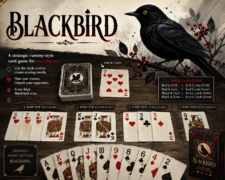
Blackbird is a card game solidly in the rummy family, with players dealt 10 cards apiece, which they are trying to meld off. Both players then score their melds.
A meld can have four, three, two, or a single card. The singleton is worth extra for having, but you cannot start with a lone-card meld, and you may only have one.
The melds one can lay off on a turn are based on a “trick card” that is face up on the table. Whatever color the card is, and whether it is odd or even, dictates what combination you can meld. So, a seven of hearts allows melds of red cards that are uneven. A mixed-suit meld is possible, but scores considerably fewer points.
On a turn, you may select the trick card, the top card of the deck, or the top card in the discard pile, make whatever moves you can, and then discard a single card. That means the “trick” card will change often.
So, while managing changing meld possibilities, you are also trying to meld suits that score best (spades in most cases), as well as figuring out what cards work best in certain melds. For example, a king/jack meld of two scores more than just two random cards, and the queen is the singleton that scores more than any other single card.
In the end, this one takes a tick or two to get your head around, as you are balancing good suit choices, with hearts being the weakest, while adjusting the “trick” card to aid yourself or block what you suspect your opponent is doing. You won’t likely be able to do it all.
You also need to be aware of how many cards you have in hand, as certain melds seem more challenging.
Overall, this one went from initial excitement after finding it, to the blush wearing off in early play, and then, as we adapted to the subtle intricacies of Blackbird, it gained our interest again. One well worth exploring if you like rummy.
About Author
Calvin Daniels is a Saskatchewan-born, self-taught journalist. He is currently Editor of Yorkton This Week, with 35-years in the newspaper business.

Blackbird
One spot online where you can dig around for quite a lot of time is pagat.com, a great card game resource.
On one of my visits, I studied up on Blackbird, thought it held some promise, so I had my buddy Trevor print out the rules, and over a java at a local coffee shop, we gave the game a whirl.
Blackbird is a card game solidly in the rummy family, with players dealt 10 cards apiece, which they are trying to meld off. Both players then score their melds.
A meld can have four, three, two, or a single card. The singleton is worth extra for having, but you cannot start with a lone-card meld, and you may only have one.
The melds one can lay off on a turn are based on a “trick card” that is face up on the table. Whatever color the card is, and whether it is odd or even, dictates what combination you can meld. So, a seven of hearts allows melds of red cards that are uneven. A mixed-suit meld is possible, but scores considerably fewer points.
On a turn, you may select the trick card, the top card of the deck, or the top card in the discard pile, make whatever moves you can, and then discard a single card. That means the “trick” card will change often.
So, while managing changing meld possibilities, you are also trying to meld suits that score best (spades in most cases), as well as figuring out what cards work best in certain melds. For example, a king/jack meld of two scores more than just two random cards, and the queen is the singleton that scores more than any other single card.
In the end, this one takes a tick or two to get your head around, as you are balancing good suit choices, with hearts being the weakest, while adjusting the “trick” card to aid yourself or block what you suspect your opponent is doing. You won’t likely be able to do it all.
You also need to be aware of how many cards you have in hand, as certain melds seem more challenging.
Overall, this one went from initial excitement after finding it, to the blush wearing off in early play, and then, as we adapted to the subtle intricacies of Blackbird, it gained our interest again. One well worth exploring if you like rummy.
About Author
Calvin Daniels
Calvin Daniels is a Saskatchewan-born, self-taught journalist. He is currently Editor of Yorkton This Week, with 35-years in the newspaper business.
See author's posts