Over on the Comics Fantastic History podcast, I have been bringing on guests from Jack of All Comics. It’s a celebration of Jack Kirby’s groundbreaking 1960s–70s work, collecting twenty‑eight essays that explore nearly every title the King of Comics touched. The latest Jack show has Keith DeCandido talking about Kirby’s Sandman series at DC, and Rich Steeves tackles Kirby’s Eternals.
One of the guests for the show was Cliff Biggers, who covered Kirby’s run on the Fantastic Four. Why did he get to write about Kirby the comic? Simple: He was the only one to start reading the Fab Four from the beginning!
For more than half a century, Cliff Biggers has been one of the most recognizable voices in American comics culture. Retailer, writer, fanzine pioneer, historian, and co‑founder of Comic Shop News, Biggers has lived through every major shift in the medium—from spinner racks and drugstore shelves to the rise of specialty shops and the modern collector’s market. His enthusiasm hasn’t dimmed; if anything, it’s sharpened with time. When he talks about comics, he speaks with the clarity of someone who has never forgotten the moment the medium first grabbed him. What follows is a lightly edited transcript of our conversation. You can also watch the full show on YouTube.
FCF: Welcome back to the podcast. Today I am excited and pleased because joining me is Cliff Biggers, who is—gosh, if you don’t know his name, you don’t collect comic books. Cliff, tell the fans your origin story. What got you into comic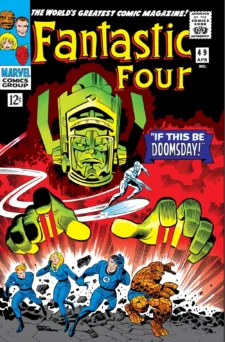 books and made you a lifelong fan?
Cliff Biggers: I can’t tell you exactly what—a tonsillectomy. When I was about six years old, the doctor said I had to have my tonsils taken out. I’d looked at comic strips all my life; my dad was a newspaper man, so comic strips fascinated me. I’d seen a couple of comic books at other people’s houses, but I never owned one. My parents said, “Let’s get you some comic books.” At that time, a tonsillectomy kept you in the hospital for three nights, and hospitals were reasonable about medical care. They said, “We’ll get you four comic books—one for the night before and one for each of the three nights after.”
I picked out my four comics. I picked out an Archie because it was a 25‑cent, 80‑page special. I picked out a Dennis the Menace for the same reason. I picked out Hot Stuff because I’d never heard of the character. And I picked out a Superman, which I thought was Superman versus King Kong—it turned out to be the origin of Titano the Super‑Ape. From that point, I was hooked. I must have read those books 50 times. Every time I found something new in them. That got me to the point where I was buying comics as much as I could.
FCF: So tell the fans a little bit about yourself.
Cliff Biggers: I’ve been reading, collecting, and enjoying comics consistently since those first four. I still have a spinner rack in my office with those four books at the top. The rack is filled with what I call my “rack of inspiration”—low‑condition junk comics from the ’50s, ’60s, and ’70s. Superhero, war, romance, humor, Charlton, Marvel, DC, Tower, Archie—anything I would’ve picked up at that time. I just reach in and pull a book at random. But those four stay at the top to remind me how I got started.
I became a science‑fiction fan in junior high, and that led me to fanzines. Through fanzines, I met people who would go on to become major creators—Jim Starlin, Marv Wolfman, Len Wein, Bernie Wrightson, Paul Levitz, Roy Thomas. It was an amazing time. I moved to Atlanta in ’77 and met Ward Batty, who became my business partner. In 1982, we bought Doctor Knows, a comic shop in Marietta. In ’86 we started a store newsletter, The Doctor Knows, which became so popular other stores asked to use it. That led to Comic Shop News in 1987. We published 57 issues a year for 35 years. We sold it in 2022, and Dave Whitting has done a great job continuing it. Meanwhile, our store is wrapping up its 49th year. Running a shop changes your enjoyment of comics, but it doesn’t take it away—it evolves. You have to read every book on two levels: what I like, and what will sell to my customers.
FCF: What made you such a big Kirby fan?
Cliff Biggers: There was an issue of Strange Tales that came out about six months before Fantastic Four #1. A scientist travels into an alternate dimension full of dinosaurs, abominable snowmen, UFOs—pure Kirby spectacle. He’s rescued by a man named Crow, and it was Jack Kirby comics through and through. Anyone who doubts Kirby was writing those pre‑hero stories needs to read that book. Crow could have been a Kamandi character 15 years earlier. I was hooked. I began looking for other books with his name on them. I was buying every pre‑hero Marvel I could find.
Then in August ’61, I walked into the local Rexall Drugstore and saw Fantastic Four #1. I assumed it was another monster book. It didn’t scream superhero. But when I read it, I was fascinated. It was a superhero book of sorts, but also an anti‑hero book. The Fantastic Four weren’t admired—they were feared. There was friction between them. It wasn’t like anything I’d read in DC. I was hooked on both the visuals and the storytelling.
FCF: You wrote the Fantastic Four essay for Jack of All Comics. Did you get assigned that or did you pick it?
Cliff Biggers: Several people asked to do Fantastic Four. Jim made the final decision. He said, “You’re the only person who’s been there since day one—who read the first issue off the stands.” He gave me a shot. I reread all 107 Kirby Fantastic Four stories, plus the annuals, plus the Strange Tales Human Torch stories. It was eye‑opening to see how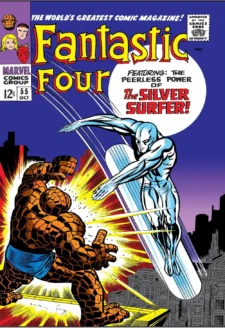 well it all holds up and how it matures.
FCF: If you hadn’t done Fantastic Four, what would you have picked?
Cliff Biggers: Probably Avengers. My third choice would have been Forever People. Out of the Fourth World books, Forever People hooked me the most.
FCF: Did you find it daunting to cover nine years of work?
Cliff Biggers: Jim was clear—no plot summaries. Capture the essence of what Kirby did and why it mattered. That was an assignment I was thrilled to run with. There would be no Marvel Universe without Fantastic Four. It changed comics history.
FCF: How did Kirby’s art evolve during his run?
Cliff Biggers: Kirby began to open up around the late 30s and into the 40s—Doom at the Baxter Building, the Inhumans, the Silver Surfer. By issue 50, his vision explodes on the page. Panels get larger. Figures leap off the page. It’s incredible growth. In Fantastic Four, we see Kirby at his most spectacular.
FCF: Do you think it’s impossible for Kirby not to influence Fantastic Four even today?
Cliff Biggers: You can’t have Fantastic Four without Kirby. His personality is imbued into that book. If you drift too far from the Kirby concept, it stops feeling like Fantastic Four. I was lucky enough to spend a few hours talking with Jack and Roz in San Diego. Jack asked my favorite issue. I said Fantastic Four #4. Jack pointed at me and said, “Cliff, I drew that book just for you.” I’ll never forget that.
FCF: Fans sometimes miss how humble and kind Jack was.
Cliff Biggers: Jack was incredibly supportive. He encouraged creators: “Don’t try to do me—do you.” He wanted people to tell great stories. There was no ego in the man at all.
About Author
