Barney Google and Spark Plug: How a Comic-Strip Racehorse Became a 1920s Sensation
When we think of legendary racehorses, all of them have strong legs, a proud stance, and they look like the sort of animal somebody would put on a trophy. Then we have Spark Plug, which is the exact opposite.
And somehow, that was part of the appeal. Billy DeBeck’s comic-strip horse became a character people wanted to follow, talk about, and take home as merchandise. Why? Well, it seems like we as humans have a soft spot for the underdog.
This was a funny-looking horse that wasn’t just there to help Barney Google deliver a joke. It gave readers another reason to care.
The Racing Part Made People Care
Horse racing is a sport that gives a storyteller something useful before the race even starts: expectation. In most cases, the favorite attracts all the attention, an outsider attracts curiosity, and everyone has an opinion, but they secretly hope for an underdog win, especially when a bet is placed.
The horse’s looks can also change the odds. If you follow TwinSpires’ guide to horse racing odds, you’ll find out more about how the prices work. In pari-mutuel betting, those prices reflect the betting pool. In other words, a horse with big muscles and a previous winning history may be attractive to more bettors.
If we analyze Spark Plug’s appearance, there is a good chance that this horse wouldn’t attract any bets, and its racing odds would be really high. He would clearly be a long shot. But sometimes long shots win races, and the payoff is big.
And for a cartoonist, that gap between what people expect and what they want to happen leaves plenty of room for a good story.
Horse racing odds describe the market’s assessment through betting activity; they aren’t a score for how lovable a horse looks. A reader can understand that distinction and still become attached to the unlikely-looking runner. We’ve all had that gut feeling about a certain horse.
Spark Plug Changed the Strip
Comics historian R. C. Harvey dates the launch of Barney’s strip to June 17, 1919, and Spark Plug’s arrival to July 17, 1922. So, the horse arrived after Barney was already established.
Harvey explains that Spark Plug helped move the feature from separate daily jokes into continuing stories. Readers had something unresolved to come back to, especially when a race was approaching. Barney’s relationship with his horse also became important. It wasn’t enough to know the result; the pair themselves were entertaining.
That makes the original strips worth looking at. The jokes show how DeBeck could make ordinary horse care part of the story, without needing a dramatic finish in every installment.
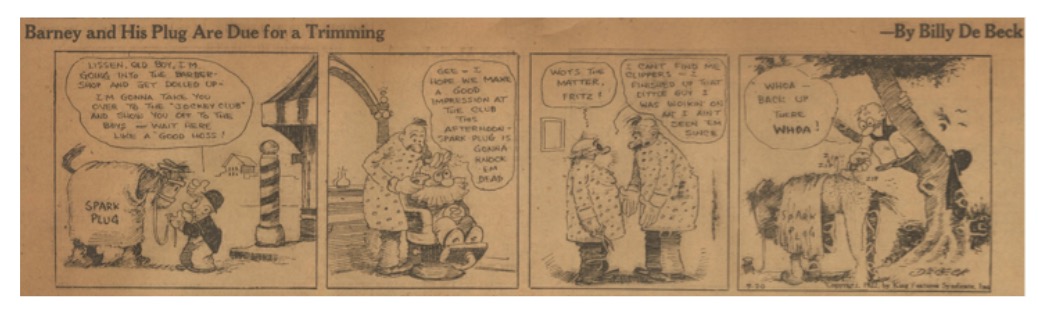
Billy DeBeck, Ranger Daily Times, July 20, 1922, page 4. Scan: Texas Tech University, Southwest Collection. Original credit: King Features Syndicate.
In this strip, Barney wants to look presentable before showing Spark Plug at the Jockey Club. The barber then discovers his clippers are missing. Barney has taken them outside to trim his horse. Apparently, getting ready involves more than a haircut for the owner.
And notice the blanket. The horse’s name is right there on it. Even in a busy newspaper drawing, you don’t have to work very hard to identify him.
Then the Horse Started Appearing on Merchandise
The scale of the craze becomes easier to understand when you look beyond the newspaper. Lambiek’s Comiclopedia records Spark Plug merchandise, including toys, balloons, and games. People could buy something connected to the character instead of waiting for his next appearance in print.
There are surviving objects behind that history. The Strong National Museum of Play catalogues a Barney Google and Spark Plug figure made by A. Schoenhut between 1922 and 1930. Its listed materials include wood, cloth, felt, and leather.
That’s a more concrete sign of popularity than simply calling the horse a sensation. A manufacturer had turned the newspaper characters into something you could keep. The blanket, the name, and the odd appearance all made Spark Plug easy to recognize away from the strip.
On top of that, the design worked without explanation. Somebody seeing the toy didn’t need a summary of Barney’s adventure to recognize the horse. The newspaper had done that work. The merchandise carried an existing attachment rather than creating one.
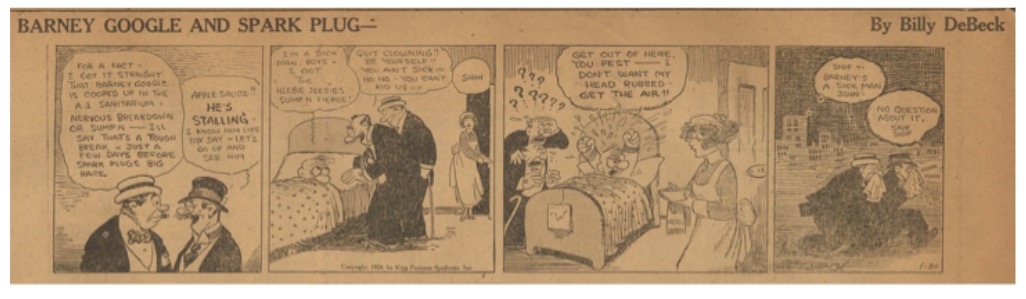
Billy DeBeck, Ranger Daily Times, January 28, 1924, page 2; strip marked 1-30. Scan: Texas Tech University, Southwest Collection. Original credit: King Features Syndicate.
Here, Spark Plug shares the heading even though Barney occupies the panels. An approaching race comes up in the conversation, keeping the horse involved without putting him in the room.
Why the Character Worked
Spark Plug had a memorable appearance, but DeBeck also gave readers an ongoing relationship to follow. Barney fussed, hoped, and made plans around him. That gave the merchandise a character people already knew.
The lesson isn’t that any funny-looking horse could become a craze. It took the stories to make the appearance mean something. Once readers cared about Spark Plug, a toy version had an appeal that a completely unfamiliar horse wouldn’t have.
About Author
