
“You can’t always get what you want, but if you try sometimes, you’ll find you get what you need.” — The Rolling Stones.
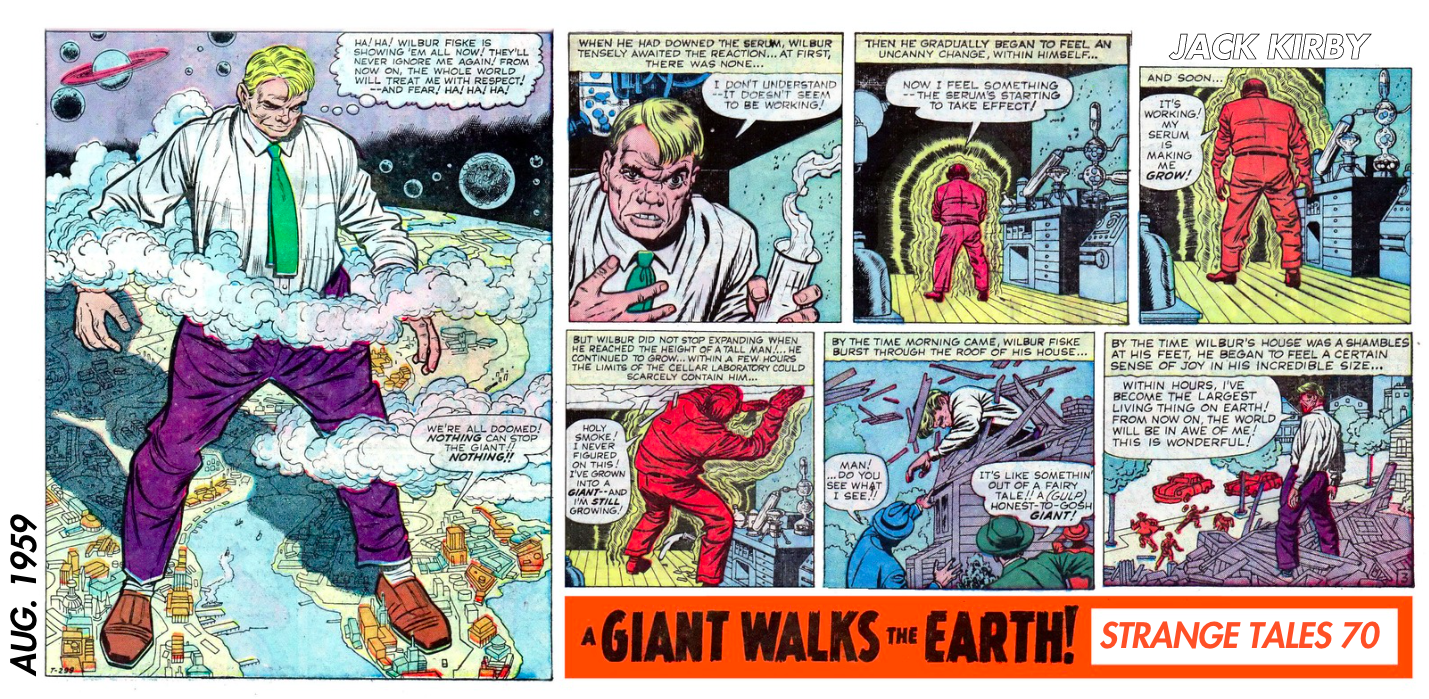
Strange Tales 70 (Aug. 1959) explored the double-edged nature of getting what you want in the Jack Kirby-drawn tale A Giant Walks the Earth.
Biochemist Wilbur Fiske is plagued by worries about his less-than-average height.
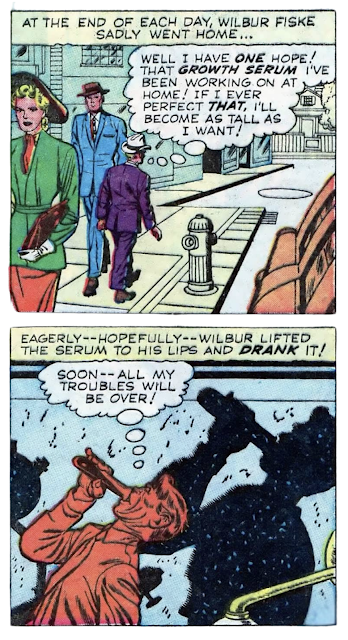 “I should have gotten that promotion!” he thinks. “I’ve been here longer than Charlie!
But it’s the same old story… Whenever there’s a chance for advancement… or a raise to be given out — I’m passed by — just because I’m too short.
“It’s always been like that… Even when I was a boy, my teachers in school didn’t appreciate me because I wasn’t as tall as the other kids! And it’s the one thing that’s prevented me from being a success — my lack of height!”
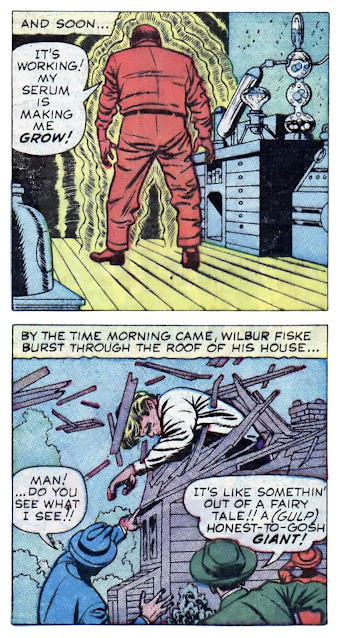
However, the obsessed Fiske proves astoundingly successful at developing a growth serum. He drinks it and shoots up in size, smashing through the roof of his house,
It’s a stunt that another biochemist, Henry Pym, will one day repeat when he grows from Ant-Man to Giant-Man.
Bigger than office buildings and now manic, Fiske evacuates a bank building and then tears it from its foundations.
“Don’t worry, folks… I’ll put the bank back soon!” he says. “I just wanta know what it’s like to be rich for a while, Ha, ha!”
But Fiske grows up through the troposphere into the stratosphere, where he cannot breathe. Suddenly, his formula loses its potency, shrinking him to normal size and saving his life.
 The court system — remarkably sympathetic for some reason — gives Fiske a suspended sentence.
Back in the lab, Fiske thinks, “All my life I wanted to be tall, but I’ll never complain about my lack of height again. Nor will I use my size as an excuse for not being a success! Instead of complaining, I’ll work harder, and I’ll receive my just rewards … honestly, and fairly!”
Well, maybe. But point taken.
The Marvel in the Silver Age blog notes that the tale was likely inspired by contemporary science fiction movies such as The Amazing Colossal Man (1957) and Attack of the 50-foot Woman (1958).
In The Uses of Enchantment, psychologist Bruno Bettelheim argued that fairy tale giants symbolize the dominant, demanding figures of adults as seen from the perspective of small children. They’re those powerful creatures that rob children of their autonomy.
“A strange contradiction is that well-educated parents outlawed fairy tales for their children at just about the time when the findings of psychoanalysis made them aware that, far from being innocent, the mind of the young child is filled with anxious, angry, destructive imaginings,” Bettelheim wrote. “It is also remarkable that these parents, so worried about not increasing their child’s anxieties, remained oblivious to all the reassuring messages in fairy tales.”
In fairy tales, after all, the protagonist usually outwits the giants, allowing children to imagine that they can be effective even against such formidable forces.
Eventually, the child becomes aware that he will grow into a “giant” himself — the same thing that happens, symbolically, in this Strange Tales story.
About Author
