
I freely admit that I dropped the Archie vs. Minor Threats mini-series around the second issue. There was no particular reason, or was there? For a few years, I have said, in a positive way, that it feels like we are in a new Golden Age of comics, because there are so many fantastic comics in all kinds of genres for all kinds of fans.
But, underlying that was the downside that there are too many comics for fans to read, no matter how fantastic they might be. Now, I kind of find myself leaning towards the idea that my se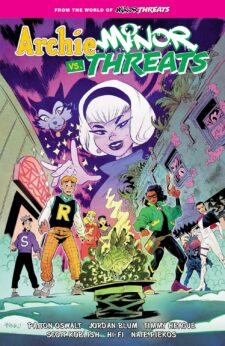 lf-proclaimed “Golden Age” is possibly causing more harm than good. Like with the Minor Threats series, too many comics on my end are getting lost in the shuffle. Luckily, all four issues are now available in a trade edition.
At first, I went into the series at a disadvantage because I wasn’t familiar with the Minor Threats mythos. With that said, Archie vs. Minor Threats shouldn’t work as well as it does, but the creative team leans into the tonal clash with real confidence. Riverdale’s bright sincerity hits a world built on grime and compromise, and the friction becomes the book’s engine. Archie and his friends aren’t rewritten to fit the darker setting; they’re allowed to stay themselves, and that contrast gives the story its spark.
The emotional weight comes from watching the Riverdale cast navigate a city that’s forgotten how to hope. Archie’s earnestness becomes a kind of resistance, something the villains can’t quite process. Betty and Veronica adapt in different ways, each revealing strengths that feel true to their long histories. The humor lands because it grows out of character, not because the book is winking at its own premise.
Scott Hepburn’s art bridges the gap between the clean silhouettes of classic Archie designs and the jagged energy of the Minor Threats universe. His pages shift easily between slapstick elasticity and sharp, grounded violence. The city feels oppressive, but the Riverdale kids remain visually distinct, their design clarity mirroring their clarity of purpose. The colors strike a smart balance between bright and muted tones, keeping both in play.
The book isn’t perfectly balanced. Some chapters lean heavily toward the Minor Threats side, leaving the Archie cast reacting rather than driving the story. Jughead, especially, feels underused for a character who could have added a wild‑card edge. A few emotional turns resolve quickly, but the ambition behind the crossover keeps even the rough spots interesting.
What makes the book work is its sincerity. It never treats the crossover as a stunt. Instead, it uses the collision of tones to explore what these characters believe in and how those beliefs hold up under pressure. Archie’s optimism isn’t naïve here—it’s stubborn, and that stubbornness becomes the story’s heart. The result is a sharp, funny, unexpectedly heartfelt book that respects both worlds and finds something new in the space between them.
About Author
