

I do admire elegant plotting.
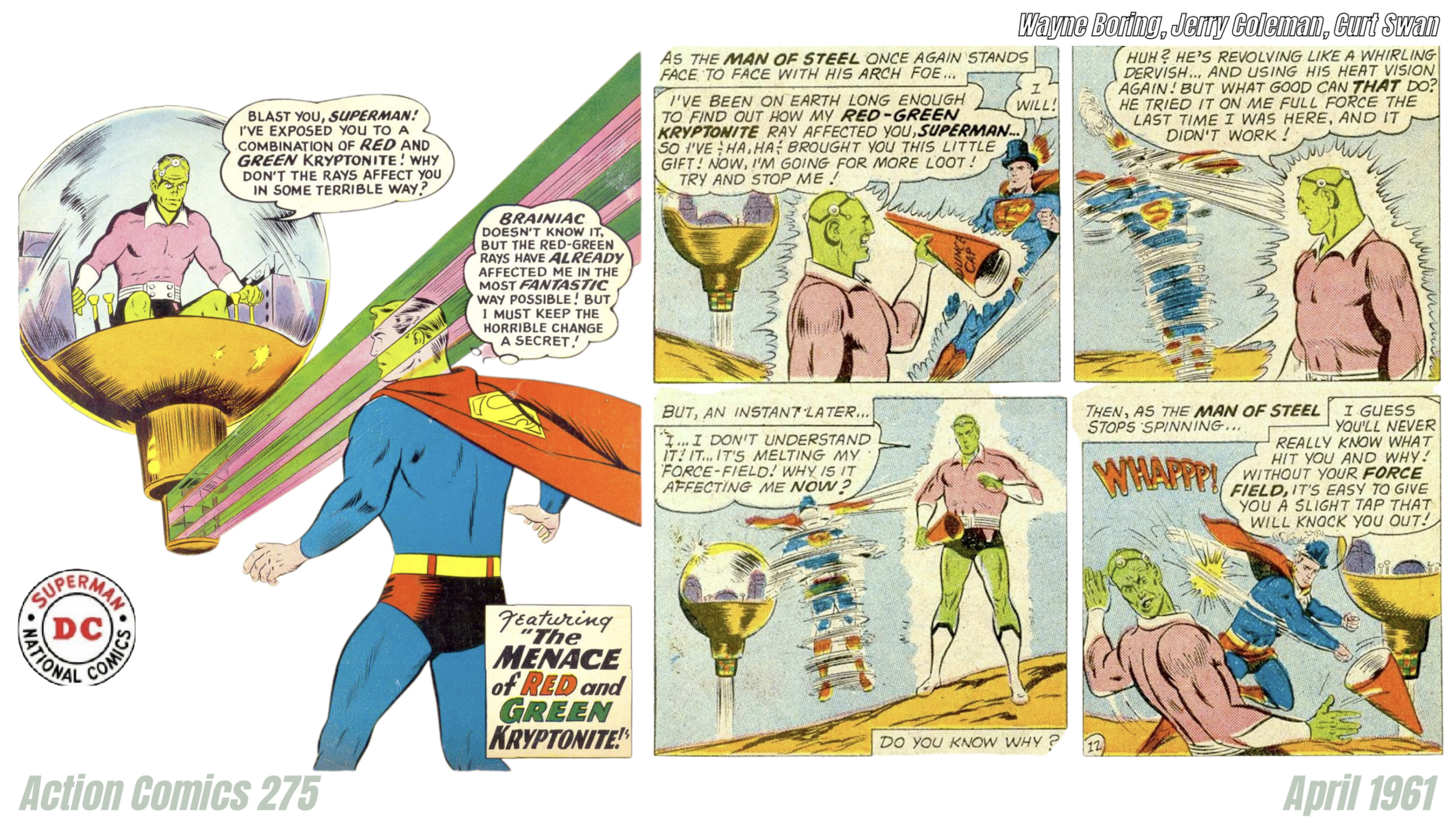
And that would include plots such as The Menace of Red-Green Kryptonite! (Action Comics 275, April 1961), In which the solution to the dramatic dilemma turns out to be inherent in the difficulty itself.
The story begins by reminding readers that the space criminal Brainiac has powers that are in some ways superior to Superman’s. When Brainiac creates a force-field hand to commit a theft, Superman can’t stop him because he has always been unable to penetrate that force field. Then the revenge-minded super villain bathes Superman in a ray that combines red and green kryptonite radiation.
 “The tale is constructed as a science fiction mystery,” noted comics historian Michael E. Grost. “The reader learns right away in the splash panel that Superman has been transformed in some way he is keeping secret from the world, and the reader. The reader is challenged to figure out what has really happened to Superman. Counterpointing this, Superman is fooling the public into thinking that the effect of the ray is causing him to behave oddly; Lois Lane and the rest of the public, along with the reader, are trying to figure out the underlying pattern to this behavior. These two mystery plots intersect in interesting ways. … Lois Lane serves as a detective figure here; writer Jerry Coleman was usually sympathetic and respectful of her.
“Superman often suffers some catastrophe in Coleman’s tales, one that is more apparent than real, but still one with whose effects Superman must live and cope. These challenges make Superman more human and less of an all-powerful stick figure.”
By stimulating Superman’s pineal gland, Brainiac’s beam has created a third eye in the back of Superman’s head, and the Man of Tomorrow engages in various Mad Hatter antics to distract the public from that development and thereby protect his secret identity.
And actually, Brainiac is responsible for his own downfall here. At first, Superman’s heat vision isn’t powerful enough to penetrate Brainiac’s force field. But by spinning at super speed and using all three of his eyes against it, he can shut it down.
“Yes, ironically enough, he was responsible for his own defeat!” Supergirl says, celebrating her cousin’s victory.
Note that Brainiac also inadvertently provided the means for his own defeat in their first encounter in The Super-Duel in Space! (Action Comics 242, July 1958).
“Superman uses one ongoing activity (Brainiac’s shrinking of cities) to get around another plot problem (Brainiac’s barriers),” Grost wrote. “This reminds one of Gardner Fox’s similar strategy in his Adam Strange tales, where Adam’s use of the zeta beam teleportation cycle allows him to interfere with various menaces’ schemes.”
The late 1950s and early 1960s were a heady era for Superman comics, as comics historian Bill Schelly observed in American Comic Book Chronicles.
“With Lois Lane in her own title, the development of the Silver Age Fortress of Solitude, the creation of the Legion of Super-Heroes, and the addition of Brainiac, Kandor and Bizarro — as well as a stronger emphasis on characterization — editor Mort Weisinger and his staff made major strides in 1958 in laying the groundwork for a more interesting and coherent ‘Superman Universe.’
“The appeal of that universe, which continued to develop in the ensuing years, contributed a great deal to the growing momentum of the Silver Age alongside the developments overseen by Julie Schwartz, and produced many highly entertaining comic books.”
And Action Comics 275 was one of them.
In addition to Superman’s fight against Brainiac, the issue gave us a glimpse of Supergirl’s loneliness and longing to be adopted in the form of a dream. The story was drawn by Jim Mooney and written by Superman’s co-creator, Jerry Siegel.
During this period, Siegel tended to supply Superman, Superbo,y and Supergirl with seemingly insurmountable problems they couldn’t solve themselves — an ironic fate for characters who were otherwise so powerful.
About Author
