Readers will notice that in recent weeks, we’ve been looking at some recent releases by Kanare_Abstract.
It just so happens they released four games – Trike and Slyde reviewed previously — all tied somewhat together by their common boxes done in a stark white with simple but effective graphics. The games look great on the shelf.
And that holds for Hexentafl from designer Kevin Kane.
Hidden at the end of the game’s name is ‘tafl’.
“Tafl games, also known as hnefatafl games, are a family of ancient Northern European strategy board games played on a checkered or latticed gameboard with two armies of an uneven number,” notes Wikipedia.
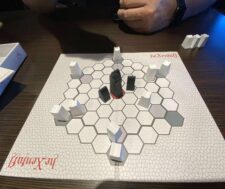
And that holds here as Hexentafl is an asymmetric abstract strategy game that is sort of the hexagonal version of Hnefatafl. One side (white) plays the attackers, and one side (black) plays the defenders.
Hexentafl can be played on a 4×4 or 5×5 hex grid – the board is marked to allow both, which creates some versatility here. The game plays differently depending on the board size used.
As is usual in tafl games, the attackers must capture the King to win. The defenders must escort the King to any of the six corners of the board to win.
It is recommended that players play in sets of two games, alternating who is the attacker and who is the defender.
Kane writes in a design article that Tafl games have long caught his attention.
“I have been fascinated by Hnefatafl for some time. For those not familiar, Hnefatafl is an ancient Norse board game that predates Chess by several hundred years. It can be played on several sizes of square chess-like board, from 7×7 to 15×15, with the most common being 11×11.
“Hnefatafl is particularly interesting to me as it is an asymmetrical abstract strategy game. One player is the defender, and usually has about half the pieces of the attackers. Despite this asymmetry, many variants are quite balanced.”
So perhaps it was obvious to someone already into game design – his NXS was reviewed here previously – to tackle a new tafl design.
“Brandub is the smallest variant of Hnefatafl that I am aware of (7×7, 49 squares),” he told The Meeple Guild via email. “I began to wonder what it would take to convert Hnefatafl to be played on hexes, and I wondered if I could make a variant that was playable on an NXS board (7 hexes across, 37 spaces). I initially conceived this as an alternate game that you could play with NXS equipment.”
After some play testing, Kane said he was satisfied he had a solid game – and The Meeple Guild agrees on that.
Kane said players can expect “a game that is surprisingly engaging despite the small board size.
“It’s a free, sh modern take on an ancient classic. Kanare has done an excellent job creating a beautiful take on the game.”
“Honestly, I don’t know if there is anything particularly unique. It’s just a modern take on Hnefatafl. But I find it fun to play.
Now we will grant that not all will like unequal force games. One player is always fighting an uphill battle to win – that is really a core concept of tafl games, but when you are the underdog and still win, it is a jolly good time indeed.
Certainly, He xentafl is worth a close look as an entry into the tafl family. Check it out at
www.kanare-abstract.comAbout Author
Calvin Daniels is a Saskatchewan-born, self-taught journalist. He is currently Editor of Yorkton This Week, with 35-years in the newspaper business.

A modern take on tafl that impresses
About Author
Calvin Daniels
Calvin Daniels is a Saskatchewan-born, self-taught journalist. He is currently Editor of Yorkton This Week, with 35-years in the newspaper business.
See author's posts