 When creator Mike Baron was asked by Madison, Wisconsin–based publisher Capital Comics to create a costumed crimefighter, he started with a simple question: Why would anyone actually put on a mask and go around beating up criminals? His answer: They’d have to be stark raving mad. Inspired by the classic psychological study The Minds of Billy Milligan and looking at the “Badger” name plastered across storefronts all over Madison, Baron conceived one of the most eccentric, hilarious, and subversively violent anti-heroes in independent comic book history.
The Badger made his debut in 1983 with Badger #1, published by Capital Comics. Capital was an indie publisher born out of Capital City Distribution, but their publishing arm was short-lived. After issuing just five issues of Badger, Capital dissolved in 1984.
 Recognizing the character’s breakout potential, Mike Baron moved the series to Chicago-based First Comics in 1985. Joined by primary interior artist Bill Reinhold, Baron’s run at First Comics turned Badger into an indie icon. The flagship series ran for 70 issues through 1991, accompanied by spin-off miniseries such as Badger Goes Berserk and graphic novels like Hexbreaker.
Following First Comics’ bankruptcy, the character found homes at Dark Horse Comics, Image Comics, and later Devil’s Due Publishing, maintaining a dedicated cult following for decades.
The man inside the suit is Norbert Sykes, a traumatized Vietnam War veteran suffering from severe Dissociative Identity Disorder (DID) caused by childhood abuse and military combat trauma.
| Persona | Description |
| Norbert Sykes | The core identity. Shy, mild-mannered, and overwhelmed. |
| The Badger | The dominant persona. A martial artist and extreme environmental vigilante who punches first and never asks questions. |
| Pierre | A homicidal, French-speaking psychopath born during a combat incident in Vietnam. |
| Emily | A frightened 9-year-old girl who manifests when Norbert feels utterly helpless. |
| Max Swell | A smooth-talking, cultured, gay architect who occasionally takes control. |
| Gastineau Grover Depaul | A streetwise African-American veteran who is oblivious to the other personalities’ existence. |
| Leroy | A dog. |
 As the Badger, Norbert believes he received a divine mandate from a deity shaped like a giant badger named Myrtle. He possesses no superpowers in the conventional sense, but he is a master of virtually every obscure martial art in existence, boasting incredible reflexes and absolute disregard for his own physical safety. Additionally, he can fluently converse with animals—a trait that frequently drives his environmental crusades.
Unlike traditional gritty vigilante stories, Badger is an unpredictable blend of martial arts action, absurd comedy, biting political satire, and real psychological tragedy.
After spending time in a state psychiatric hospital, Norbert is taken in by Hamilton “Ham” Thorndyke (real name Hammaglystwythkbrngzzaxotl), a 5th-century Welsh druid and weather wizard resurrected in modern times. Ham hires Badger to be his personal bodyguard. While Ham uses his weather control abilities to manipulate financial futures and accumulate wealth, Badger defends Ham’s castle and runs interference against demons, rival sorcerers, and local law enforcement.
Badger’s idea of fighting crime ranges from stopping legitimate atrocities to beating up people for absurd minor offenses. He frequently assaults:
-
Jaywalkers and litterbugs.
-
Indifferent fast-food clerks.
-
Developers destroying animal habitats.
-
Neo-Nazis, illegal poachers, and corporate polluters.
He also calls almost everyone he encounters “Larry”, which is eventually revealed to be the name of his abusive stepfather.
-
Daisy Fields: A clinical psychologist hired by Ham as a secretary who double-functions as Norbert’s therapist, constantly attempting to treat his severe mental illness amidst the chaos.
-
Mavis Davis: A skilled martial artist who eventually marries Norbert, matching him in physical prowess.
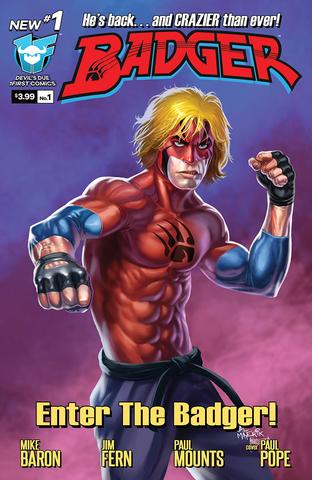 Badger stood out during the 1980s indie comic boom by refusing to take superhero tropes entirely seriously while still dealing with heavy topics like PTSD and child abuse. Mike Baron used the book’s manic energy to explore environmentalism, mental illness, and martial arts philosophy—all while delivering fast-paced, beautifully illustrated action choreography by creators like Bill Reinhold, Neil Hansen, and Kelley Jones.
It remains one of the defining titles of First Comics and a highlight of creator-owned 1980s comics.
About Author
