
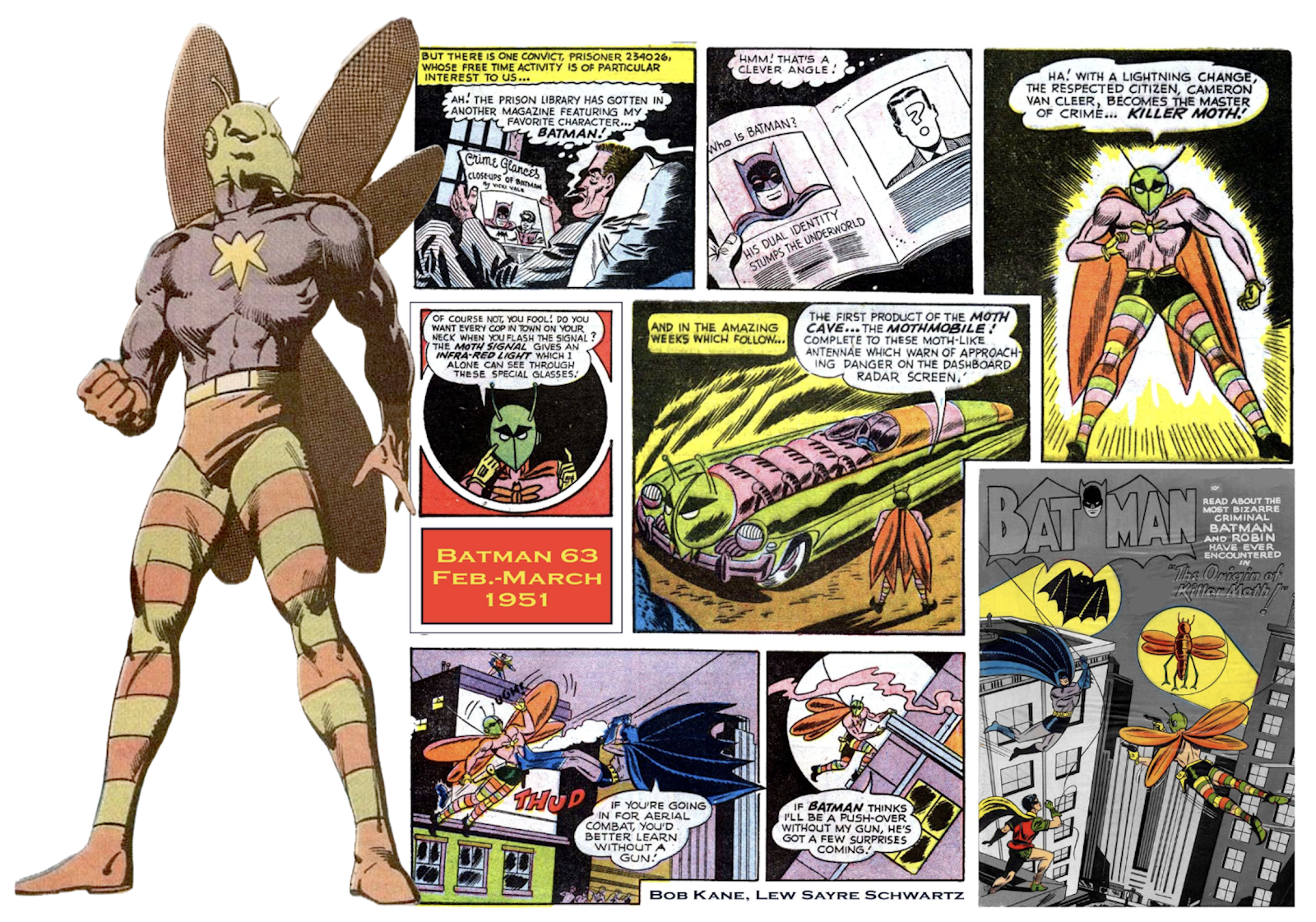
All Batman’s costumed foes are, to some degree, distorted mirror images of the hero himself, but in certain cases the point is really underlined.
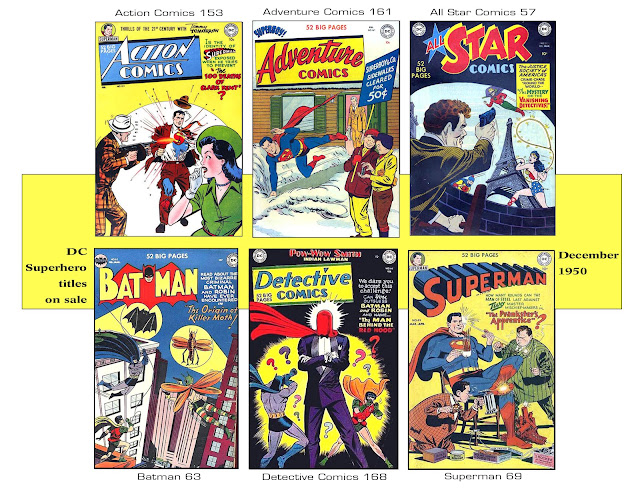
And one of those is Killer Moth, introduced in Batman 63 (Feb.-March 1951). Although a criminal, he’s in fact an admirer of Batman — the Masked Manhunter’s methods, if not his morality.
Instead of a flying mammal, the character styles himself after a flying insect. Like Batman and Robin, the Killer Moth dresses in colors that reflect his totem creature, in his case a garish, insect-y green, orange and purple.
He carefully designs himself to be the complete Anti-Batman, right down to his long, green Mothmobile and his infrared Moth Signal.
The Killer Moth’s initial battles with Batman over months amount to a fascinating saga.
“The 1950s saw the introduction of only a few villains who made multiple appearances in that decade,” noted fan Pat Curley. “Probably the most significant was Killer Moth.”
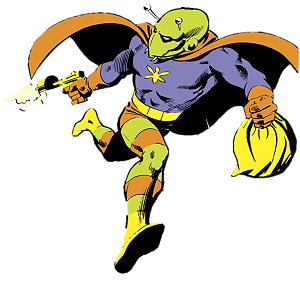 “After serving a term at Gotham State Prison, inmate #234026 decides that when he gets out, he’s going to become the patron saint of criminals by protecting them from the crimefighting Batman,” noted comics historian Jeff Rovin. “Wealthy due to his many crimes, Cameron (Van Cleer) sets up Moth Mansion, a ‘lepidopteral lair’ with a gravity-free room to trap trespassers, false walls for hiding and even a throne of melted wax.”
Van Cleer’s technical equipment is as impressive as Batman’s. He zips around in a vehicle fitted with a radar antenna, a smokescreen, and a toxic gas generator, swings around buildings on a virtually invisible wire attached to the back of his costume, and uses a handgun that functions like Spider-Man’s web-shooters. He has a lab to help facilitate the commission of crime and a trophy room ready for mementos of his illegal exploits. Crooks who have paid for his protection are given Moth Signal projectors with which to summon his help.
“As Cameron Van Cleer, he constructed a ‘wall of respectability’ designed to conceal his convict past from the respectable citizens who now surrounded him,” noted comics historian Michael L. Fleisher.
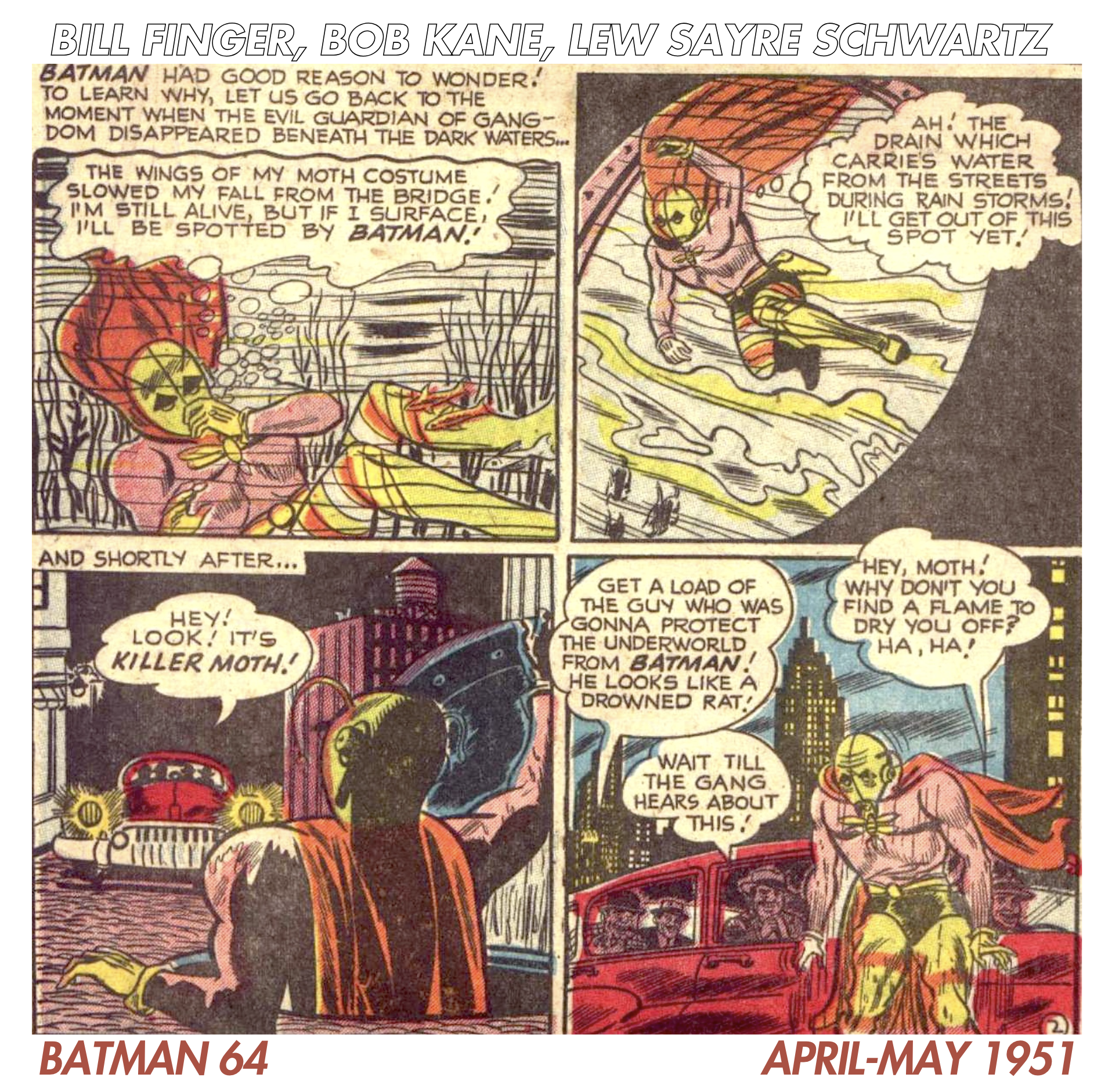
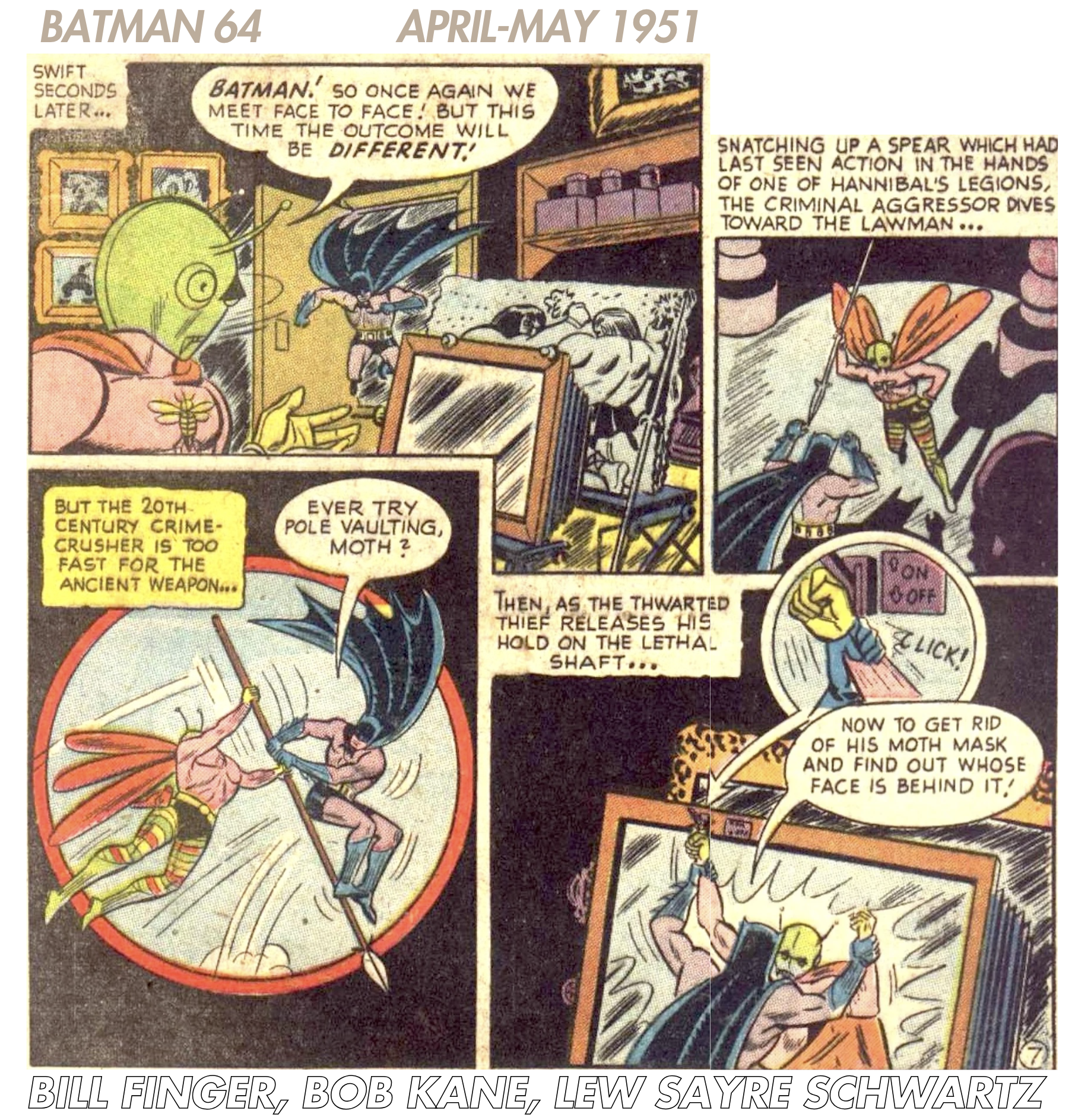
“At the end of this story, he apparently falls off a bridge to his death,” recalled Curley. “However, in Batman 64, The Return of Killer Moth (Apr-May 1951), we learn that he survived the fall, but found himself the laughingstock of the Gotham underworld after climbing out of the water looking like a drowned rat. He decides that the only way to get his reputation back is to defeat Batman.”
Killer Moth discovers Batman’s secret identity, but is later convinced otherwise through a ruse. In fact, Killer Moth’s efforts backfire, enabling Batman to deduce that the super-criminal is really Bruce Wayne’s wealthy fellow socialite Cameron Van Cleer.
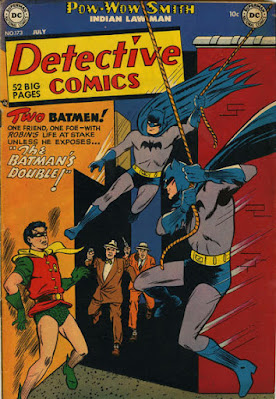 Van Cleer is imprisoned but, as persistent as a moth drawn to a flame, he escapes three months later, knowing that his established secret identity is now useless to him (The Batman’s Double, Detective Comics 173, July 1951).
Instead, the former Van Cleer decides to impersonate some other rich man, and who better than Bruce Wayne? Having kidnapped Wayne, the disguised Killer Moth learns the millionaire’s secret from Dick Grayson, and begins to appear as Batman as well.
“How ironic that with the whole city to pick from, I chose to live the life of my mortal enemy,” he muses. “What a delicious revenge for Killer Moth!”
“As many times as he is arrested by Batman, he returns — this even though during one confrontation the Killer Moth took a bullet in the head from an angry henchman,” Rovin noted. “The resultant surgery cost him part of his brain.”
And that portion of his brain was, of course, the part that knew Batman’s secret identity.
 Although it took him 16 years, the Killer Moth did get back into business just in time to witness the arrival of a new superhero (The Million Dollar Debut of Batgirl! Detective Comics 359, Jan. 1967). He also made his screen debut then, sort of. Killer Moth appeared in the unaired segment of the Batman TV show that was based on the origin of Batgirl.
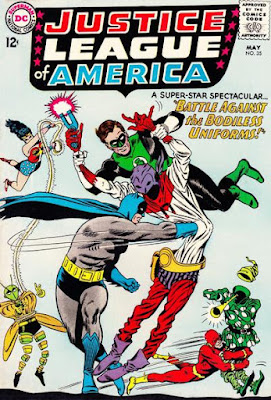
Although Killer Moth himself didn’t appear between 1951 and 1967, his costume did. The gaudy garment popped up to battle the Justice League when the Demons Three magically animated supervillains’ wardrobes (Battle Against the Bodiless Uniforms, Justice League of America 35, May 1965).
About Author
