 Talk about upgrading a game.
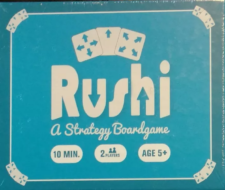
Rushi, from designer Danny Zondervan, began life as a card game for two players, or at least something close to one. It was really a board game in which the player pieces were cards that moved across a defined grid, with each player trying to be the first to get all six pieces across the board. Vaguely, it brings to mind Salta, a game dating back to 1899.
Cards worked just fine, I’m sure.
However, the copy of Rushi being reviewed this week is the “souped-up” version, to borrow a car term from my youth.
This edition comes from the woodideas. store in Ukraine. Having previously reviewed Knjo from Wood Ideas, we expected this version of Rushi to be impressive. In this case, it is really impressive. In fact, it is a step up from Knjo in terms of overall presentation.
The board comes in two checkerboard-style wooden sections that connect magnetically to form a 6×7 playing surface. It’s a very attractive design. The squares feature inlaid directional markers that indicate movement. There are three single-arrow spaces, two side-arrow spaces, and two corner-arrow spaces.
The entire game fits neatly into a felt carrying case about the size of a large hardcover book. Once again, this is a thoughtful touch, making Rushi an ideal game to bring along for a coffee break with a friend.
Each player begins with six pieces on the board and one piece in hand.
Players take turns placing the piece in their hand onto the board. A piece can only be placed on a square that one of the player’s existing pieces is pointing toward. Players cannot place a piece on an occupied square. After placing a piece, the player must pick up the piece that was pointing to that square, which becomes the piece they will play on their next turn.
There are a couple of important rules that appear to be missing from the included rulebook and require some additional research by The Meeple Guild.
These mostly involve situations where pieces become locked facing one another with no legal moves available. In these cases, players may simply exchange pieces on their turn. While this resolves the stalemate, it is generally not an ideal move because it does not help advance pieces toward the goal.
Another key rule is that when a piece reaches the far row, it becomes frozen in place. This is an important aspect of the strategy, as it prevents players from later repositioning those pieces to influence the movement options of other pieces.
Rushi occupies a similar space to the excellent Murus Gallicus. While Murus Gallicus may still have the edge, Rushi offers a faster experience that is perfect for a best-of-seven series of games.
Combined with the exceptional craftsmanship and presentation of this edition, Rushi earns an easy recommendation for anyone looking for an attractive and engaging abstract strategy game.
About Author
Calvin Daniels is a Saskatchewan-born, self-taught journalist. He is currently Editor of Yorkton This Week, with 35-years in the newspaper business.

Stunning game quality really enhances the play experience
Rushi, from designer Danny Zondervan, began life as a card game for two players, or at least something close to one. It was really a board game in which the player pieces were cards that moved across a defined grid, with each player trying to be the first to get all six pieces across the board. Vaguely, it brings to mind Salta, a game dating back to 1899.
Cards worked just fine, I’m sure.
However, the copy of Rushi being reviewed this week is the “souped-up” version, to borrow a car term from my youth.
This edition comes from the woodideas. store in Ukraine. Having previously reviewed Knjo from Wood Ideas, we expected this version of Rushi to be impressive. In this case, it is really impressive. In fact, it is a step up from Knjo in terms of overall presentation.
The board comes in two checkerboard-style wooden sections that connect magnetically to form a 6×7 playing surface. It’s a very attractive design. The squares feature inlaid directional markers that indicate movement. There are three single-arrow spaces, two side-arrow spaces, and two corner-arrow spaces.
The entire game fits neatly into a felt carrying case about the size of a large hardcover book. Once again, this is a thoughtful touch, making Rushi an ideal game to bring along for a coffee break with a friend.
Each player begins with six pieces on the board and one piece in hand.
Players take turns placing the piece in their hand onto the board. A piece can only be placed on a square that one of the player’s existing pieces is pointing toward. Players cannot place a piece on an occupied square. After placing a piece, the player must pick up the piece that was pointing to that square, which becomes the piece they will play on their next turn.
There are a couple of important rules that appear to be missing from the included rulebook and require some additional research by The Meeple Guild.
These mostly involve situations where pieces become locked facing one another with no legal moves available. In these cases, players may simply exchange pieces on their turn. While this resolves the stalemate, it is generally not an ideal move because it does not help advance pieces toward the goal.
Another key rule is that when a piece reaches the far row, it becomes frozen in place. This is an important aspect of the strategy, as it prevents players from later repositioning those pieces to influence the movement options of other pieces.
Rushi occupies a similar space to the excellent Murus Gallicus. While Murus Gallicus may still have the edge, Rushi offers a faster experience that is perfect for a best-of-seven series of games.
Combined with the exceptional craftsmanship and presentation of this edition, Rushi earns an easy recommendation for anyone looking for an attractive and engaging abstract strategy game.
About Author
Calvin Daniels
Calvin Daniels is a Saskatchewan-born, self-taught journalist. He is currently Editor of Yorkton This Week, with 35-years in the newspaper business.
See author's posts