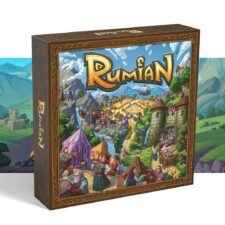
 It has been a surprisingly strong year for first-time plays at The Meeple Guild table, and Rumian ended up being one of the more pleasant surprises.
Going into the game, expectations were honestly fairly low. As the rules were explained, it initially sounded like the sort of design that might drain some of the fun out of the experience. One particular rule, where two players can effectively work together to take points away from the leader, immediately raised alarms. Those “gang up on the leader” mechanics are rarely enjoyable and often feel more frustrating than strategic.
Thankfully, even the rulebook itself suggests players can ignore that rule, which is exactly what we did.
Once the game actually got moving, however, the reaction around the table changed quickly. What initially sounded cumbersome turned out to be a much more enjoyable and flexible experience than expected. Credit definitely goes to designers Viktor Kadziolka and Andreas Kobari for creating something that feels familiar while still doing a few things differently.
At first glance, Rumian resembles a worker placement game, a mechanic the Meeple Guild traditionally doesn’t gravitate toward, but it never really locks players down the way many worker placement titles do.
Each player controls a single piece moving around the board. While only one player can occupy a location outside the central city at a time, territories are never fully blocked because battles allow players to invade occupied spaces. That keeps the board surprisingly open and interactive.
Publisher Murdoc Games describes the game as a mix of resource management, exploration, and high adventure. The “high adventure” label may oversell things a bit, though. In reality, Rumian is a lighter strategy game throughout, which actually works in its favor.
Every turn offers several different approaches to scoring points. Players can:
- Battle neighboring opponents and hope the dice cooperate
- Gather quest cards and work toward objectives
- Collect resources to craft and sell goods at the market
- Construct gates and cottages that generate points or resources
Initially, the ability for other players to destroy buildings sounded potentially aggravating, but in practice, it never became a major issue during our plays. Perhaps with four players,s the destruction becomes more aggressive, but in a three-player game, it stayed relatively manageable.
The game does allow players to fall behind, and catching up can be difficult once that happens. Still, most sessions seem likely to feature at least two players remaining competitive until the end.
Rules-wise, Rumian is refreshingly straightforward. We rarely had to stop and consult the rulebook, which is always appreciated in a medium-weight strategy title.
Production quality is solid as well, with wooden components that feel nice on the table without trying to over-impress.
In many ways, “nice” may be the best overall description for Rumian. It probably will not crack the top five games for groups that play dozens upon dozens of titles every year, but it absolutely feels like the kind of game players will remember fondly afterward.
In the end, Rumian is a dependable and enjoyable addition to almost any game shelf.
About Author
Calvin Daniels is a Saskatchewan-born, self-taught journalist. He is currently Editor of Yorkton This Week, with 35-years in the newspaper business.

The Meeple Guild: Rumian gets core idea of worker placement right
Going into the game, expectations were honestly fairly low. As the rules were explained, it initially sounded like the sort of design that might drain some of the fun out of the experience. One particular rule, where two players can effectively work together to take points away from the leader, immediately raised alarms. Those “gang up on the leader” mechanics are rarely enjoyable and often feel more frustrating than strategic.
Thankfully, even the rulebook itself suggests players can ignore that rule, which is exactly what we did.
Once the game actually got moving, however, the reaction around the table changed quickly. What initially sounded cumbersome turned out to be a much more enjoyable and flexible experience than expected. Credit definitely goes to designers Viktor Kadziolka and Andreas Kobari for creating something that feels familiar while still doing a few things differently.
At first glance, Rumian resembles a worker placement game, a mechanic the Meeple Guild traditionally doesn’t gravitate toward, but it never really locks players down the way many worker placement titles do.
Each player controls a single piece moving around the board. While only one player can occupy a location outside the central city at a time, territories are never fully blocked because battles allow players to invade occupied spaces. That keeps the board surprisingly open and interactive.
Publisher Murdoc Games describes the game as a mix of resource management, exploration, and high adventure. The “high adventure” label may oversell things a bit, though. In reality, Rumian is a lighter strategy game throughout, which actually works in its favor.
Every turn offers several different approaches to scoring points. Players can:
Initially, the ability for other players to destroy buildings sounded potentially aggravating, but in practice, it never became a major issue during our plays. Perhaps with four players,s the destruction becomes more aggressive, but in a three-player game, it stayed relatively manageable.
The game does allow players to fall behind, and catching up can be difficult once that happens. Still, most sessions seem likely to feature at least two players remaining competitive until the end.
Rules-wise, Rumian is refreshingly straightforward. We rarely had to stop and consult the rulebook, which is always appreciated in a medium-weight strategy title.
Production quality is solid as well, with wooden components that feel nice on the table without trying to over-impress.
In many ways, “nice” may be the best overall description for Rumian. It probably will not crack the top five games for groups that play dozens upon dozens of titles every year, but it absolutely feels like the kind of game players will remember fondly afterward.
In the end, Rumian is a dependable and enjoyable addition to almost any game shelf.
About Author
Calvin Daniels
Calvin Daniels is a Saskatchewan-born, self-taught journalist. He is currently Editor of Yorkton This Week, with 35-years in the newspaper business.
See author's posts