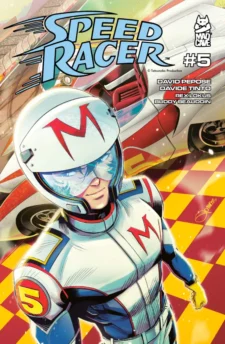
Recently, I sat down with David Pepose to talk about Mad Cave Studios’ Speed Racer, whose 8th issue is released today. Also, the first Speed Racer trade was recently released, collecting the first five issues. You can listen to the full interview wherever you listen to your podcasts. You can also watch it on YouTube.
FCF: David, let’s talk some Speed Racer!
 David Pepose: Things have been great with Speed Racer. The first trade paperback just came out. You can order it through your local comic shop — it collects issues 0 through 6, our whole first arc, by me and artist Davide Tinto. Working on this book has been such a treat, and I’m excited for people to see what’s coming, especially in issue 8. That’s where we debut one of the most iconic cars in Speed Racer mythology: the Great Mammoth Car. It really elevates things, especially with Speed’s relationship with his love interest and team owner, Trixie Turnwell. Definitely let your shop know you want that issue — it’s going to be a fun one.
FCF: Last year, when we last talked, Speed Racer was still a bit off. Now it’s been a year. Are you surprised by how it’s taken off?
David Pepose: You always hold your breath with a new book. You wonder how it’s going to land — your approach, your team’s approach, and then all the intangibles you can’t control: release schedules, the comics industry’s instability, fan response, retailer response, press amplification. There’s a lot you can’t account for.
But I had a lot of confidence in this book because of the source material. It’s iconic, engaging, and racing is just inherently fun and dramatic. And I knew we had the right creative team. I’d worked with Davide Tinto before on Avengers Unlimited at Marvel and loved his style. When we ran into each other right after I landed the book at New York Comic Con, I asked if he’d be interested. Luckily, he was available. Once he was on board, I felt like 90% of the work was done. I’m a big believer that if you have the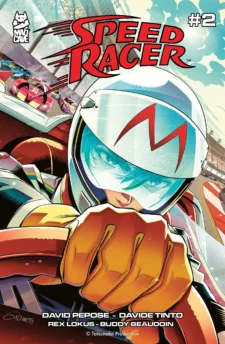 right artist for the right project, you’re already well on your way to success.
So yes, there’s always risk, but I felt the wind was at my back. It’s nice when you start a project thinking, “This one’s mine to lose.”
FCF: We joked earlier about you becoming a rock star creator, but you’re really down‑to‑earth. You’ve been doing Space Ghost, Speed Racer, Captain Planet — how do you balance all that without letting it get to your head?
David Pepose: I feel very lucky to have this job. That sense of gratitude inspires me to get up every day and deliver the best work I can. Sometimes that makes me a pain to my editors when I ask, “Can we tweak this?” Even if they say no, at least I asked.
Balancing different projects comes down to each book having something unique. Space Ghost is a tight core trio going from adventure to adventure. Captain Planet has a larger cast, real‑world allegory, and a longer runway. Speed Racer is a sports book — no superpowers, the cars are the closest thing. Every artist also brings a different tone, which helps me keep things straight.
A few years ago, I was writing Moon Knight: City of the Dead, Punisher, and The Devil That Wears My Face at the same time. All grim, gritty, street‑level books. That was tricky. But the artists were different enough that it helped me differentiate. I like exercising different creative muscle groups. When one gets tired, I can shift to another.
FCF: How do you balance bringing back the core of 1960s Speed Racer while modernizing it for older and younger fans?
David Pepose: My approach is always to learn the lay of the land. For Space Ghost and Speed Racer, I watched every episode of the original series. I wanted to know the landmarks — what long‑time fans expect, what episodes feel bigger, what characters pop.
For Space Ghost, building toward the Council of Doom made sense. For Speed Racer, I looked at which characters stood out: Kim Jugger, the Great Mammoth Car, the GRX engine — that two‑parter was my favorite. As a writer, you’re a prism. You absorb all the lore and interpret what feels important.
For example, in our Great Mammoth Car issue, Speed’s story is anti‑capitalist. He needs to win the Formula X League, so his dad can get a heart transplant. He’s a broke kid who needs the money. Cruncher Block, the gangster behind the Mammoth Car, mirrors that struggle — he’s got a chip on his shoulder about the wealthy elite. That contrast wasn’t something I planned at first, but it emerged naturally while writing.
Older readers appreciate that we honor the spirit of the original while modernizing it. Younger readers, who don’t know the lore, think it’s cool and give me more credit than I deserve. It’s the JJ Abrams Star Trek approach — that first movie made me understand why people love Kirk and Spock. That’s the Rosetta Stone for how I handle licensed properties.
FCF: Do you have favorite characters, or do their stories unfold as you go?
 David Pepose: I try to give every character their due. It’s an ensemble, but Speed is raw talent with rough edges. His evolution comes from the people around him.
SP Bridle is Speed minus the trauma — passionate, young, unscarred by losing his brother. Racer X is the opposite: dark, jaded, having left everything behind to protect his family. He sees Speed as “me minus my mistakes.”
Trixie is the Carol Ferris to Speed’s Hal Jordan — there’s a will‑they/won’t‑they dynamic complicated by her being his boss. Pops was sidelined early but becomes Speed’s corner man once he’s out of his coma. He wants to support Speed’s dreams but keep him safe.
FCF: Do you have an endpoint? And can you tease what’s coming up?
David Pepose: My initial contract is through issue 15. That’s where this meta‑arc — Pops’ heart issues and the Formula X Championship — wraps up. But the response has been great, and there are characters we haven’t used yet. So there’s definitely a world where we could do more, depending on story, framework, and my bandwidth. I also have a baby on the way, so that factors in.
The Great Mammoth Car shows up in the next issue, and Cruncher Block plays a big part in that story. After that, we’ve got a two‑parter called Demon on Wheels, which I see as the flip side of the GRX arc. Speed winds up facing an unexpected opponent who might be the biggest danger he’s dealt with so far.
Starting in issue 11, we bring in the Mélange, which is another big piece of classic Speed Racer lore I’ve been excited to reintroduce. And a little further down the line, readers will finally see the return of Dante Ferno — he’s the head of Alpha Automotive and the owner of the Car Acrobatic Team. Longtime fans will remember that he used to race under a very different identity as the ruthless Captain Terror. He’s the Red Baron of the racetrack, and when he shows up, he’s really going to put Speed through the ringer.
FCF: David Pepose, writer of the hit Speed Racer series from Mad Cave Studios. Issue 8 is out now. Thanks for joining me.
David Pepose: My pleasure. Thanks so much for having me.
About Author
