 I will admit I procrastinated on writing this review far longer than I should have.
The reason is simple enough. We kept hoping we were missing something with Stackup.
The game, from designers Bartłomiej Matuszek and Ludwik Matuszek, arrived with very high expectations.
While the copy we played was a prototype, a 3D-printed version we assume, it was still very well done. In fact, it looked good enough that you would not be disappointed purchasing a finished copy.
Part of the excitement was that Stackup is a two-player abstract strategy game, a favourite of both Meeple Guilder Trevor and me.
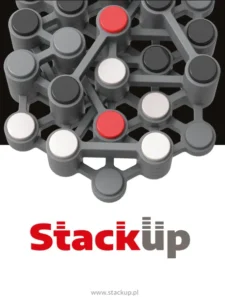
The game is played on a hexagonal grid board, with players placing and stacking pieces to form a multi-level structure. The goal is to have the majority of your colour visible on the highest completed level at the end of the game.
With a few neutral pieces included to create blocks and add strategic depth, this initially felt like a game that could be a major find.
Pieces may be placed directly on the base or on top of existing pieces, provided they follow the placement rules for their type.
If a player cannot, or chooses not to, make a move on their turn, they must discard a piece from the game. This can actually become a late-game strategy, as you begin to recognize that some pieces are unlikely to be played and can instead be sacrificed as a delaying tactic.
A new level may only be created when a piece is placed so that it bridges one white field and one black field.
That sounds great, but the first player to reach a new level tends to maintain control.
Yes, there are moments where a savvy move can shift the balance, but it does not happen often enough. The first player to reach level two generally holds the advantage, leaving the other player struggling to catch up without much hope.
When a piece is placed across two fields of the player’s own colour, they earn an extra move. That move must start on the newly placed piece, but cannot rest fully on top of it. This is a neat feature and feels like it should provide a comeback mechanism, but it rarely does.
Once all pieces have been placed, or both players pass, the highest level is scored. The player with the most visible fields of their colour on that level wins. If there is a tie, the next level down is scored, and so on, until a winner is determined.
Mechanically, Stackup works, and even in prototype form, it looks quite nice as the layers build. However, it consistently feels like something is missing. The gameplay becomes too mechanical, with the winner often apparent far too early.
In the end, Stackup is a game where high expectations were not quite met.
About Author
Calvin Daniels is a Saskatchewan-born, self-taught journalist. He is currently Editor of Yorkton This Week, with 35-years in the newspaper business.

Play did not match expectations
The reason is simple enough. We kept hoping we were missing something with Stackup.
The game, from designers Bartłomiej Matuszek and Ludwik Matuszek, arrived with very high expectations.
While the copy we played was a prototype, a 3D-printed version we assume, it was still very well done. In fact, it looked good enough that you would not be disappointed purchasing a finished copy.
Part of the excitement was that Stackup is a two-player abstract strategy game, a favourite of both Meeple Guilder Trevor and me.
The game is played on a hexagonal grid board, with players placing and stacking pieces to form a multi-level structure. The goal is to have the majority of your colour visible on the highest completed level at the end of the game.
With a few neutral pieces included to create blocks and add strategic depth, this initially felt like a game that could be a major find.
Pieces may be placed directly on the base or on top of existing pieces, provided they follow the placement rules for their type.
If a player cannot, or chooses not to, make a move on their turn, they must discard a piece from the game. This can actually become a late-game strategy, as you begin to recognize that some pieces are unlikely to be played and can instead be sacrificed as a delaying tactic.
A new level may only be created when a piece is placed so that it bridges one white field and one black field.
That sounds great, but the first player to reach a new level tends to maintain control.
Yes, there are moments where a savvy move can shift the balance, but it does not happen often enough. The first player to reach level two generally holds the advantage, leaving the other player struggling to catch up without much hope.
When a piece is placed across two fields of the player’s own colour, they earn an extra move. That move must start on the newly placed piece, but cannot rest fully on top of it. This is a neat feature and feels like it should provide a comeback mechanism, but it rarely does.
Once all pieces have been placed, or both players pass, the highest level is scored. The player with the most visible fields of their colour on that level wins. If there is a tie, the next level down is scored, and so on, until a winner is determined.
Mechanically, Stackup works, and even in prototype form, it looks quite nice as the layers build. However, it consistently feels like something is missing. The gameplay becomes too mechanical, with the winner often apparent far too early.
In the end, Stackup is a game where high expectations were not quite met.
About Author
Calvin Daniels
Calvin Daniels is a Saskatchewan-born, self-taught journalist. He is currently Editor of Yorkton This Week, with 35-years in the newspaper business.
See author's posts