

Adam Strange couldn’t come to grips with the greatest of his foes.
That’s because he was a whirlwind. Literally.
The problems that confronted Dr. Strange (he must have been a Ph.D., right?) when he visited the planet Rann were often curiously elemental — oversized sentient atoms, planets that grew menacing tentacles, looming hostile clouds, gigantic fireflies or rays that transformed people into liquid, gas, crystal or shadows. These were all part of the offbeat charm of the 38 Adam Strange adventures Julius Schwartz edited for Mystery in Space.
 In keeping with the weird menace tone of his feature, Adam Strange’s greatest enemy was not a corporeal being at all, but a sentient whirlwind, a living alien Dust Devil called Jakarta whom he fought three times.
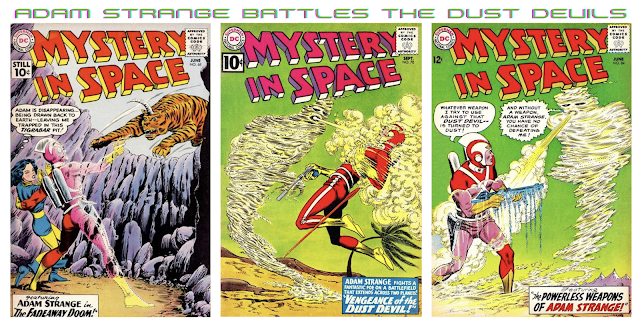
The middle story in the trio was called Vengeance of the Dust Devil (Mystery in Space 70, Sept. 1961).
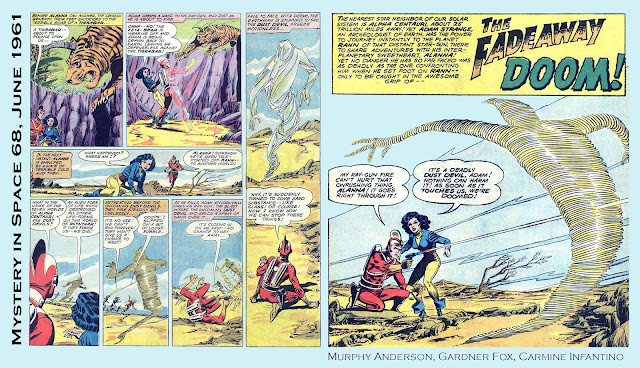
“The Dust Devil first appeared in a cameo role in The Fadeaway Doom, two issues before,” recalled comics historian Michael E. Grost. “(Writer Gardner) Fox and (artist Carmine) Infantino knew a good thing when they saw it, because he is brought back here as the main menace of the story.
“The Dust Devil appears in the air, a favorite location for Fox and Infantino. Also, the Dust Devil’s body is made up of complexly patterned clouds of dust, something with which Infantino’s art has a field day.
“Adam Strange gets a new jet-rocket at the start of this story. He had abandoned his earlier pack in the previous story, as part of his counterplot against the menace. This sort of careful attention to detail is a hallmark of the series.”
In their first encounter, the Champion of Rann had defeated the Dust Devils by using his ray gun in combination with sand to turn their sodium-based systems into glass.
However, one of them, Jakarta, not only avoided capture but shrank himself to hide in Strange’s ray-gun holster so he could escape to Earth.
“It is pleasing to see Adam Strange operate on Earth, and in the same role as on Rann, as a champion who defeats menaces,” Grost noted. “On Earth, he does not wear his Adam Strange space suit. Instead, he is clad in explorer’s clothes, befitting his Earth profession of archaeologist.”
Because Jakarta won’t fall for the same trick twice, the space-faring archaeologist goes to an Australian science hobby shop to buy a Wimshurst Machine. Hiding the device on his back, he uses it to generate static electricity, which paralyzes the Dust Devil.
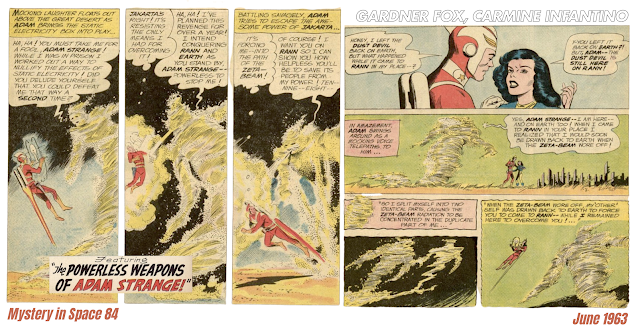
The Dust Devil escapes from his Australian prison in 1963’s The Powerless Weapons of Adam Strange. This time, Strange fights fire with fire, overcoming the Dust Devil with radioactive dust.
“This is the third tale about the Dust Devil,” Grost noted. “It is unusual for Fox to have a villain return so many times. It is not the Dust Devil’s personality that interests Fox — he is not trying to create a series villain like the Penguin or the Joker. Rather, it is the technological properties of the Dust Devil as a menace that Fox likes.”
Luckily, Adam Strange didn’t really need to come to grips with the intangible Dust Devil, because he always won his battles with his brains, not his fists.
Not for nothing was he known as the thinking man’s superhero.
About Author
