
Before graphic novels became a mainstream literary phenomenon, Terry Moore was proving that comic books could tell compelling stories about love, friendship, heartbreak, and the complicated relationships between ordinary people.
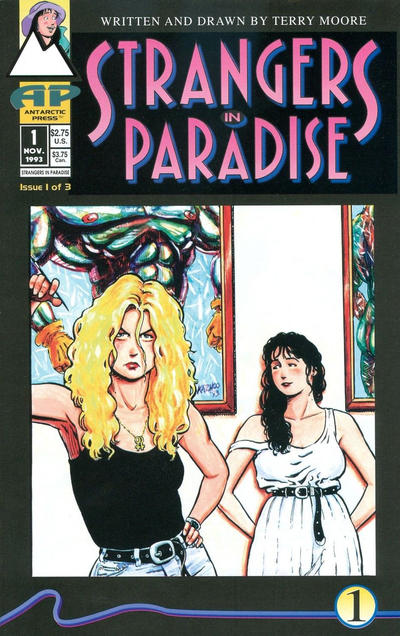 In November 1993, writer and artist Terry Moore introduced Strangers in Paradise, a black-and-white comic book that would become one of the most critically acclaimed independent titles of its generation. What began as a modest three-issue miniseries from Antarctic Press eventually developed into a sprawling, 14-year saga that challenged traditional expectations of what an American comic book could be.
At a time when the industry was dominated by superheroes, exaggerated anatomy, and action-oriented storytelling, Moore offered something different. His characters were not superheroes. They were recognizable people struggling with relationships, personal secrets, and emotional conflicts.
At the center of the series were three characters: Katina “Katchoo” Choovanski, Francine Peters, and David Qin.
Katchoo was a fiercely independent, outspoken blonde with a troubled past and a deep emotional attachment to her best friend, Francine. Francine was more conventional, longing for marriage, stability, and the perfect romantic relationship, although her actual love life rarely went according to plan. David was a gentle, thoughtful young man who fell in love with Katchoo, creating a complicated emotional triangle that would drive much of the story.
The relationship between Katchoo and Francine formed the emotional heart of Strangers in Paradise. Their friendship, love, jealousy, misunderstandings, and devotion gave the series a depth rarely encountered in mainstream American comic books of the early 1990s.
 The concept originated while Moore was attempting to develop a syndicated newspaper comic strip. After experimenting with several ideas, he realized that his characters needed a longer narrative format rather than short daily gags. He turned his attention toward comic books, spending nights and weekends producing the first issue at his kitchen table.
Moore submitted the finished work to several publishers before reaching an agreement with Antarctic Press. The first issue appeared in November 1993, followed by two additional issues that completed the original miniseries in early 1994.
Although the initial sales were modest, readers responded enthusiastically to Moore’s expressive artwork, natural dialogue, and believable characters. The response encouraged him to continue the story.
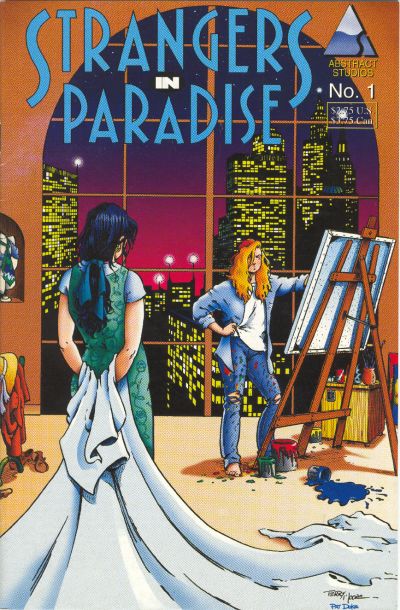
In September 1994, Moore relaunched Strangers in Paradise through his own Abstract Studio imprint. This second volume ran for 14 issues and significantly expanded the scope of the story.
What initially appeared to be a romantic comedy gradually transformed into a sophisticated combination of drama, crime fiction, political intrigue, and psychological thriller. Katchoo’s mysterious past introduced readers to the dangerous world of the Parker Girls, a secretive organization connected to powerful criminal and political figures.
 The introduction of this darker material demonstrated Moore’s ability to blend different genres without abandoning the relationships that made the series appealing in the first place.
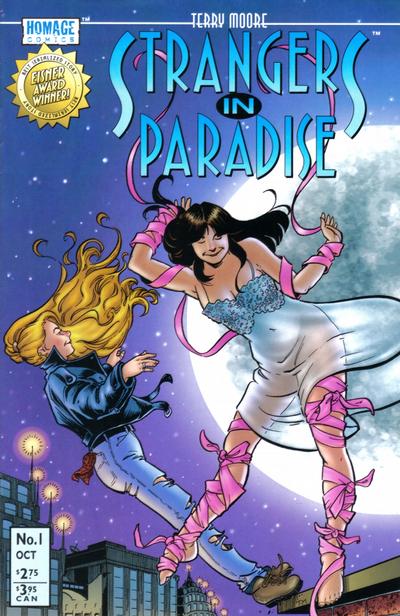
In 1996, Strangers in Paradise received one of the comic book industry’s highest honors when it won the Eisner Award for Best Continuing Series. The recognition confirmed that an independently produced, character-driven comic could compete with titles from the industry’s largest publishers.
Later that year, Moore joined Jim Lee’s Homage Comics imprint at Image Comics, launching a third volume of Strangers in Paradise with another new first issue. The opening issue even featured a superhero dream sequence illustrated by Jim Lee, providing an unexpected connection between Moore’s intimate storytelling and the superhero artwork that dominated the decade.
After eight issues through Homage, Moore returned the series to Abstract Studio, continuing the existing numbering rather than beginning another volume.
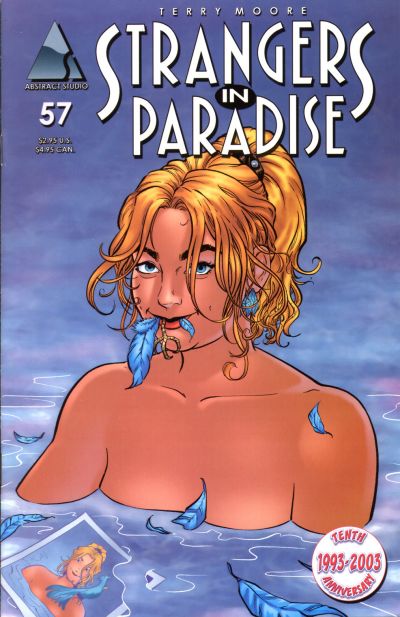
The third volume eventually ran for 90 issues, concluding in June 2007. Across its three original volumes, Strangers in Paradise accumulated 107 issues and established itself as one of the great achievements of creator-owned independent comics.
One of the series’ most distinctive features was Moore’s artwork. His expressive faces, natural body language, and attention to subtle emotional details allowed characters to communicate as much through their expressions as through their dialogue. His use of black and white gave the pages an intimate atmosphere, while his ability to transition between humor, romance, and suspense kept the storytelling engaging.
 Unlike many comic book artists working during the 1990s, Moore did not rely on elaborate costumes or explosive action sequences. A conversation between two characters sitting in a kitchen could carry as much emotional weight as a dramatic confrontation.
The series also became significant for its portrayal of women and LGBTQ relationships. Katchoo and Francine were complex individuals whose feelings and identities could not be reduced to simple stereotypes. Their relationship developed naturally over the course of the series, earning Strangers in Paradise a devoted readership that extended beyond traditional superhero fans.
The comic received GLAAD Media Awards for Outstanding Comic Book, recognizing its contribution to LGBTQ representation in sequential storytelling.
Although the original series concluded in 2007, Moore was not finished with these characters. In 2018, he returned to the world of Strangers in Paradise with Strangers in Paradise XXV, celebrating the title’s 25th anniversary. The new series connected characters and storylines from Moore’s other creator-owned works, including Echo, Rachel Rising, and Motor Girl.
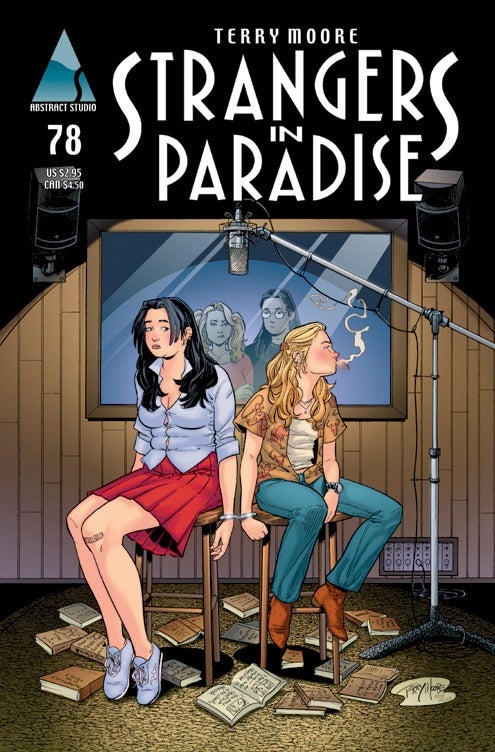 The original stories have also remained available through numerous collected editions, allowing new generations of readers to discover the complete saga.
Today, Strangers in Paradise is recognized as a landmark in independent comics. It demonstrated that readers would support a long-running series built around human relationships, sophisticated characterization, and the personal artistic vision of a single creator.
Terry Moore showed that comic books did not need superheroes to deliver compelling drama, and that independent creators could build lasting careers while retaining control of their characters and stories.
Strangers in Paradise began as a three-issue black-and-white comic from Antarctic Press and grew into a 107-issue independent comics classic. Terry Moore’s story of Katchoo, Francine, and David helped prove that the greatest adventures in comics do not always involve saving the world. Sometimes they involve understanding the people you love.
About Author
