
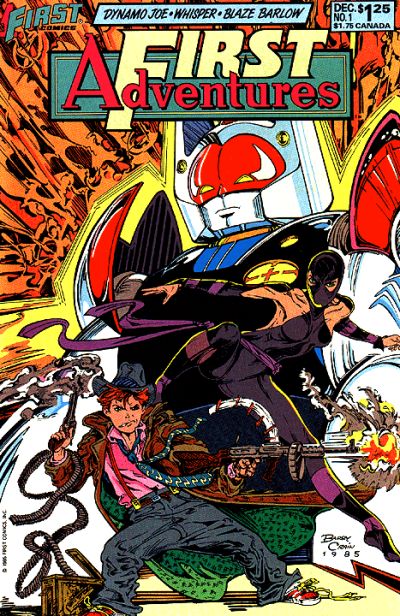
 During the 1980s, independent comic book publishers were exploring new genres and storytelling approaches that went beyond traditional superheroes. First Comics was at the forefront of this movement, publishing innovative titles such as American Flagg!, Nexus, Grimjack, Badger, and Jon Sable, Freelance. Among its more unusual offerings was Dynamo Joe, an ambitious science-fiction adventure that combined giant robots, interstellar warfare, political intrigue, and humor.
Created by artist Doug Rice and writer John Ostrander, Dynamo Joe brought the excitement of Japanese giant robot animation to American comic books. At a time when Robotech and Mobile Suit Gundam were introducing audiences to elaborate mechanical warriors and futuristic military conflicts, Dynamo Joe offered its own interpretation of the genre.
What made the series particularly interesting was that it was not simply about enormous robots fighting alien monsters. Beneath the spectacular battles was a surprisingly detailed science-fiction universe populated by competing civilizations, unusual alien species, military organizations, and characters whose personal relationships were just as important as the war surrounding them.
 Dynamo Joe’s publishing history began in 1984, when the character appeared in backup stories in issues #10 through #12 of Mars, another science-fiction comic published by First Comics.
These early stories introduced readers to the futuristic universe and the enormous mechanical battle suits that would become the centerpiece of the series.
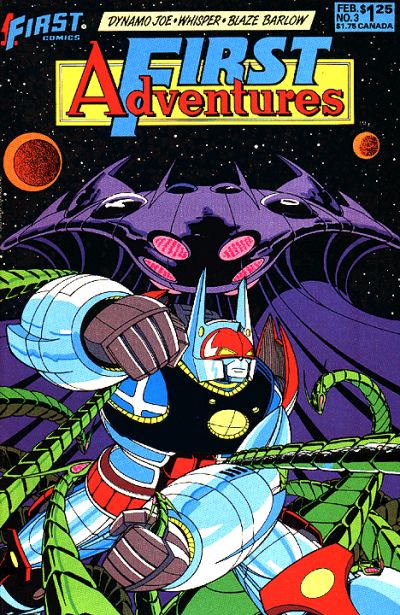
In 1985, Dynamo Joe became one of the featured attractions in First Adventures, an anthology published by First Comics. The title showcased three very different properties: Dynamo Joe, Whisper, and Blaze Barlow and the Eternity Command.
The anthology allowed First Comics to introduce readers to new characters without immediately committing to individual ongoing titles. Dynamo Joe appeared throughout the five-issue run, with Rice providing the artwork and Ostrander writing the scripts.
The response was sufficient for First Comics to give the property its own title.
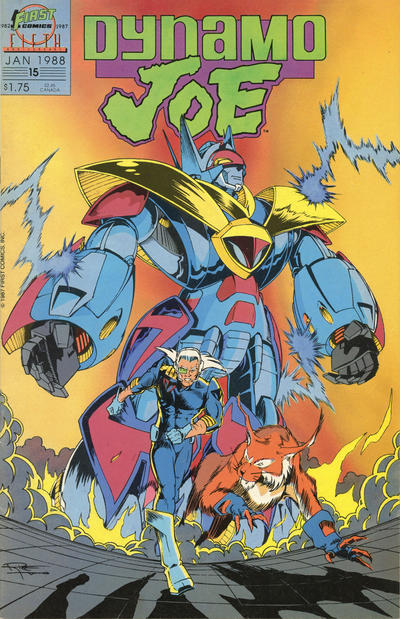
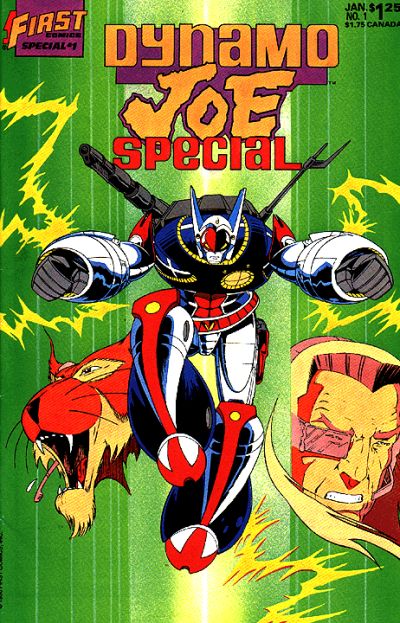
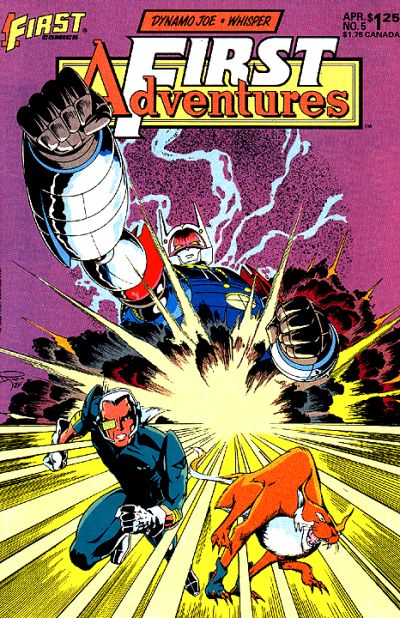 Dynamo Joe #1 arrived with a May 1986 cover date, initially planned as a three-issue limited series. The comic ultimately continued for 15 issues, concluding in January 1988. First Comics also published a Dynamo Joe Special in 1987, reprinting the original stories from Mars with additional material.
The world of Dynamo Joe is set in a distant future in which humanity has spread across the stars and encountered other intelligent civilizations.
Three spacefaring societies find themselves threatened by the Mellenares, a mysterious alien force consisting of gigantic green machines capable of devastating entire worlds.
The Mellenares appear almost unstoppable. They move relentlessly through space, destroying whatever stands in their path. Their seemingly mindless behavior makes them particularly frightening because traditional military strategies and diplomacy offer little hope of stopping them.
Facing possible extinction, civilizations with very different political systems, cultures, and philosophies must cooperate against their common enemy.
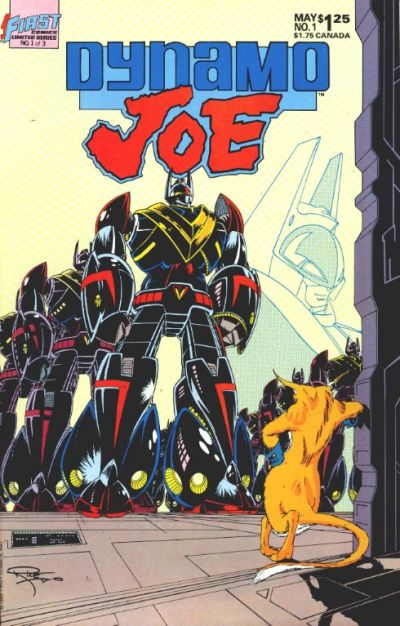 Their most powerful weapons are the Dynamo Class Robosoldiers, enormous fusion-powered mechanical battle suits designed for combat in space and on planetary surfaces.
These mechanical giants are equipped with advanced weaponry and can be adapted to a variety of battlefield conditions. However, they are not autonomous superheroes. They require living crews, and the abilities, personalities, and decisions of those individuals frequently determine the outcome of a battle.
The war provides the series with its central conflict, but the relationships between the different civilizations create much of its dramatic tension.
At the heart of the series are two unlikely partners: Sergeant Elanian Daro and Private Pomru Purrwakkawakka.
Sergeant Elanian Daro is a military officer from the Imperium, a powerful civilization ruled by the mysterious Magna Khan. Once a captain, Daro was demoted to sergeant under circumstances become part of the ongoing intrigue surrounding his character.
Daro is a capable officer and skilled warrior, but his position within the Imperium is complicated by political maneuvering and the unusual interest the Magna Khan takes in him.
 His partner, Pomru Purrwakkawakka, better known as Tabby, is a member of the Tavitan species, a race of intelligent, feline humanoids known for their extraordinary engineering abilities.
Tabby serves as Dynamo Joe’s mechanic, constantly modifying and improving the giant battle suit. His technological genius is matched by an enthusiasm for bending the rules, borrowing equipment without permission, and creating problems for military authorities.
The contrast between Daro’s disciplined military personality and Tabby’s mischievous ingenuity provides the comic with much of its humor.
Their partnership is essential to the success of Dynamo Joe. Daro brings military experience and tactical judgment, while Tabby continually finds ways to make their mechanical warrior more effective against the Mellenares.
One of the strengths of Dynamo Joe is the attention given to the civilizations involved in the war.
Humanity has spread throughout the galaxy, establishing colonies and developing competing political and military organizations. Even with an external threat, humans have not abandoned their internal disputes.
 The Imperium, ruled by the immortal Magna Khan, is a highly advanced society with a rigid political hierarchy. Its citizens place tremendous importance on physical ability, discipline, and personal achievement. The Khan’s long rule and complicated relationships with his subjects contribute to the series’ political intrigue.
The Tavitans, meanwhile, are a matriarchal feline civilization ruled by the Great Mother. They possess remarkable technological abilities and a natural talent for engineering. Their culture and personalities frequently contrast with the more rigid military structures of their allies.
These differences are not merely background details. They influence how characters interact, how military decisions are made, and how effectively the alliance responds to the alien invasion.
Rather than portraying the conflict as a simple battle between good and evil, the series explores the difficulty of bringing fundamentally different societies together when their survival depends on cooperation.
Artist Doug Rice was instrumental in defining the appearance and personality of Dynamo Joe.
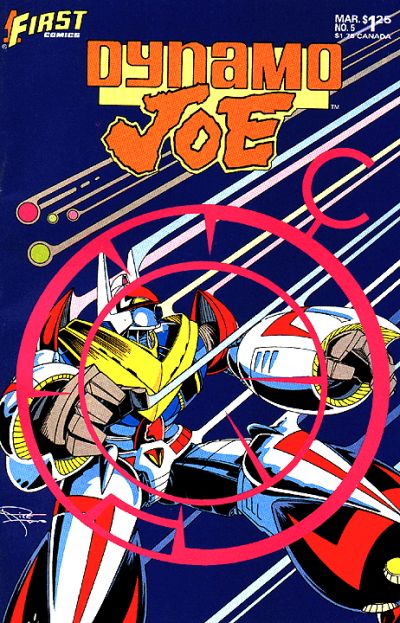 Rice was a fan of Japanese giant robot adventures, and that influence is immediately apparent in the elaborate mechanical designs, spectacular space battles, and enormous armored warriors that dominate the artwork.
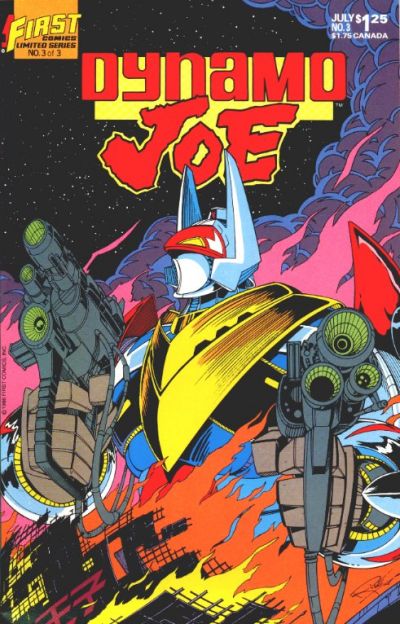
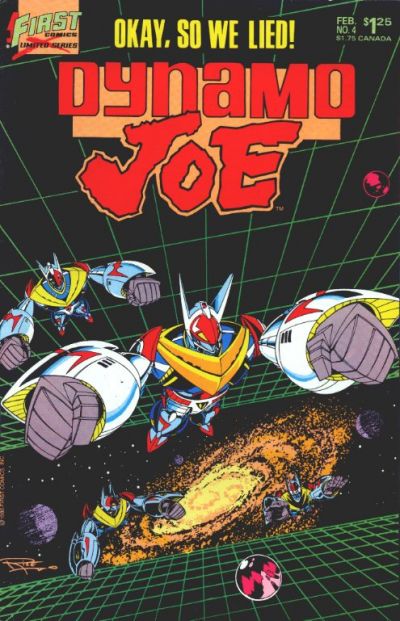
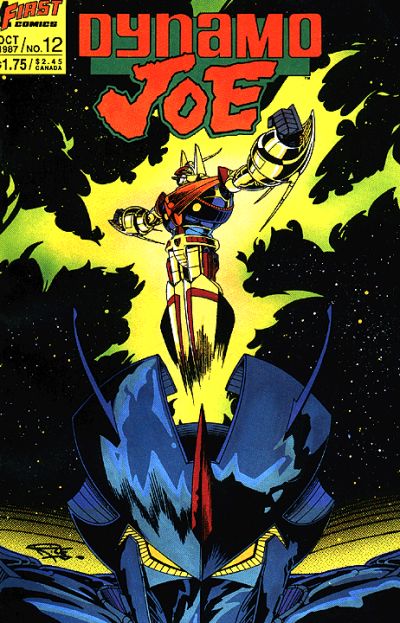
Unlike the more streamlined designs traditionally associated with American superheroes, the Dynamo battle suits feature complex mechanical structures, interchangeable weaponry, and a strong sense of physical weight.
Rice’s designs give the robots the appearance of sophisticated military equipment rather than simply oversized costumed heroes.
The influence of Japanese animation extends beyond the visual appearance of the machines. The emphasis on military organizations, specialized pilots, technological development, and complicated interstellar conflicts reflects many of the ideas that made Japanese science-fiction animation increasingly popular with American audiences during the decade.
Yet Dynamo Joe was not simply an imitation. Rice and Ostrander incorporated humor, distinctive alien cultures, and a decidedly American approach to character interaction.
The result was a comic that combined the excitement of giant robot animation with the storytelling traditions of American science-fiction adventure.
 John Ostrander brought considerable storytelling ability to Dynamo Joe, helping establish the complex political and military environment surrounding its characters.
Ostrander was also associated with First Comics’ Grimjack, another series known for its elaborate fictional universe and memorable supporting cast. His ability to balance action, character development, and intricate plots made him particularly well suited to the challenges of writing Dynamo Joe.
The early stories established the war against the Mellenares while gradually introducing the different civilizations and the relationships between their military personnel.
Following the initial three issues of the ongoing comic, Phil Foglio took over scripting duties beginning with issue #4.
Foglio, already known for his humorous storytelling and distinctive approach to science fiction and fantasy, brought a different sensibility to the series. His involvement helped emphasize the comic’s comedic elements without abandoning the ongoing interstellar conflict.
Artist Ben Dunn, whose work would become strongly associated with manga-influenced American comics, also contributed artwork to the series.
This combination of creators gave Dynamo Joe an unusual mixture of serious military science fiction, spectacular robot combat, political intrigue, and character-driven humor.
One of the more interesting elements of Dynamo Joe was its connection to the larger fictional universe associated with First Comics.
The series introduced Wolf-1, a mysterious, sentient battle suit associated with the extradimensional city of Cynosure.
Readers of Grimjack will recognize Cynosure as the extraordinary city where multiple dimensions intersect. Its inclusion connected Dynamo Joe to the broader science-fiction and fantasy mythology that First Comics was developing.
 The technology associated with Wolf-1 also influenced Tabby’s continuing modifications to Dynamo Joe, allowing the giant robot to become increasingly sophisticated.
This connection was particularly appealing because Dynamo Joe occupied a very different genre from Grimjack. One was a futuristic military space opera, while the other combined hard-boiled detective fiction with science fiction and fantasy.
The shared concepts demonstrated how First Comics could connect seemingly unrelated properties without sacrificing their individual identities.
Despite its ambitious premise and imaginative artwork, Dynamo Joe never became one of First Comics’ biggest commercial successes.
The original three-issue limited series expanded into an ongoing title, but publication was interrupted after issue #3. The series resumed with issue #4, cover-dated February 1987, and continued through issue #15 in January 1988.
Although the story reached a degree of resolution, the series ended with considerable potential for further adventures.
Its 15-issue run, five chapters in First Adventures, and earlier backup stories provided readers with an extensive introduction to a science-fiction universe that could have supported many more stories.
Looking back, Dynamo Joe represents an interesting moment in the development of American comic books.
During the 1980s, Japanese animation and manga were becoming increasingly influential, but American comic book publishers were still experimenting with how to incorporate those influences into their own material.
 Dynamo Joe was an early example of an American comic that embraced the giant robot genre while developing its own characters, mythology, and storytelling identity.
It also reflected the willingness of First Comics to take creative risks. Rather than concentrating exclusively on superheroes, the publisher explored science fiction, crime, fantasy, martial arts, and other genres that appealed to an increasingly diverse comic book readership.
Although Dynamo Joe never achieved the lasting popularity of Nexus, Grimjack, or American Flagg!, it remains a worthwhile discovery for readers interested in independent comics and the history of giant robot storytelling.
Doug Rice’s mechanical designs, John Ostrander’s world-building, and Phil Foglio’s humor helped create a series that was both visually exciting and surprisingly ambitious.
Nearly four decades after its final issue, Dynamo Joe remains a reminder of a period when independent publishers were willing to experiment with new ideas and introduce readers to fictional worlds unlike anything else on the comic book stands.
For collectors interested in rediscovering the property, the original Mars backup stories, First Adventures #1-5, Dynamo Joe Special #1, and Dynamo Joe #1-15 provide the complete original publishing history.
About Author
