
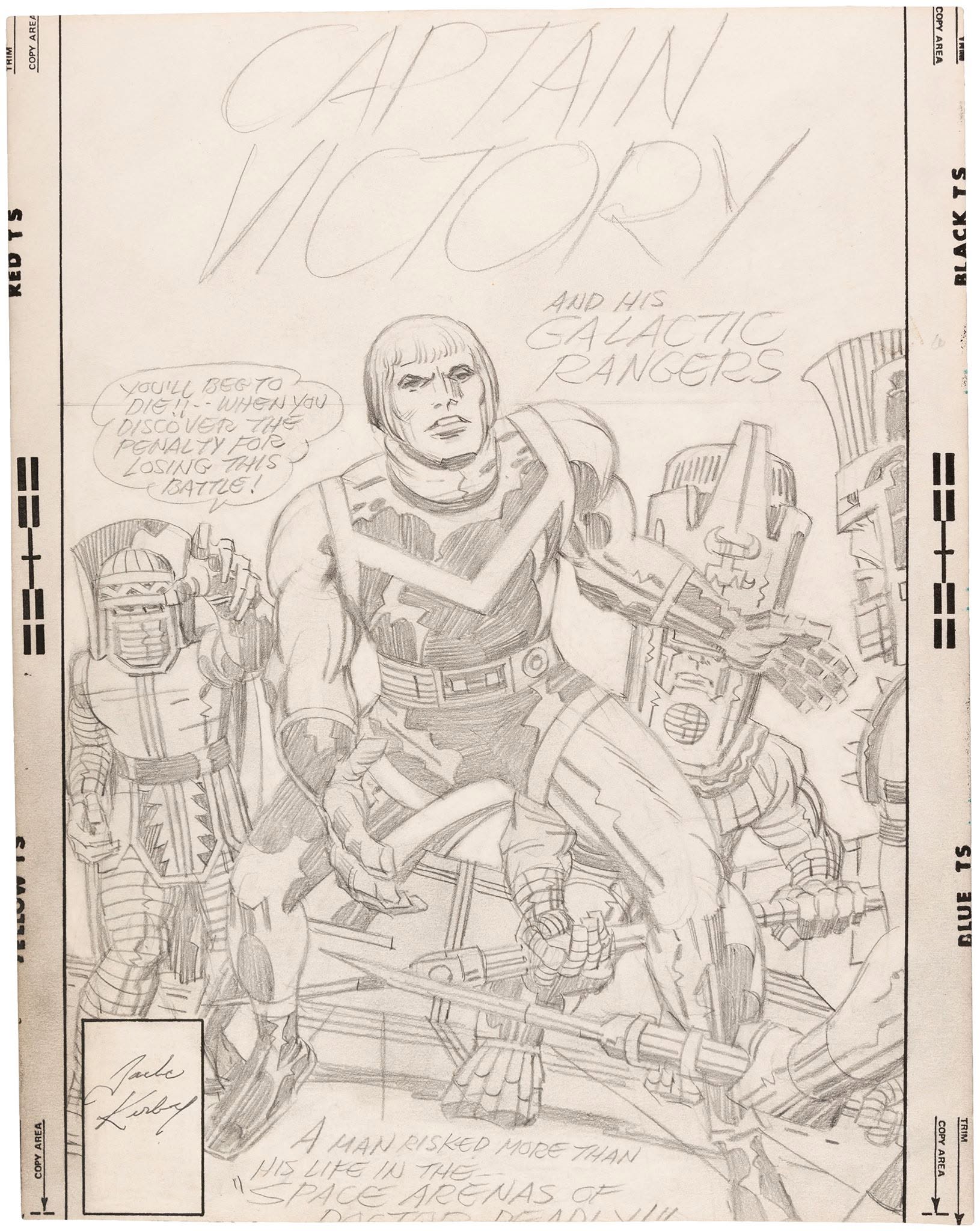
 By 1981, Jack Kirby had already transformed the American comic book industry several times. He had helped create Captain America, the Fantastic Four, the X-Men, the Avengers, and countless other characters that became foundations of modern superhero comics. At DC Comics, he had introduced his ambitious Fourth World mythology, including the New Gods, Darkseid, Mister Miracle, and the Forever People.
Yet even after decades of extraordinary accomplishments, Kirby still had new worlds to explore.
That opportunity arrived with CAPTAIN VICTORY AND THE GALACTIC RANGERS, an ambitious science-fiction adventure published by the fledgling Pacific Comics.
The series represented something enormously important in Kirby’s career. For the first time, the legendary creator could develop a major new superhero property while retaining ownership of his characters and exercising extensive creative control.
The result was a wildly imaginative space opera overflowing with alien civilizations, monstrous enemies, bizarre technology, cosmic warfare, and the larger-than-life storytelling that had made Kirby the King of Comics.
But CAPTAIN VICTORY was more than another Jack Kirby comic.
It was part of a revolution in how comic books were created, published, and owned.
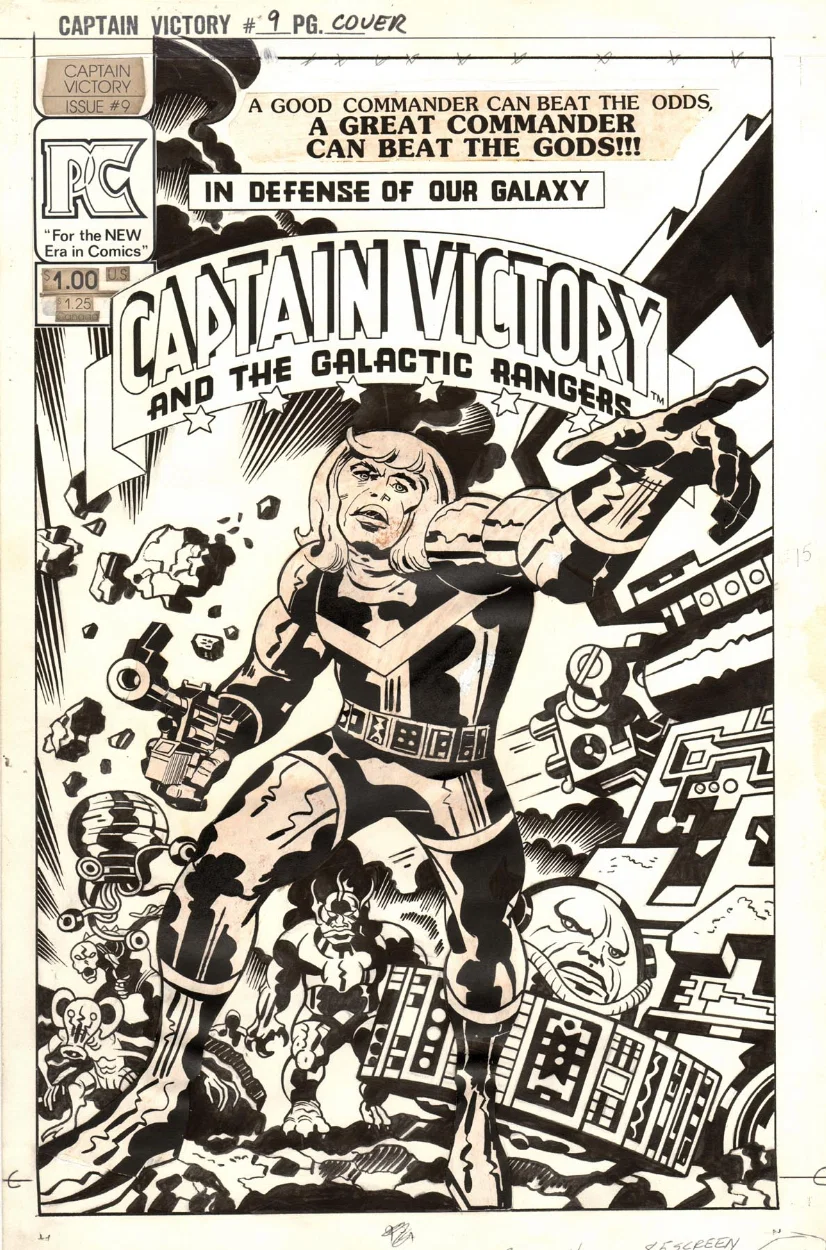 In the late 1970s, brothers Steve and Bill Schanes were building Pacific Comics into an important force in the developing direct-market comic book business.
Their company began as a comics retailer and distributor before expanding into publishing. They believed comic book professionals deserved greater control over their creations and offered arrangements allowing creators to retain ownership of their intellectual property.
For their publishing debut, they approached one of the biggest names imaginable: Jack Kirby.
Kirby had been developing CAPTAIN VICTORY as a science-fiction project before Pacific became involved. The concept had evolved from material originally intended for a screenplay and later considered for a graphic novel.
Pacific provided the opportunity to bring that material to comic book readers.
CAPTAIN VICTORY AND THE GALACTIC RANGERS #1 reached comic book shops in 1981, becoming one of the landmark early publications of the independent comics movement.
Kirby was no longer creating a new character that would automatically belong to Marvel or DC. This time, the cosmic universe was his.
The success of CAPTAIN VICTORY helped establish Pacific Comics as a serious publishing company and demonstrated that established creators could attract readers outside the traditional Marvel and DC publishing system.
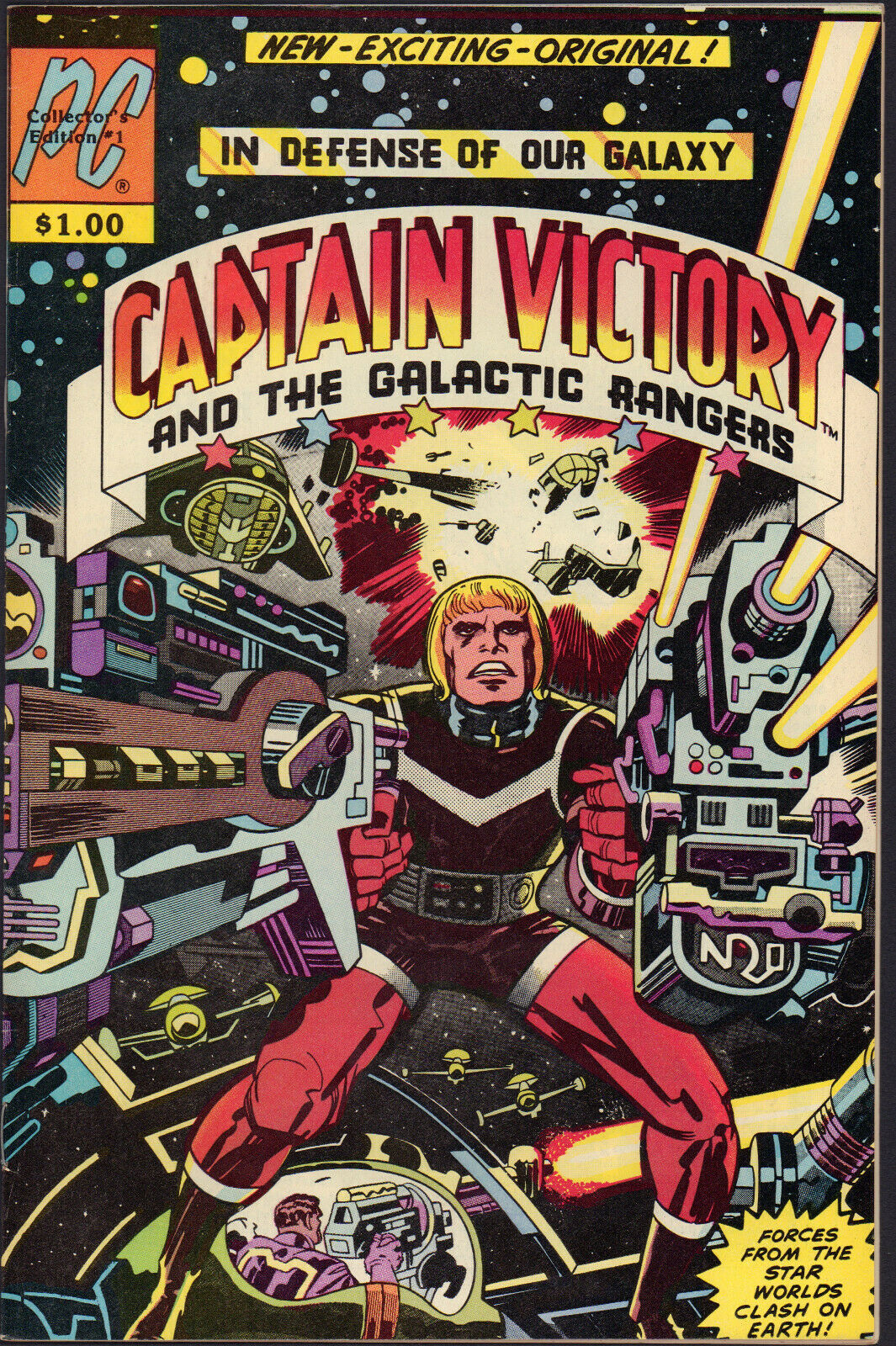 Captain Victory is the commander of the Galactic Rangers, an interstellar military and peacekeeping organization dedicated to protecting the galaxy against extraordinary threats.
With his distinctive costume, imposing presence, advanced weaponry, and commanding personality, Victory appears to be the ultimate science-fiction superhero.
He leads his Rangers into dangerous regions of space, confronting alien invaders, monstrous creatures, and civilizations capable of threatening entire worlds.
However, beneath his heroic exterior lies a surprisingly complex character.
Victory is a warrior who understands sacrifice. His missions routinely place him in situations where death is a very real possibility.
What makes him particularly unusual is that death does not necessarily mean the end.
Captain Victory has access to a sophisticated cloning system that allows his consciousness and identity to continue in a replacement body after his physical form is destroyed.
This gives Kirby an opportunity to examine concepts rarely explored in conventional superhero adventures of the period.
What does death mean to someone who can be replaced?
Is the new Captain Victory truly the same individual?
Can a warrior continue fighting indefinitely without losing something essential about himself?
Although the series presents these ideas through explosive action and science-fiction spectacle, they give Captain Victory a fascinating dimension beyond the familiar image of a costumed hero battling villains.
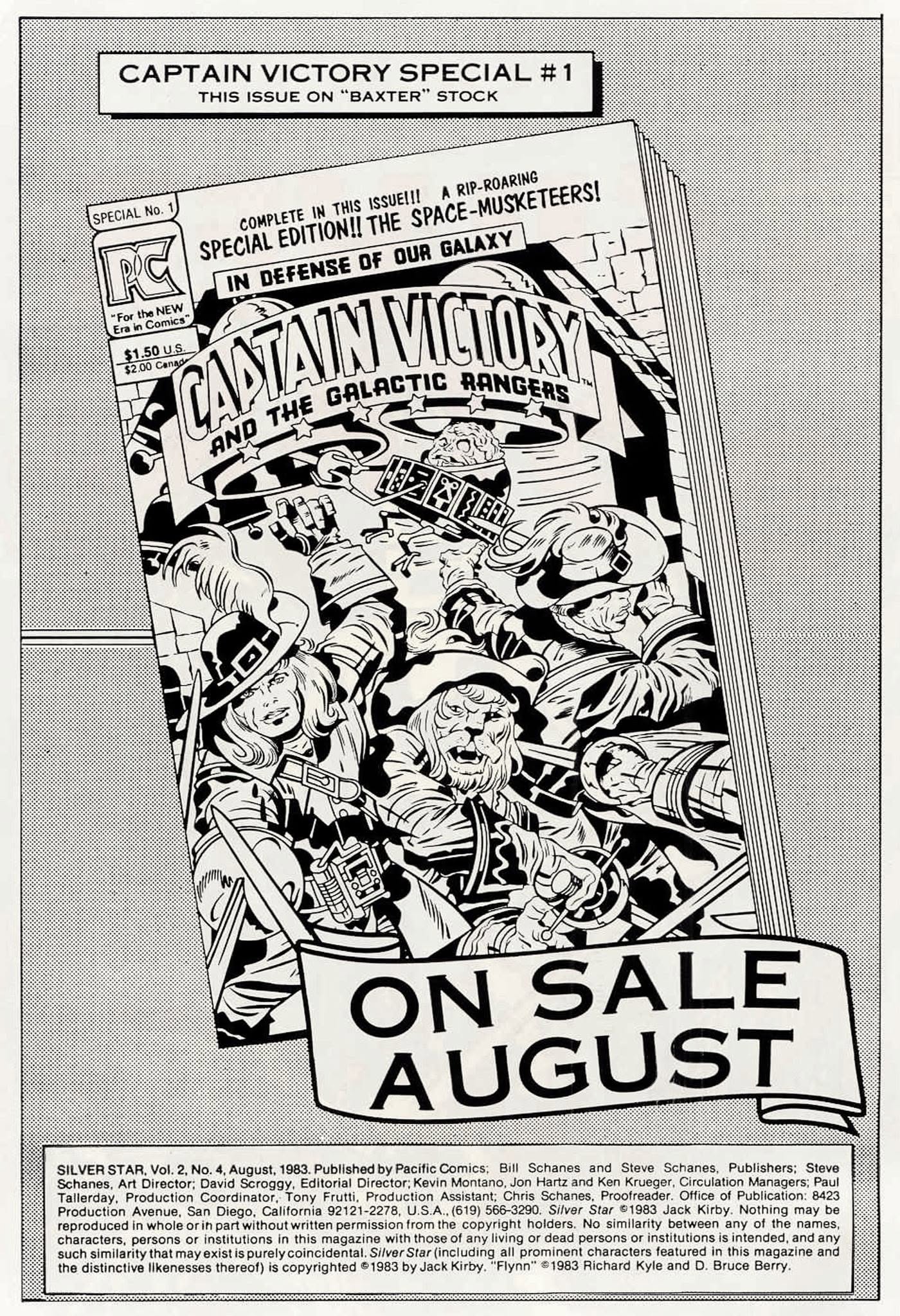 Captain Victory does not fight alone.
The Galactic Rangers are a highly organized interstellar force equipped with advanced spacecraft, sophisticated weapons, and technology designed to operate across the vast reaches of space.
The Rangers combine elements of a futuristic military organization, an interplanetary police force, and a traditional superhero team.
Their adventures take them into encounters with strange civilizations, dangerous cosmic phenomena, and enemies capable of challenging even their most advanced technology.
One of the supporting characters, Major Klavus, reflects Kirby’s enthusiasm for giving his cosmic organizations distinctive personalities rather than treating them as anonymous armies.
The Rangers also serve an important storytelling function. They provide Kirby with an entire universe of supporting characters and potential adventures.
While Captain Victory is the central figure, the organization surrounding him suggests a much larger fictional world.
In typical Kirby fashion, even minor characters and background concepts sometimes seem interesting enough to support stories of their own.
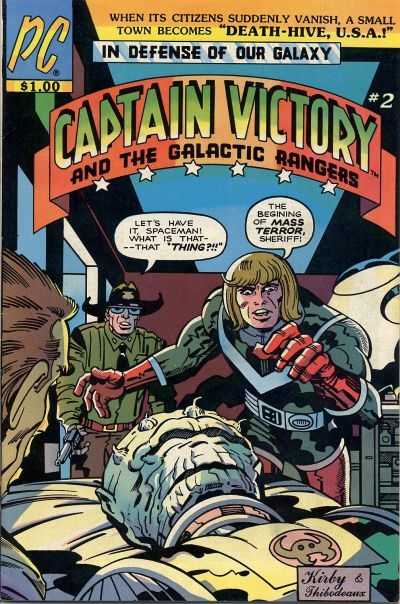 Among the most memorable enemies introduced in the series are the Insectons, a terrifying race of insect-like extraterrestrial creatures.
The Insectons represent an almost overwhelming biological menace. Their appearance and behavior provide a sharp contrast to the technological sophistication of the Galactic Rangers.
Kirby uses them to create battles that are simultaneously grotesque, spectacular, and enormous in scale.
The conflict between Victory and the Insectons becomes one of the defining struggles of the series.
These confrontations demonstrate Kirby’s remarkable ability to transform even a straightforward alien-invasion storyline into something visually extraordinary.
His pages are filled with massive spacecraft, strange creatures, explosive machinery, and action sequences that seem ready to burst beyond the borders of the comic book.
The Insectons also emphasize the importance of Victory’s cloning technology, particularly when the cost of protecting the galaxy becomes devastatingly personal.
Perhaps the most intriguing aspect of CAPTAIN VICTORY is its apparent connection to Kirby’s legendary Fourth World mythology.
During the final issues of the original series, Kirby began exploring Captain Victory’s mysterious origins.
Readers learned about Victory’s troubled childhood, his family, and a sinister figure named Blackmaas.
Blackmaas was portrayed as an enormously powerful and malevolent presence with unmistakable similarities to Darkseid, the principal villain of Kirby’s NEW GODS.
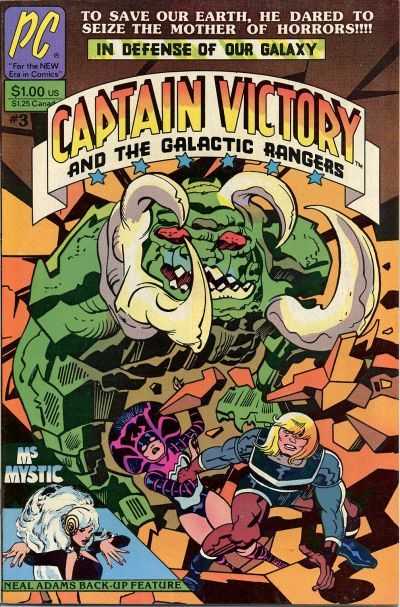 Other clues suggested that Captain Victory might actually be the son of Orion, Darkseid’s rebellious son.
One particularly revealing detail involved equipment associated with Victory’s father that closely resembled Orion’s famous Astro-Harness.
Kirby never explicitly identified Orion or Darkseid by name in the Pacific Comics series.
Nevertheless, the similarities were difficult to overlook.
The implication was extraordinary.
Captain Victory could be interpreted as the next generation of Kirby’s New Gods mythology, a descendant of the cosmic family whose conflicts had defined the Fourth World.
If that interpretation was correct, Victory was not simply an interstellar hero. He was potentially the grandson of Darkseid.
The connection remained implied rather than officially established within DC continuity, but it added considerable depth to the character.
For longtime Kirby readers, these revelations suggested that the King had never entirely abandoned his unfinished cosmic mythology.
He had simply found another way to continue exploring it.
 One of the greatest attractions of CAPTAIN VICTORY AND THE GALACTIC RANGERS is the opportunity to experience Jack Kirby working with remarkable creative freedom.
The series contains nearly everything associated with Kirby’s most imaginative science-fiction work.
There are gigantic machines, elaborate spaceships, bizarre alien environments, monstrous creatures, futuristic armor, and enough cosmic energy to power an entire superhero universe.
Kirby’s instantly recognizable artistic techniques are everywhere.
His dramatic perspective makes characters appear to leap directly toward the reader. His machinery consists of impossible combinations of geometric forms, mechanical components, and intricate technological details.
And, of course, there is Kirby Krackle, the distinctive clusters of black dots that became his visual shorthand for cosmic energy and overwhelming power.
Even in the early 1980s, after more than four decades in the comic book industry, Kirby was still drawing with enormous enthusiasm.
His characters rarely stand still.
They charge, leap, strike, shout, and confront their enemies with explosive physical energy.
The artwork is not always as polished as his celebrated Marvel work of the 1960s, and the storytelling can occasionally become crowded with ideas.
But those imperfections are also part of the series’ personality.
 CAPTAIN VICTORY is Kirby operating without the familiar editorial restrictions of a major corporate publisher.
The stories go wherever his imagination takes them.
For readers who appreciate Kirby’s unrestrained creativity, that freedom is a substantial part of the appeal.
The historical significance of CAPTAIN VICTORY extends far beyond its fictional universe.
For decades, American comic book publishers had generally operated under work-for-hire arrangements that left writers and artists with little or no ownership of the characters they created.
Kirby understood the consequences better than almost anyone.
Although his imagination had helped build Marvel Comics into an entertainment powerhouse, he did not own most of the famous characters he had helped create.
Pacific Comics offered a different business model.
Creators could retain ownership of their properties while having their work published and distributed professionally.
Kirby’s participation gave the new publishing company immediate credibility.
His involvement also helped demonstrate that creator ownership was not merely an idealistic concept. It could be a viable commercial approach.
CAPTAIN VICTORY opened the door for other major creators to explore independent publishing opportunities.
Pacific would go on to publish work by Mike Grell, Steve Ditko, Sergio Aragonés, and other prominent artists and writers.
Among the important titles associated with the publisher were STARSLAYER, SILVER STAR, GROO THE WANDERER, and the early appearances of THE ROCKETEER.
 The changes happening at Pacific helped establish precedents that would influence independent comics throughout the 1980s and beyond.
A decade later, creator ownership would become one of the central principles behind the formation of Image Comics.
CAPTAIN VICTORY was an important early milestone on that road.
Despite its historical importance, CAPTAIN VICTORY did not become an enduring commercial franchise during Kirby’s lifetime.
The original Pacific Comics series concluded with issue #13, cover-dated January 1984, with an additional special completing its publishing history.
Pacific Comics itself experienced financial difficulties and ceased publishing in 1984.
The company’s relatively brief existence did not diminish its influence.
Its willingness to offer prominent creators ownership of their work helped establish a model that other independent publishers would continue to develop.
For Captain Victory, however, the conclusion of the Pacific series meant that the character would largely disappear from new comic book stories for several years.
The Galactic Rangers had fought across the universe, but their greatest enemy turned out to be the uncertainties of the comic book publishing business.
Captain Victory would eventually return through several publishing projects.
In 1994, Topps Comics attempted to revive several Jack Kirby properties as part of its Kirbyverse line.
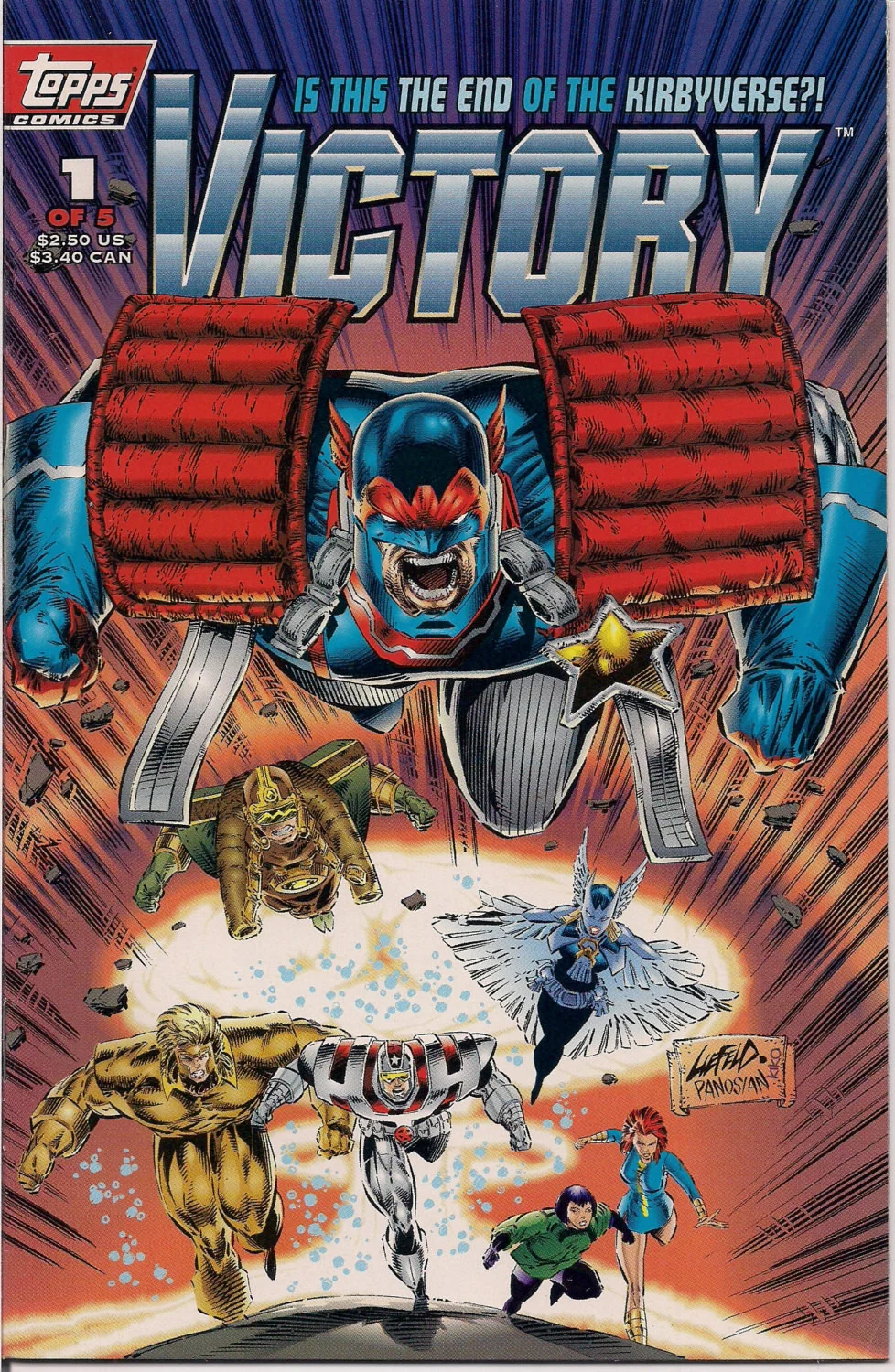 The publisher released VICTORY #1, but the planned continuation ended after the first issue.
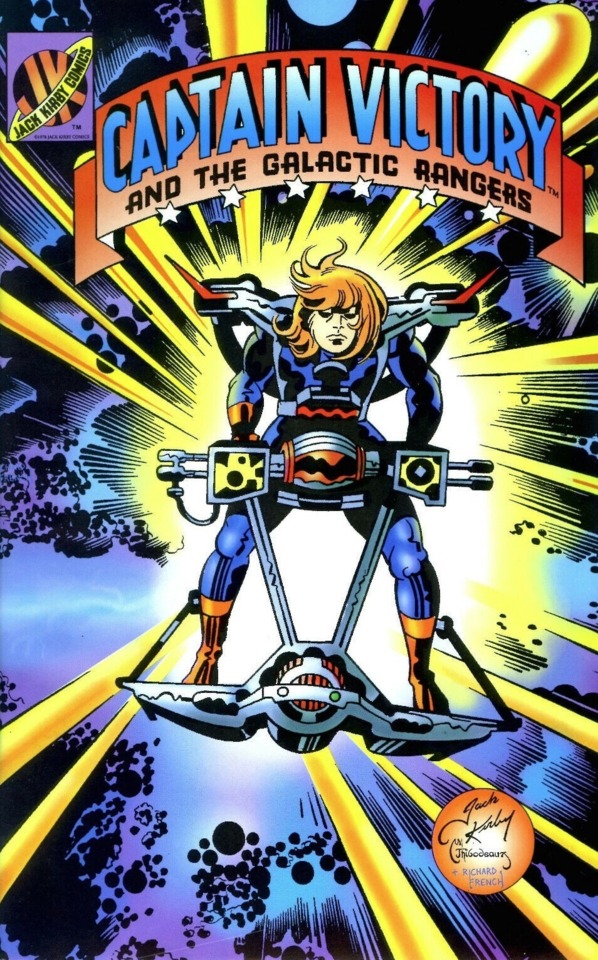
In 2000, Kirby’s grandson Jeremy Kirby revisited the character through Jack Kirby Comics, publishing a three-issue reinterpretation of the original material.
Captain Victory subsequently appeared in JACK KIRBY’S GALACTIC BOUNTY HUNTERS, a 2006 limited series published through Marvel’s Icon imprint and developed with the involvement of Kirby’s daughter Lisa.
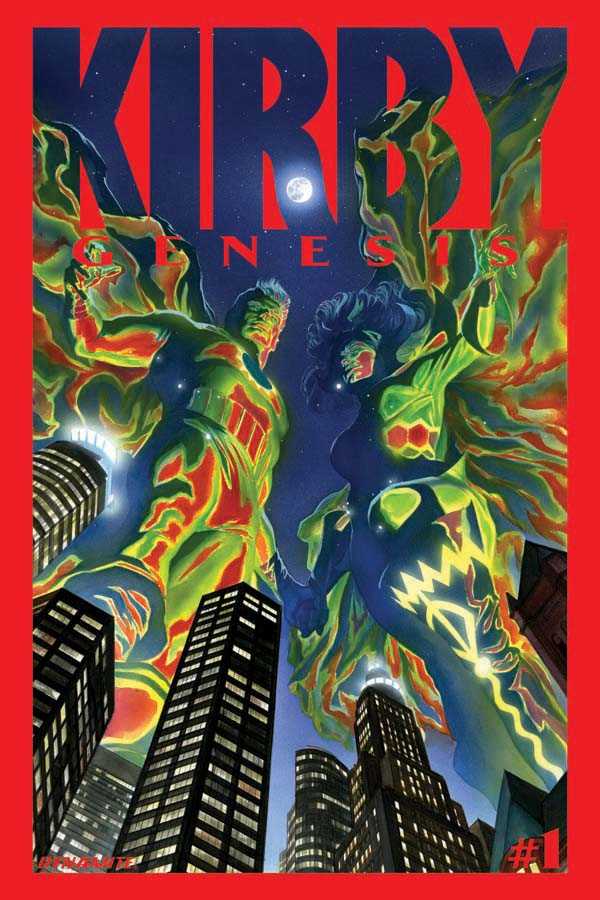
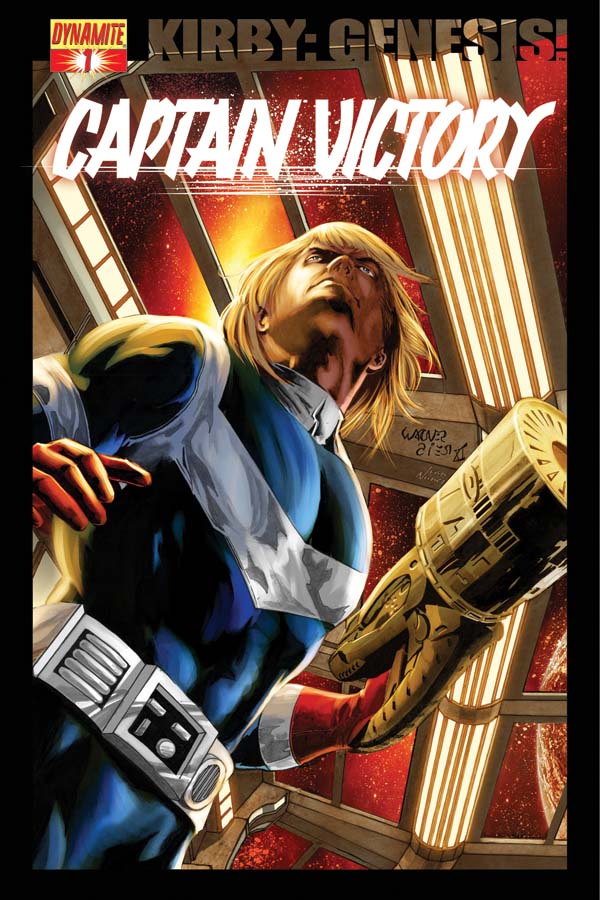
Dynamite Entertainment later brought the character back as part of its KIRBY: GENESIS initiative.
A new CAPTAIN VICTORY series debuted in 2011, written by Sterling Gates.
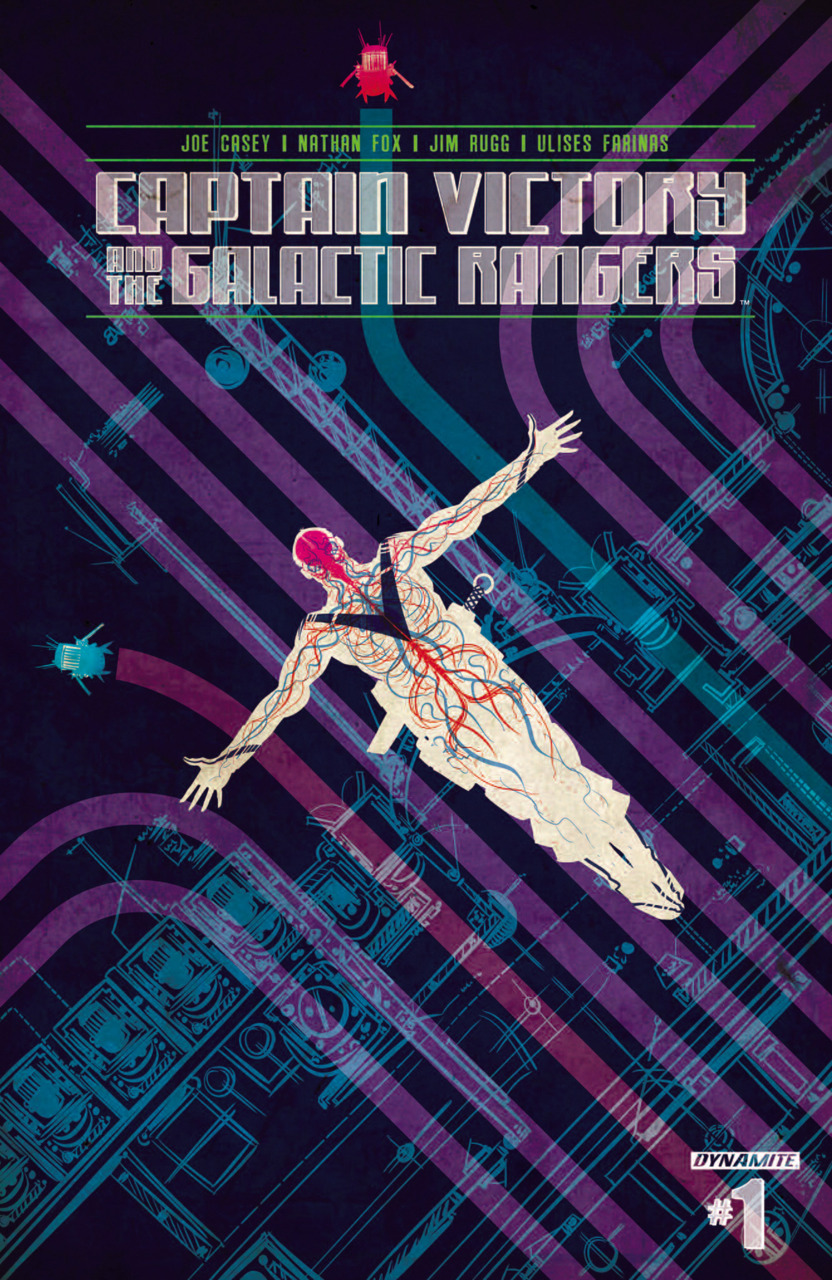
Another revival followed in August 2014, with writer Joe Casey and artist Nathan Fox helping introduce Kirby’s cosmic warrior to a new generation.
That six-issue series embraced the experimental, unpredictable character of Kirby’s original work while incorporating contributions from numerous contemporary artists.
Although none of these revivals established Captain Victory as a permanent fixture in the comic book marketplace, they demonstrated the continuing interest in Kirby’s lesser-known creations.
CAPTAIN VICTORY AND THE GALACTIC RANGERS occupies a unique place in comic book history.
On one level, it is an entertaining science-fiction adventure by one of the medium’s most influential creators.
On another, it is a fascinating continuation of the cosmic storytelling Kirby developed through the Fantastic Four, Thor, the Eternals, and the New Gods.
But perhaps its greatest significance is what it represented professionally.
After spending decades helping create characters owned by other companies, Jack Kirby finally had the opportunity to build a new superhero universe on his own terms.
 That made CAPTAIN VICTORY something more than another comic book.
It was a declaration of creative independence.
The series also serves as a reminder that independent comics did not emerge suddenly with the arrival of Image Comics in 1992.
The foundations had been established years earlier by creators and publishers willing to challenge the industry’s traditional business practices.
Jack Kirby was among those pioneers.
At an age when many artists might have been content to rest on their accomplishments, he was still creating new characters, experimenting with ambitious concepts, and helping push the comic book industry toward a different future.
Captain Victory never achieved the recognition enjoyed by Captain America, the Fantastic Four, or the New Gods.
His adventures remain relatively obscure outside the community of devoted Jack Kirby fans and collectors of independent comics.
Yet the original series is well worth discovering.
It captures an enormously influential creator at a fascinating moment in his career.
The pages contain Kirby’s familiar visual excitement, his enthusiasm for grand science-fiction concepts, and his enduring fascination with the struggle between good and evil.
They also reveal an artist who was still willing to experiment.
The cloning concept, the mysteries surrounding Victory’s ancestry, and the larger Galactic Rangers organization all demonstrate that Kirby had no shortage of ideas.
There are moments when the storytelling becomes wonderfully excessive, with cosmic concepts introduced so rapidly that readers barely have time to absorb one before another arrives.
But that was always part of Kirby’s magic.
He could make readers believe that the universe was infinitely larger, stranger, and more exciting than anything they had previously imagined.
CAPTAIN VICTORY AND THE GALACTIC RANGERS deserves to be remembered both as an entertaining Jack Kirby science-fiction epic and as one of the comic books that helped change the relationship between creators and publishers.
About Author
