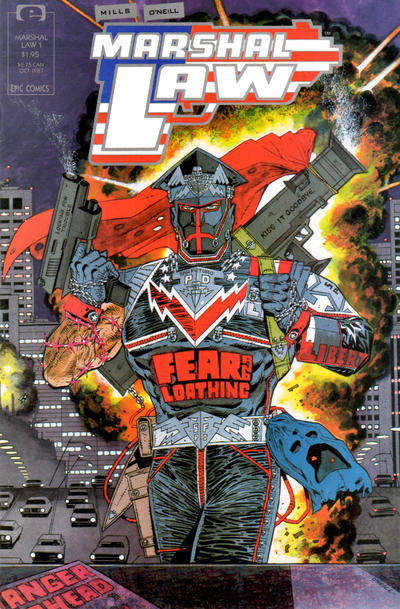
 In 1987, when superheroes were becoming darker, more violent, and increasingly complicated, Marvel Comics’ Epic imprint introduced a character who took those trends to their most outrageous extreme. His name was Marshal Law, and he hated superheroes.
Created by British comic book legends Pat Mills and Kevin O’Neill, Marshal Law was unlike anything else on American comic book shelves. It was violent, outrageous, politically charged, frequently offensive, and wickedly funny. More importantly, it challenged the very idea of what superheroes represented.
While most superhero comics celebrated costumed champions as symbols of hope and justice, Marshal Law asked a very different question: What happens when the people who are supposed to protect society become its greatest threat?
The answer was a government-sanctioned superhero hunter who was just as disturbed and dangerous as the people he pursued.
Behind the terrifying costume of Marshal Law is Joe Gilmore, a former soldier living in the futuristic American city of San Futuro.
In this dystopian future, the United States has produced a generation of superpowered individuals through military experimentation. Many of these supposed heroes are veterans whose experiences and enhanced abilities have left them psychologically damaged, violent, and incapable of functioning within ordinary society.
Rather than becoming inspirational defenders of the innocent, many have turned into criminals, predators, and celebrities who believe they are above the law.
Someone has to control them.
That responsibility belongs to Marshal Law.
Working as a government-authorized enforcer, Law tracks down rogue superheroes and dispenses a particularly brutal form of justice. He has little patience for their excuses, no respect for their costumes, and absolutely no belief in their supposed nobility.
There is one problem.
Marshal Law is himself a superpowered individual, a living example of everything he despises.
His hatred of superheroes is inseparable from his hatred of himself.
That contradiction gives the character a psychological depth beneath the outrageous violence and dark humor.
San Futuro is one of the most memorable aspects of the series.
Built upon the ruins of San Francisco following a devastating earthquake, the city represents a decaying American society where government corruption, rampant commercialization, celebrity worship, and unchecked violence have become everyday realities.
Superheroes are everywhere, but they are hardly heroic.
Many are little more than dangerous individuals hiding behind colorful costumes and carefully manufactured public images.
Mills uses this setting to attack virtually every convention of American superhero comics. The muscular physiques, dramatic costumes, patriotic symbols, and larger-than-life personalities are all present, but their traditional meanings have been twisted into something grotesque.
The superheroes of San Futuro are less like noble champions and more like celebrities, professional athletes, corrupt politicians, and psychologically unstable soldiers.
For Marshal Law, the difference between a superhero and a supervillain is often little more than public relations.
The original six-issue miniseries, later collected as Marshal Law: Fear and Loathing, introduces readers to the violent world of San Futuro and its most famous superhero, the Public Spirit.
The Public Spirit appears to embody everything America traditionally celebrates in its superheroes. He is powerful, handsome, patriotic, and adored by the public.
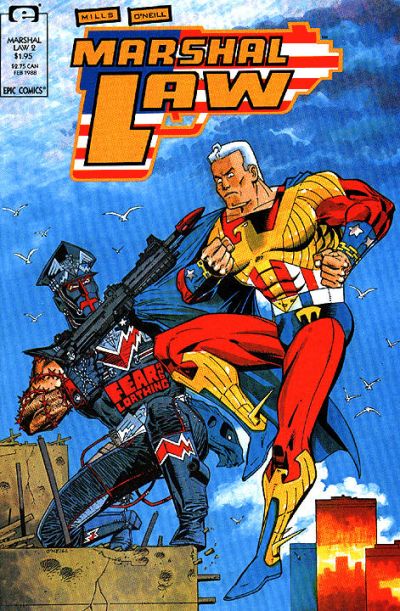 He also represents everything Marshal Law despises.
As Law investigates a series of brutal murders committed by a mysterious killer known as the Sleepman, he discovers disturbing connections between the crimes and the city’s celebrated superhero establishment.
What begins as an investigation becomes a vicious examination of hero worship, corruption, and the uncomfortable truths hidden beneath patriotic mythology.
The Public Spirit is an unmistakable parody of Superman and the idealized American superhero. However, Mills is interested in more than simply making fun of familiar characters.
He explores what would happen if society gave extraordinarily powerful individuals unlimited admiration without demanding accountability.
The result is a disturbing story in which the supposed heroes may be more dangerous than the criminals they claim to oppose.
The original series ran from October 1987 through April 1989, with delays between installments, and established Marshal Law as one of the most uncompromising characters of the era.
By the time Marshal Law debuted, Pat Mills had already established himself as one of Britain’s most influential comic book writers.
A founding editor of 2000 AD, Mills helped shape the British comics revolution that produced a generation of writers and artists who would eventually transform American comics.
His work was frequently confrontational, politically aware, and suspicious of authority.
Those qualities were central to Marshal Law.
Mills approached the American superhero not as an untouchable cultural institution but as a collection of ideas that deserved serious examination and, whenever possible, merciless ridicule.
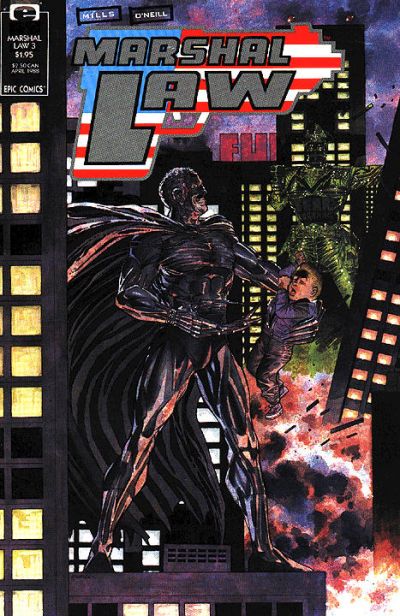 Superhero patriotism became an opportunity to examine nationalism. Superhuman strength became a metaphor for unchecked power. The familiar battle between good and evil became a vehicle for questioning who gets to decide what those words mean.
The writing could be shocking, but the shock was rarely the entire point.
Beneath the outrageous situations was an angry satire of militarism, celebrity culture, institutional corruption, and the commercialization of heroism.
Mills was not simply asking whether superheroes were realistic.
He was asking whether the ideals they represented could survive contact with the real world.
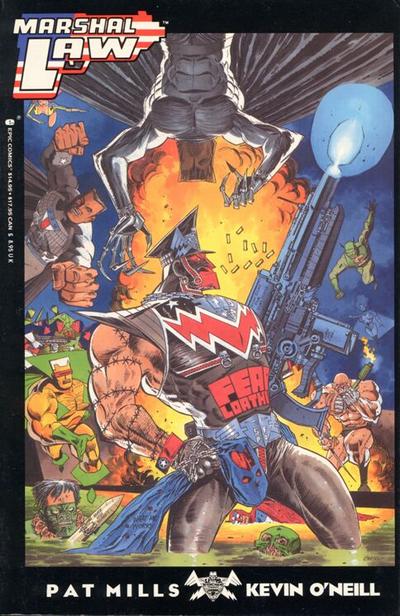
If Pat Mills supplied the anger and satire, Kevin O’Neill gave Marshal Law its unforgettable visual identity.
O’Neill’s artwork was unlike the polished, idealized superhero illustration that dominated American comics during the 1980s.
His characters were exaggerated, grotesque, and frequently unsettling.
Superhero costumes looked less like noble uniforms and more like bizarre combinations of military equipment, fetish clothing, and advertising gimmicks.
Faces twisted into expressions of rage, fear, madness, and cruelty. Bodies were distorted. Architecture was oppressive. Every street corner seemed filled with visual jokes, advertisements, and disturbing details.
O’Neill’s pages demanded attention.
His imagination transformed San Futuro into a sprawling nightmare where almost every background contained another piece of social commentary.
The violence was often shocking, but his artwork also gave the series an unmistakable sense of black comedy.
O’Neill had previously encountered controversy when his artwork for a Green Lantern story at DC was considered objectionable by the Comics Code Authority. That experience made him particularly well suited to a project that rejected conventional restrictions on superhero storytelling.
 Together, Mills and O’Neill created something far more distinctive than another dark superhero comic.
They created a world in which everything familiar about superheroes had been turned inside out.
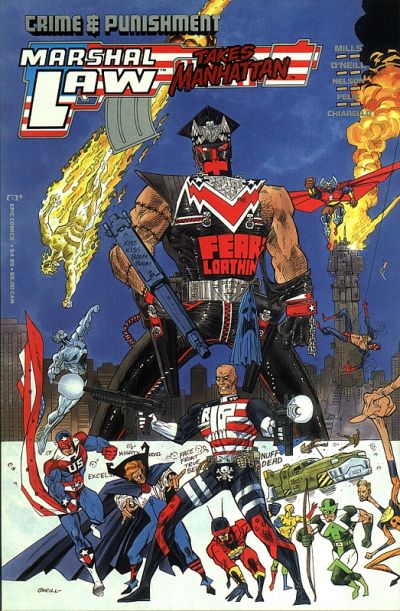
Following the original miniseries, Epic Comics published Crime and Punishment: Marshal Law Takes Manhattan in 1989.
This one-shot allowed Mills and O’Neill to turn their attention directly toward the superheroes of the Marvel Universe.
Although the characters were presented as parodies rather than their actual Marvel counterparts, the targets were unmistakable.
America’s most recognizable superheroes became inmates in a bizarre institution filled with dysfunctional costumed personalities.
The story mercilessly mocked familiar superhero conventions, including secret identities, tragic origins, team rivalries, and the endless excuses offered for increasingly ridiculous behavior.
The fact that a Marvel imprint published such a savage parody of its own superhero traditions made the comic particularly remarkable.
Marshal Law Takes Manhattan demonstrated that the creative freedom offered by Epic Comics could extend even to making fun of the company’s most recognizable genre.
It remains one of the character’s most memorable appearances.
 Marshal Law’s adventures did not end with his original publisher.
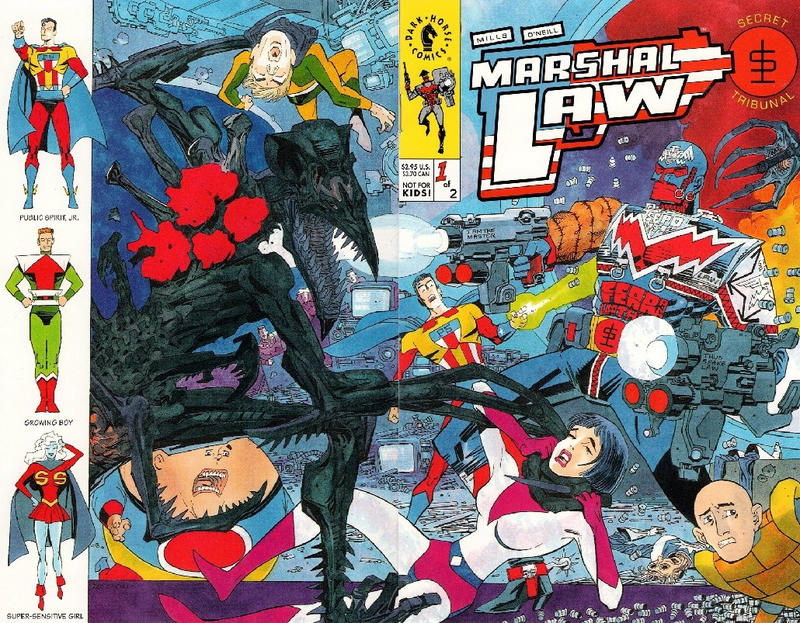
The character eventually moved through several companies, reflecting both the changing independent comics marketplace and the determination of Mills and O’Neill to continue telling stories on their own terms.
These appearances established Marshal Law as an unusual independent comic book property capable of crossing publisher boundaries while maintaining its distinctive personality.
When discussing revisionist superhero comics of the 1980s, the conversation usually turns to Watchmen and The Dark Knight Returns.
Both works challenged readers’ expectations and helped establish a new level of sophistication in mainstream superhero storytelling.
Marshal Law approached the same general territory from a radically different direction.
Where Watchmen examined superheroes through political intrigue, psychological complexity, and moral ambiguity, Marshal Law attacked the genre with savage humor, grotesque violence, and open contempt for superhero mythology.
It was less interested in whether superheroes could exist in the real world than in exposing the absurdities of a society that worshipped them.
The difference was important.
Many comics that followed the darker superhero trend of the late 1980s simply replaced traditional heroism with greater violence and aggression.
Marshal Law understood the irony of that approach.
Its protagonist was the ultimate violent antihero, but his own psychological problems made him part of the very system he was supposedly fighting.
The comic was satirizing not only traditional superheroes but also the increasingly fashionable antiheroes who were replacing them.
That double-edged criticism is one of the reasons the series remains relevant.
Despite its relatively limited number of appearances, Marshal Law occupies an important place in the history of alternative superhero comics.
 It demonstrated how far the superhero concept could be pushed outside the traditional boundaries of mainstream comic book storytelling.
The series also provided another example of the creative freedom available through Epic Comics, an imprint that offered established creators opportunities to experiment with unusual subjects and approaches.
For Mills and O’Neill, Marshal Law became one of their defining collaborations.
The work combined Mills’ confrontational writing with O’Neill’s extraordinary visual imagination in a way that neither conventional superhero comics nor straightforward science fiction could have accommodated.
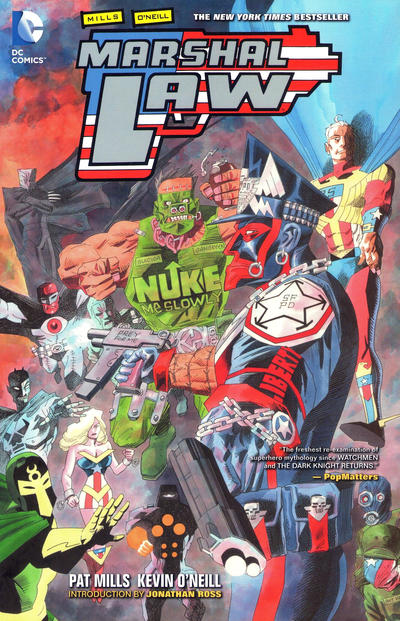
Years later, DC Comics collected much of the character’s history in Marshal Law: The Deluxe Edition, a 480-page hardcover published in 2013. The collection brought together the original Epic Comics miniseries and several subsequent adventures, preserving a substantial portion of the character’s publishing history.
The collection also helped introduce the character to readers who had missed the original comics.
Nearly four decades after his debut, Marshal Law remains a fascinating contradiction.
He is a superhero who hates superheroes, an enforcer of justice who frequently behaves like a monster, and a supposed defender of society who has almost no faith in the society he protects.
That contradiction was always the point.
Mills and O’Neill recognized that superheroes could represent the very best qualities of humanity, but they could also serve as symbols of authority, violence, celebrity, and unquestioned power.
Marshal Law took those darker possibilities and transformed them into a savage parody of the entire genre.
It was frequently excessive, deliberately provocative, and certainly not intended for every reader.
Yet beneath the bloodshed, outrageous costumes, and relentless attacks on superhero mythology was a comic that had something meaningful to say about the relationship between power and responsibility.
 For readers interested in the history of superhero deconstruction, the creative freedom of Epic Comics, or the remarkable partnership of Pat Mills and Kevin O’Neill, Marshal Law deserves to be remembered.
He may not have been the superhero the world wanted.
He certainly wasn’t the superhero the world expected.
But in the strange, violent world of San Futuro, he was the one sent to hunt down everyone else wearing a cape.
About Author
