
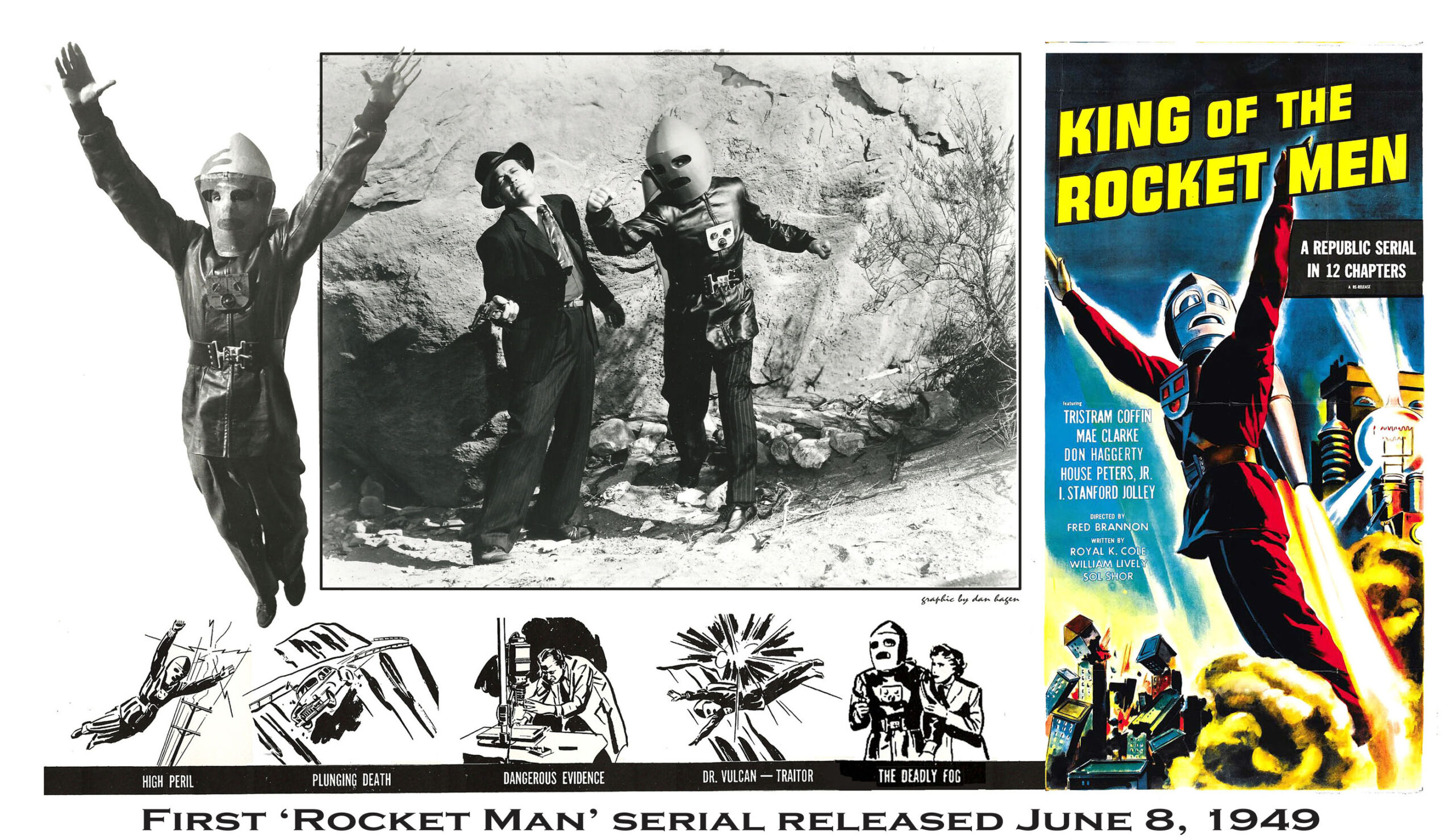
In the 1940s, comic book heroes flew off the page — literally.
Rocket Man was one of the few superheroes with special powers who was original to movie serials — a precursor of Iron Man, in a way.
“Despite the huge volume of film serials, truly interesting ones were relatively few and far between,” noted Larry Ivie’s Monsters and Heroes.
 “The studio heads just didn’t seem to comprehend the fact that pictures about run-of-the-mill cowboys and detectives were not as interesting to audiences as superheroes. Flash Gordon, Superman, Batman, the Green Hornet, the Spider, Tarzan and a few other well-known heroes obviously pulled in bigger audiences than other serials, or the studios wouldn’t have gone to the extra expense of paying out the royalties necessary to produce sequels to them.
“But although most of each studio’s serials were attempts to capture equally large audiences with original characters, it seldom occurred to them to pattern those heroes along equally imaginative lines.”
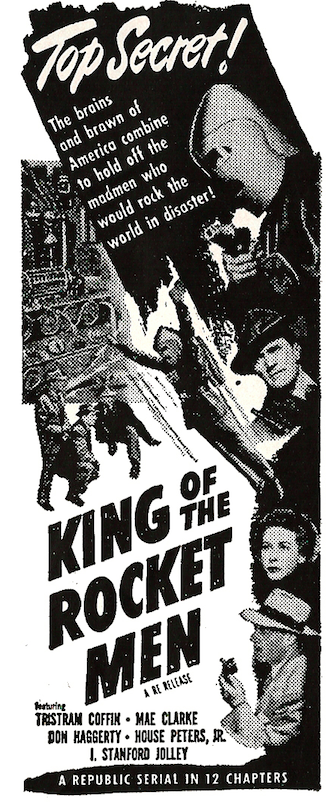
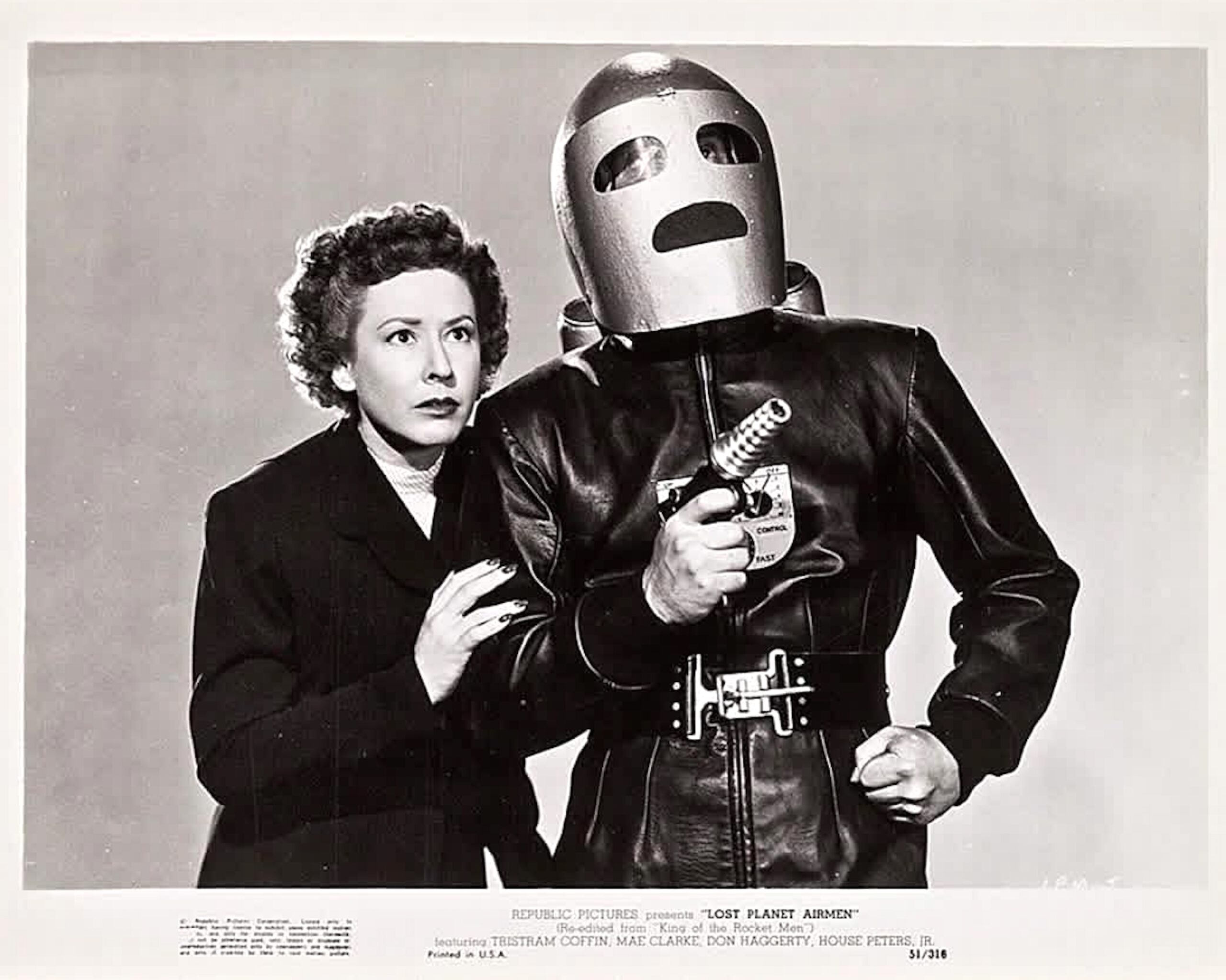
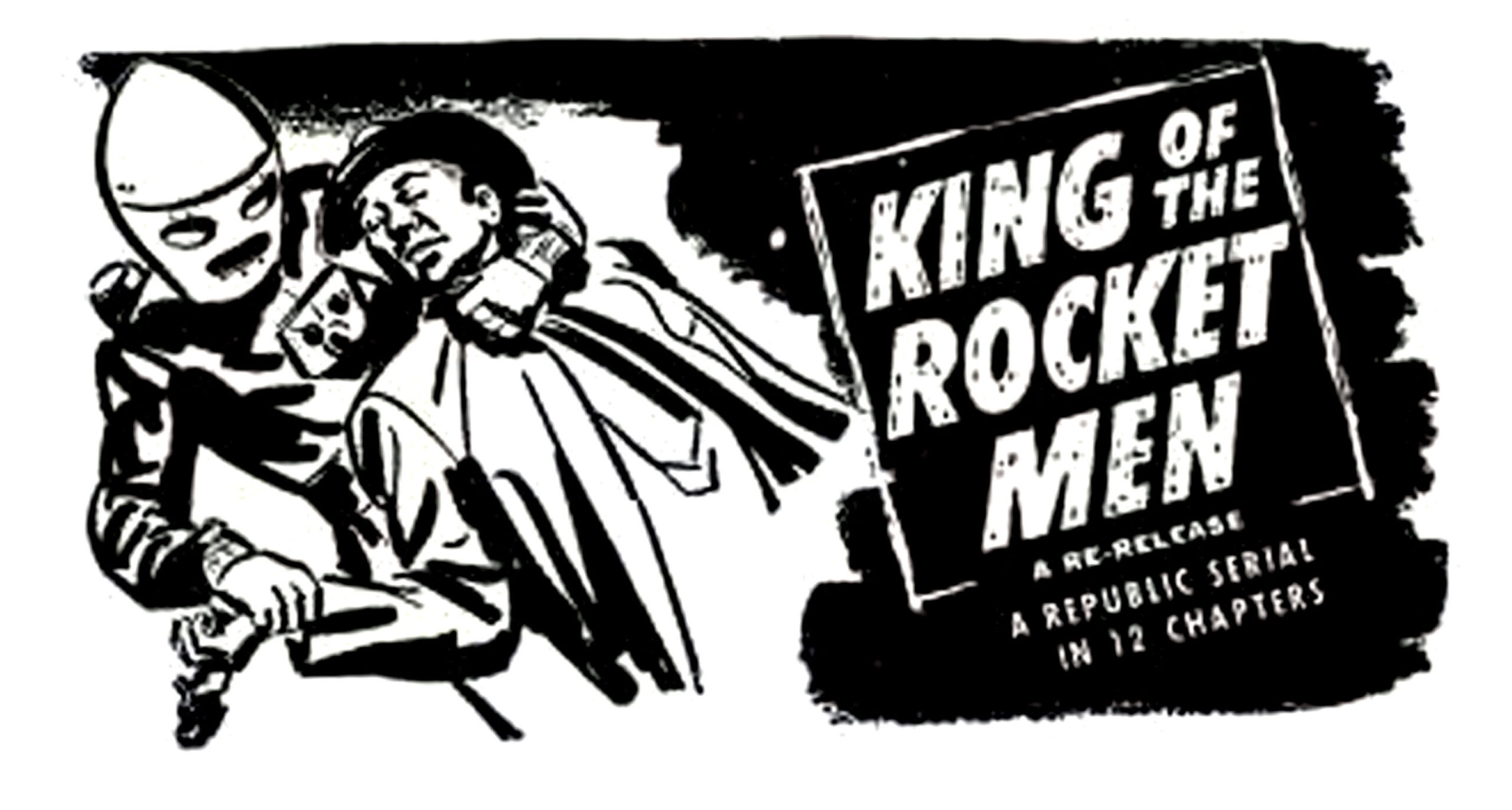
One notable exception was Republic’s 1949 serial King of the Rocket Men, starring Tristram Coffin and Mae Clarke (who’d appeared as Elizabeth in Frankenstein all the way back in 1931 and gotten a grapefruit shoved in his face by Jimmy Cagney that same year in The Public Enemy).
“Coffin, usually cast as a serial villain, and not bothering to shave off his mustache for the short time he would be a hero, was given the role when the first choice — Kirk Alyn. who had played Superman — was still busy completing a previous picture,” Ivie reported.
Coffin played Jeff King, a scientist who adopted the secret identity of Rocket Man when he donned his mask and flying belt.
“Republic Studios repeatedly used this same play on words,” wrote Michael Benson in Vintage Science Fiction Films, 1896-1949. “In King of the Texas Rangers (1941) the hero was Tom King. Steve King was King of the Forest Rangers (1946), while Bert King was King of the Carnival (1955).”
Another flying Rocket Man had appeared in comic books beginning in 1941, but was an unrelated character.
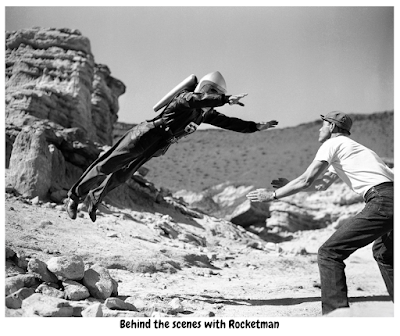
As with Adventures of Captain Marvel in 1941, this serial’s best thrills came from Republic’s flying effects.
“Republic’s product had the gloss and production values of A features,” wrote Jan Alan Henderson.
“This was due in no small part to the wizardry of special effects technicians Howard and Theodore Lydecker. The two brothers worked in close collaboration to conjure effects that were both economical and believable.”
 The serial’s ending is intriguing, and rather strange. For once, the superhero is a little too late, and Manhattan is inundated and destroyed, although nobody finally seems to mind too much.
I always presumed — correctly — that Republic was thriftily reusing some old disaster footage (from the 1933 RKO film Deluge, as it turned out).
Serial historian James Van Hise described the climax: “Rather than place himself close enough to New York to risk capture, (the villain Dr. Vulcan) sets himself up on Fisherman’s Island, 300 miles off the coast, and aims (his decimator ray) at the Amsterdam Fault on the ocean floor, as disturbing this causes earthquakes which in turn produce tidal waves which begin smashing into New York and shattering its skyline.
“When this begins, the mayor actually orders the authorities to begin an ‘orderly evacuation.’ Even in 1949, the city had millions of people that would have taken days to evacuate under the best of conditions, much less when buildings are disintegrating all around them.”
Meanwhile, Rocket Man crashes into the villain’s lair through a window, destroys the decimator ray machine with his own sonic gun and roars off again, leaving Dr. Vulcan to be blown to bits by bombers.
“This was Republic’s really last noteworthy serial,” noted serial historian Alan G. Barbour. “Stock from this film was used in three subsequent serial adventures: Flying Disc Man from Mars (Republic 1951), Radar Men from the Moon (Republic 1952) and Zombies of the Stratosphere (Republic 1952).”
And that’s how Jeff King’s superhero identity evolved into “Commando Cody.” The character also obviously inspired The Rocketeer.
Matter-of-factly, this serial presents science not as a discipline of international free inquiry and shared knowledge, but as a precarious pursuit that is and should properly be under the virtually totalitarian control of the U.S. government.
The ineluctable implications of the atom bomb detonations four years before had gotten everybody’s attention.
“While past serial heroes tended to be policemen, vigilantes or detectives, Jeff King, alias Rocket Man, was a scientist and a member of the inner circle of Science Associates,” Van Hise noted.
“Rocket Man was a new breed of hero. The scientific hero. In the wake of the development of the atomic bomb, science fiction didn’t seem quite so fantastic, and the studios were more willing to incorporate such ideas into their films on a more regular basis.”
About Author
