 Right off the hop, which is of course a rather tongue-in-cheek thing to say in relation to this review, I like games where the key mechanic is jumping pieces.
That probably goes back to my grandfather regularly trouncing me at checkers, and my immediate love affair with George S. Parker’s 1930 release Camelot when I was first introduced to it. I still rate that game as a classic.
In some small way, Rey Alicea’s recent design Jumpers reminds me of Camelot in that players can jump their own pieces or capture an opponent’s piece through forced jumps, and at times combine the two.
Ultimately, every turn you must make a jump of some sort, or you lose.
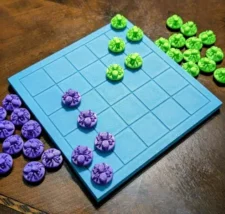
Alicea has attached a theme to this one, with the game being a duel between two colonies of jumping spiders on a diamond-shaped web.
OK, I suppose that makes for cute 3D pieces, but checkers work just fine. Since this is a pure abstract strategy game, the theme is really just window dressing with no impact on play.
The game is played on the intersections of a 6×6 grid, and your pieces can move only by leaping over another piece.
Each player starts with four pieces in their own corner of the grid, which is turned so it looks like a diamond between the opponents.
Players also begin with a reserve of pieces off the board, 12 for whoever moves first and 13 for whoever moves second.
Pieces sit on the points and move only along the lines.
Every turn involves one of two actions. You can capture, and when a capture is available, you must take it. You leap over an adjacent opponent’s piece onto the empty point beyond, removing the jumped piece from the game. You then keep jumping as long as additional captures are available.
If no capture is available, you hop instead. You leap over one of your own pieces, chain additional jumps if you like, and then bring a new piece from your reserve onto the board next to where you landed.
You win when your opponent starts a turn with no legal move, meaning there is nothing to capture and no way to jump and bring in a new piece.
A lone piece is a terrible thing in Jumpers, as it is extremely limited in what it can accomplish.
In some respects, this is a game where you do not exactly win so much as your opponent loses. They get pieces isolated and lose, or they run out of reserves and lose. Still, you deserve some credit for forcing them into that situation.
Using the spider theme, designer Rey Alicea explained the strategy on BoardGameGeek:
“The skill lies in balancing aggression with cohesion. Pushing forward to hunt the other colony stretches your own spiders thin, and a careless leap can leave one exposed to capture or cut off from the group. Strong players keep their spiders linked in chains that can always leap onward, spend reserve spiders where they strengthen those chains, and look for the capture that doesn’t just remove an enemy but severs the last link holding their opponent’s colony together.”
As Trevor and I played Jumpers, I was immediately and happily impressed.
Trevor was initially cooler toward the game, but over several plays, as we slowed down our approaches and worked more on maintaining balance, his appreciation grew.
I still like it more than he does, but that probably goes back to my earlier experiences with jumping games.
Still, this is a game you can play on a checkerboard using checker pieces, with the rules available free online.
Jumpers is a little abstract strategy gem that we highly recommend.
About Author
Calvin Daniels is a Saskatchewan-born, self-taught journalist. He is currently Editor of Yorkton This Week, with 35-years in the newspaper business.

JUMPERS
That probably goes back to my grandfather regularly trouncing me at checkers, and my immediate love affair with George S. Parker’s 1930 release Camelot when I was first introduced to it. I still rate that game as a classic.
In some small way, Rey Alicea’s recent design Jumpers reminds me of Camelot in that players can jump their own pieces or capture an opponent’s piece through forced jumps, and at times combine the two.
Ultimately, every turn you must make a jump of some sort, or you lose.
Alicea has attached a theme to this one, with the game being a duel between two colonies of jumping spiders on a diamond-shaped web.
OK, I suppose that makes for cute 3D pieces, but checkers work just fine. Since this is a pure abstract strategy game, the theme is really just window dressing with no impact on play.
The game is played on the intersections of a 6×6 grid, and your pieces can move only by leaping over another piece.
Each player starts with four pieces in their own corner of the grid, which is turned so it looks like a diamond between the opponents.
Players also begin with a reserve of pieces off the board, 12 for whoever moves first and 13 for whoever moves second.
Pieces sit on the points and move only along the lines.
Every turn involves one of two actions. You can capture, and when a capture is available, you must take it. You leap over an adjacent opponent’s piece onto the empty point beyond, removing the jumped piece from the game. You then keep jumping as long as additional captures are available.
If no capture is available, you hop instead. You leap over one of your own pieces, chain additional jumps if you like, and then bring a new piece from your reserve onto the board next to where you landed.
You win when your opponent starts a turn with no legal move, meaning there is nothing to capture and no way to jump and bring in a new piece.
A lone piece is a terrible thing in Jumpers, as it is extremely limited in what it can accomplish.
In some respects, this is a game where you do not exactly win so much as your opponent loses. They get pieces isolated and lose, or they run out of reserves and lose. Still, you deserve some credit for forcing them into that situation.
Using the spider theme, designer Rey Alicea explained the strategy on BoardGameGeek:
“The skill lies in balancing aggression with cohesion. Pushing forward to hunt the other colony stretches your own spiders thin, and a careless leap can leave one exposed to capture or cut off from the group. Strong players keep their spiders linked in chains that can always leap onward, spend reserve spiders where they strengthen those chains, and look for the capture that doesn’t just remove an enemy but severs the last link holding their opponent’s colony together.”
As Trevor and I played Jumpers, I was immediately and happily impressed.
Trevor was initially cooler toward the game, but over several plays, as we slowed down our approaches and worked more on maintaining balance, his appreciation grew.
I still like it more than he does, but that probably goes back to my earlier experiences with jumping games.
Still, this is a game you can play on a checkerboard using checker pieces, with the rules available free online.
Jumpers is a little abstract strategy gem that we highly recommend.
About Author
Calvin Daniels
Calvin Daniels is a Saskatchewan-born, self-taught journalist. He is currently Editor of Yorkton This Week, with 35-years in the newspaper business.
See author's posts