
 During the 1980s, Neal Adams’ Continuity Comics built one of the more distinctive independent superhero universes on the stands. The company’s books were immediately recognizable for their detailed artwork, dramatic storytelling, larger-than-life characters, and an interconnected universe that frequently brought its heroes together.
Among the most memorable of those characters was Samuree, a teenage martial artist whose adventures combined superhero action, mystery, and some of the most eye-catching artwork Continuity produced.
Samuree was Darryl Sheppard, a 16-year-old martial-arts prodigy trained by the mysterious Momma Sensei. Although Darryl possessed extraordinary fighting skills, there was considerably more to her story than simply being a talented martial artist.
She knew surprisingly little about her own background, and much of the early series was built around questions concerning who she really was, where she came from, and why the world around her sometimes seemed strangely unfamiliar.
That mystery separated Samuree from a straightforward martial-arts adventure. Her story was as much about discovering her identity as it was about defeating villains.
 It also placed her firmly inside the larger Continuity universe.
Samuree quickly became associated with Megalith, Armor, and Silver Streak, members of the Revengers. Her first issue brought those characters directly into her adventure, immediately establishing that Samuree was part of the shared world Neal Adams and his collaborators were constructing.
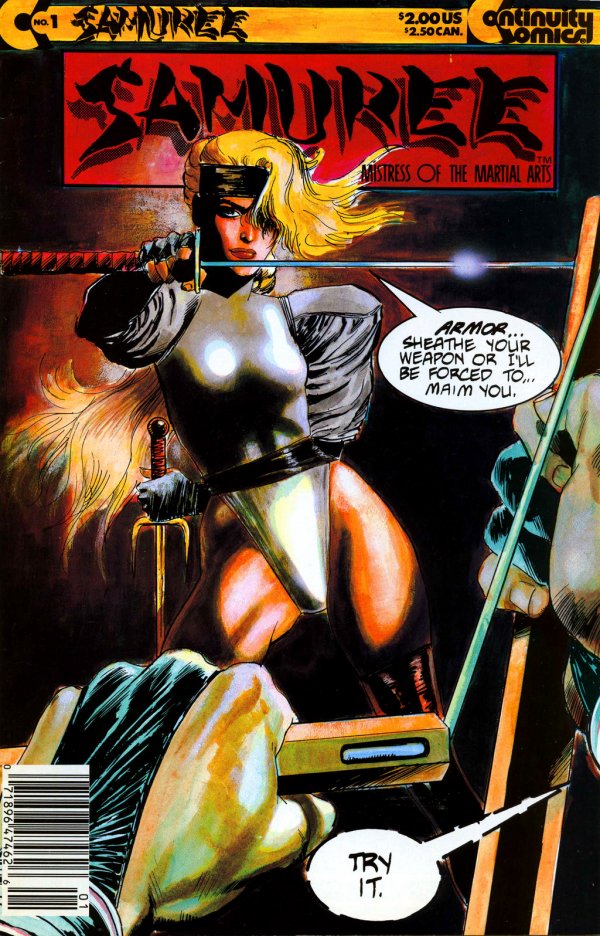
Samuree #1 was published by Continuity Comics in May 1987.
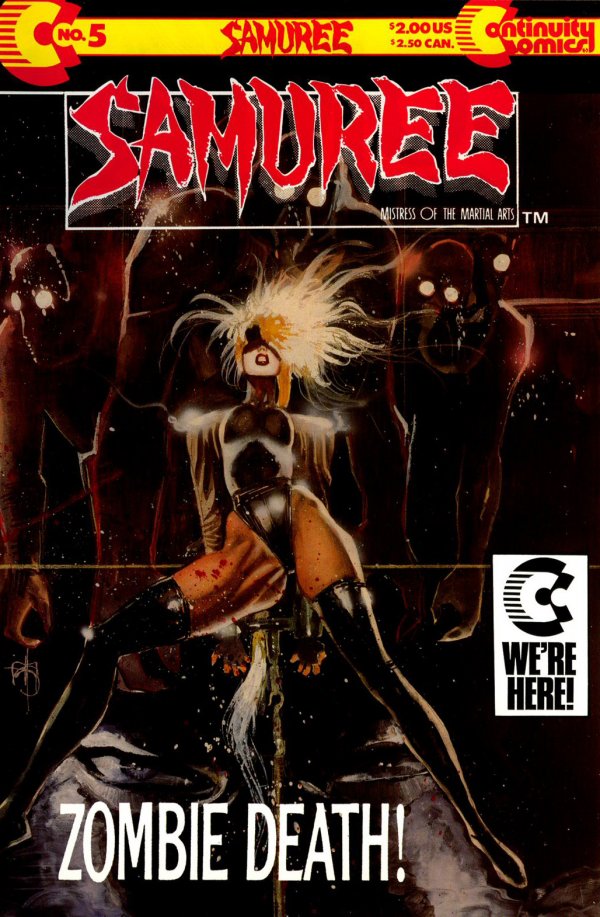
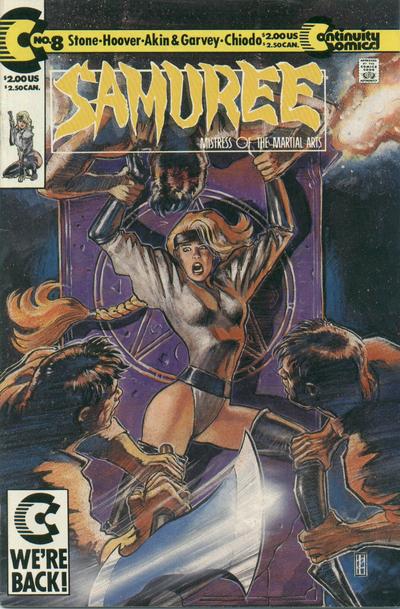
The 36-page comic featured a 26-page story, “Hijack Goes Awry,” scripted by Neal Adams with pencils by Mark Beachum, inks by Ian Akin and Brian Garvey, colors by Elizabeth Safian, and lettering by Ken Bruzenak. Beachum also provided the striking cover artwork.
Beachum’s involvement became an important part of Samuree’s visual identity.
His highly rendered figure work fit comfortably within the distinctive Continuity aesthetic established by Adams while still having a look of its own. Samuree’s costumes, poses, and martial-arts movements made the character instantly recognizable on the comic rack.
The original series carried the subtitle “Mistress of the Martial Arts,” an accurate description of a heroine who generally relied on training, speed, agility, and combat skill rather than the conventional superpowers possessed by many of her Continuity counterparts.
Continuity Comics had a recognizable house style.
Adams’ influence could be found throughout the line, even when he was not personally drawing an entire issue. Artists associated with the company included Mark Beachum, Dave Hoover, Michael Netzer, Tom Grindberg, Bart Sears, Richard Bennett, Esteban Maroto, and others. Adams frequently contributed plots, layouts, inks, corrections, or other artistic touches to the books.
 Samuree fit perfectly into that environment.
The stories combined martial arts with superheroes, crime, science fiction, and increasingly fantastic elements. Characters from one Continuity title could appear in another without lengthy explanations. It felt like a universe rather than a collection of unrelated comics.
The books could also be considerably more intense than many mainstream superhero titles of the period. Violence was often harder-edged, storytelling was visually aggressive, and Continuity was willing to push the presentation of its heroes beyond the relatively conservative style still common at Marvel and DC.
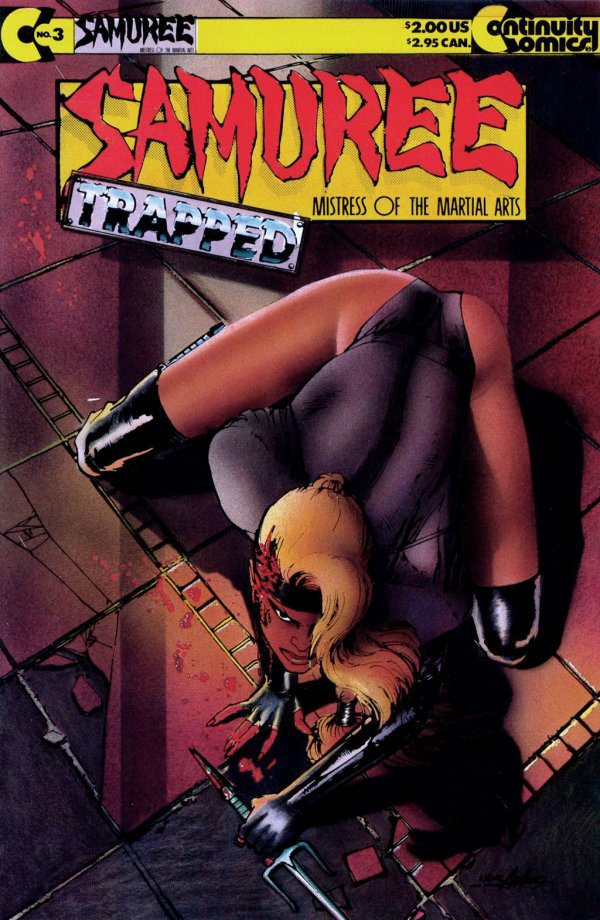
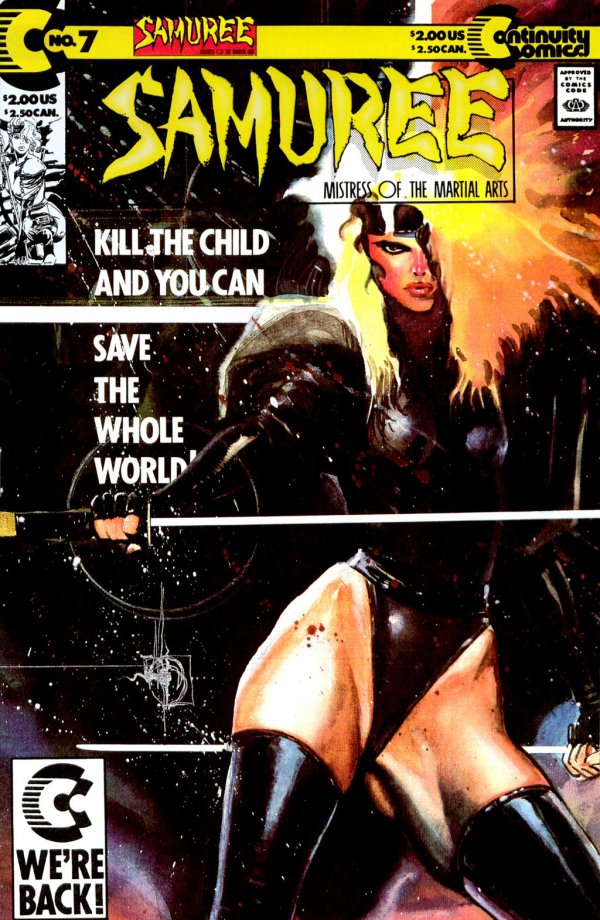
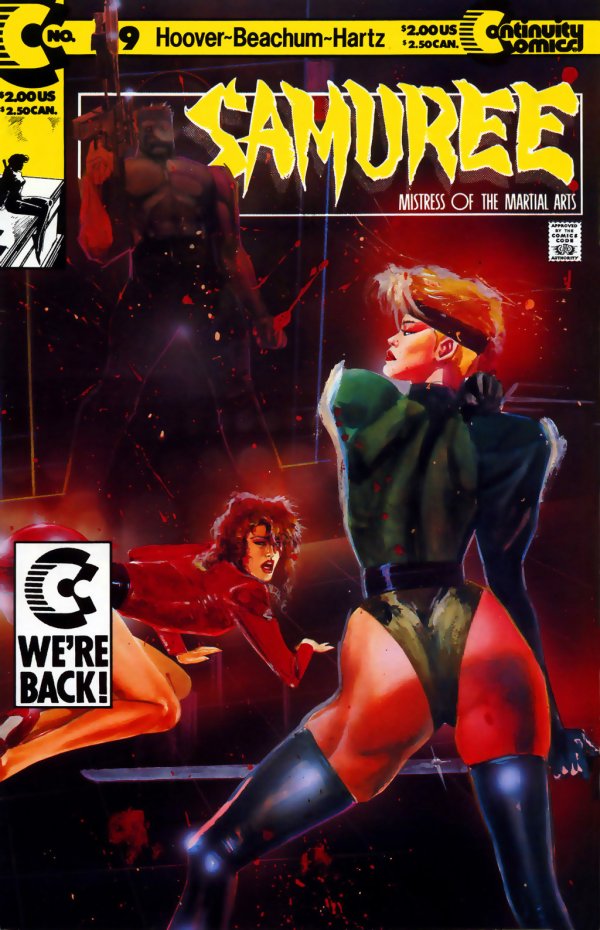
Samuree herself became one of the most visually provocative characters in the line, particularly through Beachum’s cover work.
The first Samuree series ultimately ran for nine issues between 1987 and 1991.
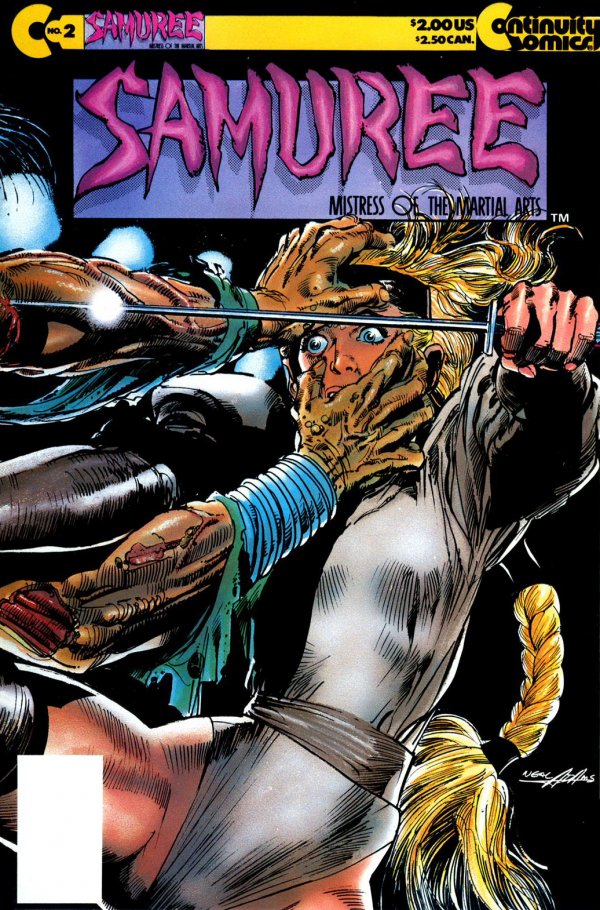
Publication was sometimes irregular. The first issue appeared in May 1987, followed by #2 in August. Issue #3 did not arrive until May 1988, and subsequent issues appeared intermittently through January 1991.
Different creators contributed as the series progressed.
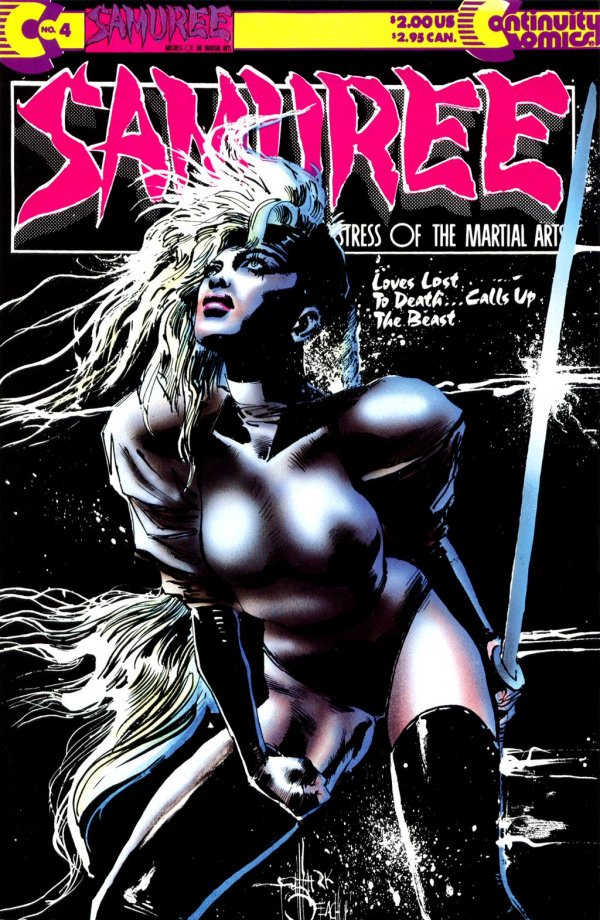 By Samuree #9, Peter Stone was scripting the series, with Dave Hoover providing pencils, Mark Beachum and Brian Garvey handling inks, Jon Hartz coloring, and Ken Bruzenak lettering. Beachum supplied the painted cover.
Stone became one of Continuity’s principal writers and worked extensively from concepts and plots created within Adams’ studio.
The result was a comic that could change artists while maintaining a recognizable Continuity identity.
Samuree returned during Continuity’s early-1990s revival.
A new Samuree #1 appeared in May 1993, beginning a second series. This version was tied directly into Continuity’s ambitious Rise of Magic crossover.
The opening story, “The Demon 500,” was scripted by Peter Stone and featured Samuree alongside Megalith, Armor, Silver Streak, and Ariman. Rudy Nebres was among the artists involved, while the cover combined work by Mark Beachum and Alex Niño.
Only four issues of this incarnation were published, running from May 1993 through January 1994. All four were connected to Rise of Magic.
 The timing proved unfortunate.
Continuity Comics was entering the final stage of its original publishing life. The company ceased regular publication in 1994, leaving Rise of Magic and several other storylines caught in the collapse.
That wasn’t quite the end.
When Continuity stopped publishing, several of its properties eventually appeared elsewhere. Samuree was among the characters revived through Windjammer, the creator-owned imprint associated with Acclaim/Valiant.
A new Samuree limited series appeared in 1995, ultimately producing three issues from October through December.
It was a brief second life for the character, but it demonstrated that Samuree had enough recognition to survive beyond the company where she had originated.
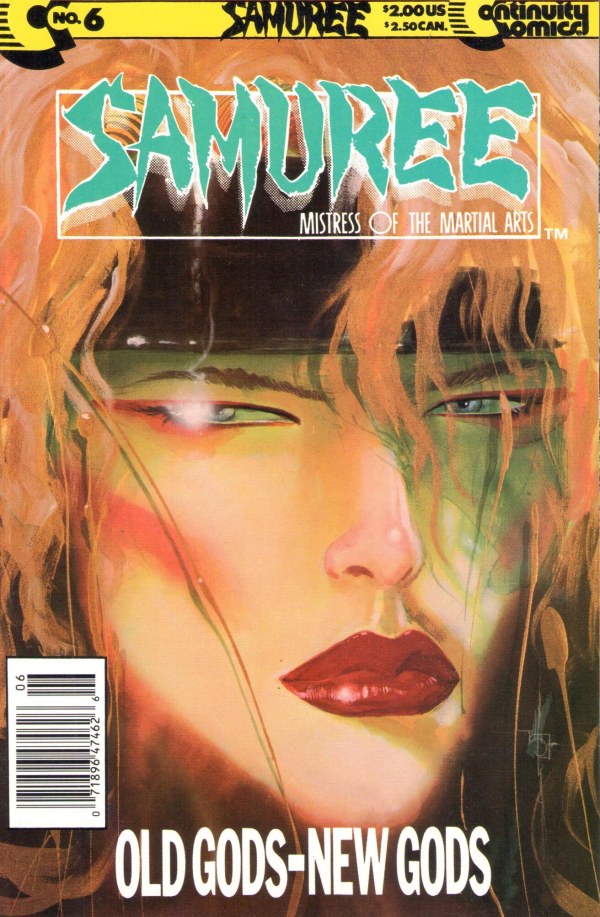 Any discussion of Samuree has to give considerable credit to Mark Beachum.
Continuity had several memorable female characters, including Ms. Mystic and Valeria the She-Bat, but Beachum gave Samuree a particularly recognizable visual identity.
His illustrations were heavily rendered, dynamic, and frequently exaggerated. He could make a static cover feel as though the character were moving directly toward the reader.
That style made Samuree ideally suited for Continuity.
The company placed enormous importance on presentation. Neal Adams understood better than most publishers that a dramatic image could sell a comic before the reader knew anything about the character inside.
Samuree benefited enormously from that philosophy.
 Continuity Comics lasted only about a decade as a major comic-book publisher, but the company produced an unusually interconnected collection of characters.
Megalith, Armor, Ms. Mystic, CyberRad, Toyboy, the Hybrids, Zero Patrol, Earth 4, Valeria, and Samuree all existed in a world that frequently crossed from one title into another.
There were certainly problems. Continuity became notorious among retailers for erratic publishing schedules, and the company’s aggressive participation in the gimmick-cover and speculation era ultimately became part of its reputation.
 But looking back at the books decades later, it is easier to appreciate what Neal Adams and the Continuity creators were attempting.
They were building their own superhero universe outside Marvel and DC.
And Samuree was one of its stars.
Samuree is unmistakably a product of its era, but that is also a large part of its charm.
It has martial arts, mysterious origins, superhero crossovers, impossibly dramatic anatomy, elaborate painted covers, strange villains, and the visual excess that helped define independent superhero comics of the late 1980s and early 1990s.
More importantly, there was genuine ambition behind it.
 Samuree wasn’t simply designed as a female martial-arts hero dropped into unrelated adventures. Her mysterious background gave the series an ongoing question, while her connections to Megalith, Armor, Silver Streak, and the rest of the Continuity universe continually expanded the scope of her story.
For readers interested in the independent superhero boom of the 1980s, Neal Adams’ post-DC career, or one of the industry’s more fascinating lost universes, Samuree is well worth rediscovering.
She was the Mistress of the Martial Arts, and for a brief period, she was also one of the defining heroes of Continuity Comics.
About Author
