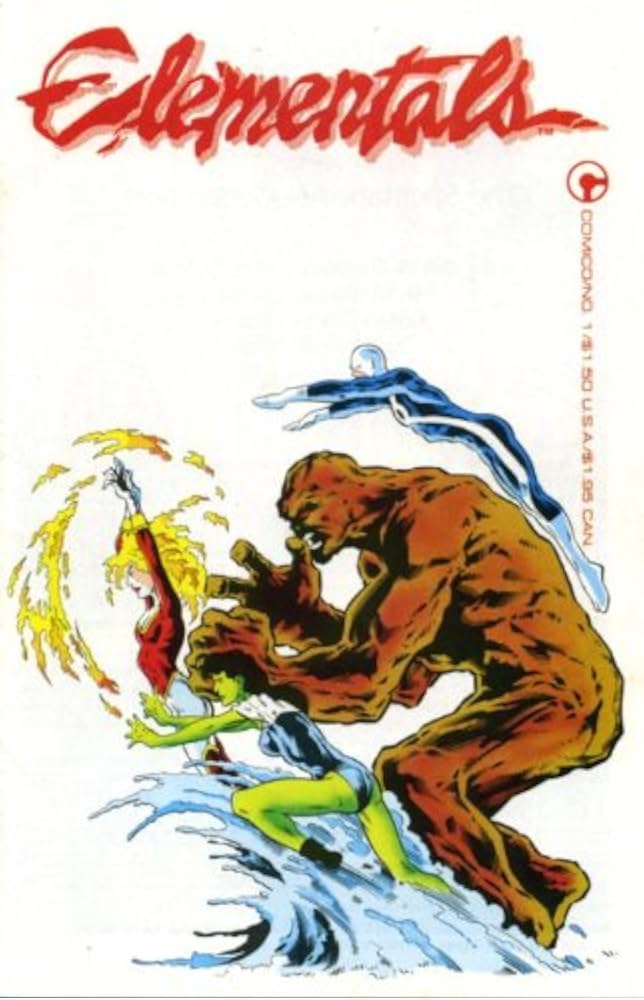
 Before Fables, before Bill Willingham became one of the best-known fantasy writers in comics, there was The Elementals.
Created by Willingham in the early 1980s, The Elementals was one of the titles that helped define the growing independent comics movement of the era. It took familiar superhero concepts and pushed them in darker, stranger, and often more mature directions.
The team made its first appearance in Justice Machine Annual #1, published by Texas Comics in 1983. When Texas Comics folded, the characters moved to Comico, which launched Elementals as an ongoing series.
Comico’s first Elementals series ran for 29 issues from 1984 through 1988, followed by a second volume, specials, spin-offs and later stories that kept the characters in print into the 1990s.
But the most interesting thing about the Elementals was never simply that they controlled earth, air, fire and water.
It was how they got those powers.
The basic premise of The Elementals immediately separated the series from most superhero comics.
To become an Elemental, you first had to die.
Four ordinary people are killed by one of the traditional elements. Rather than remaining dead, each is chosen by an elemental force, resurrected and given extraordinary powers connected to the element that killed them.
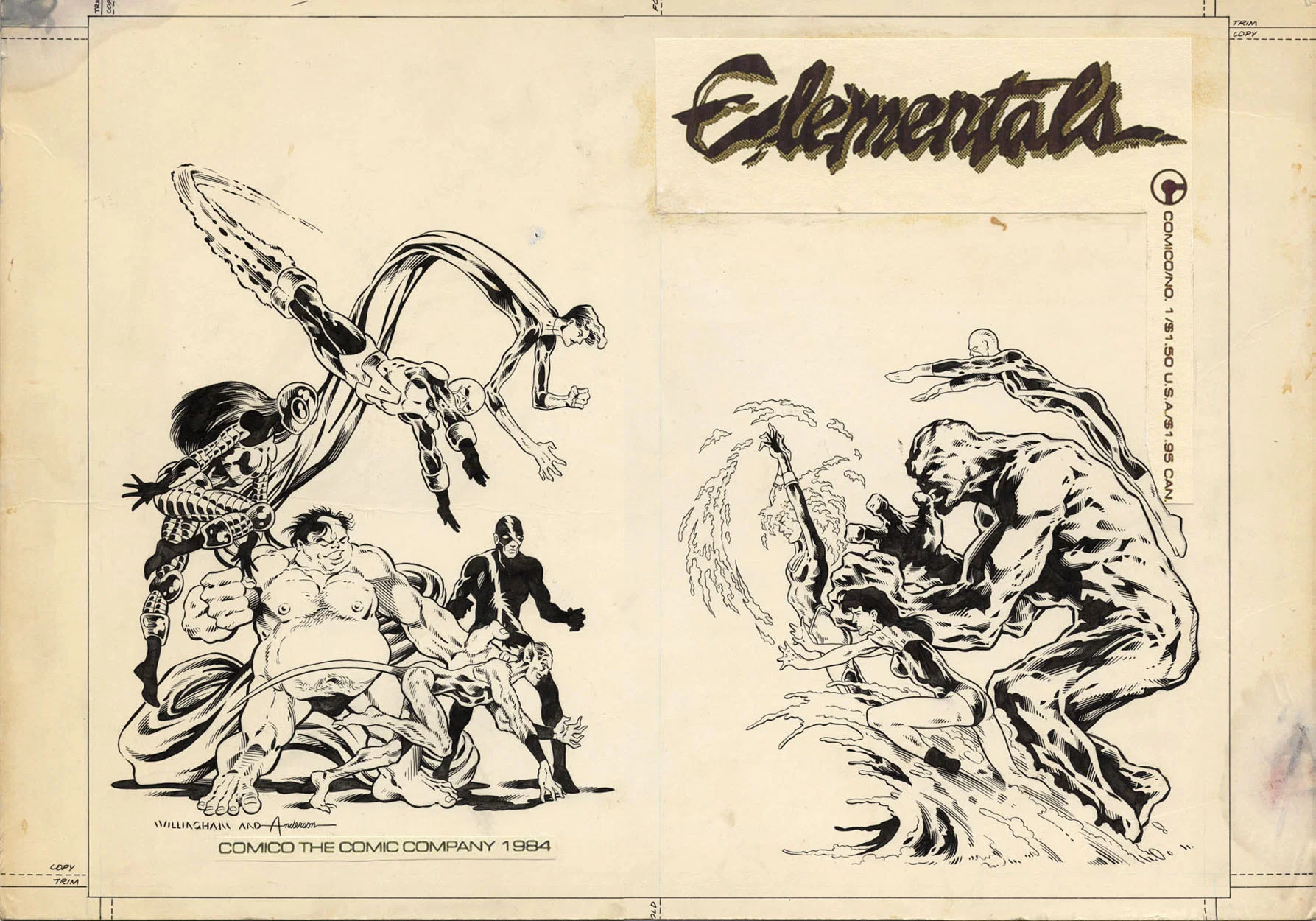
The result is a team consisting of:
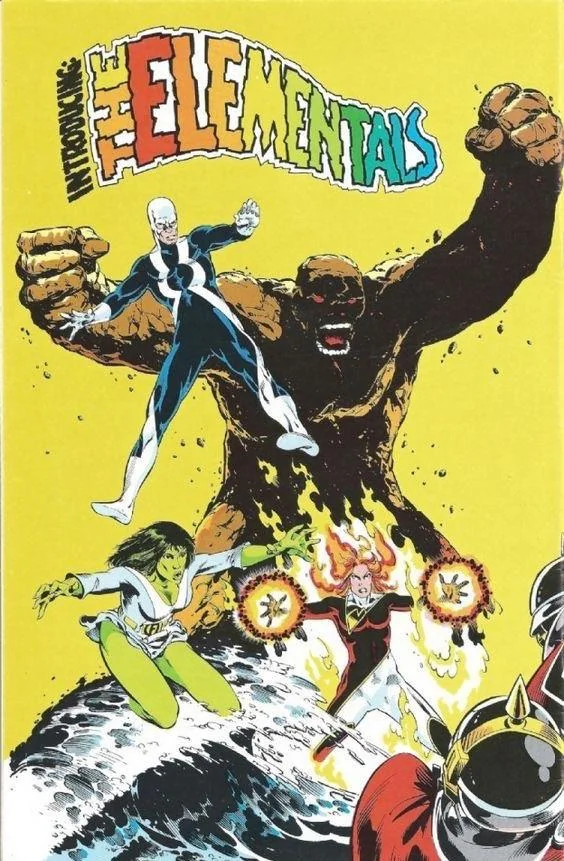
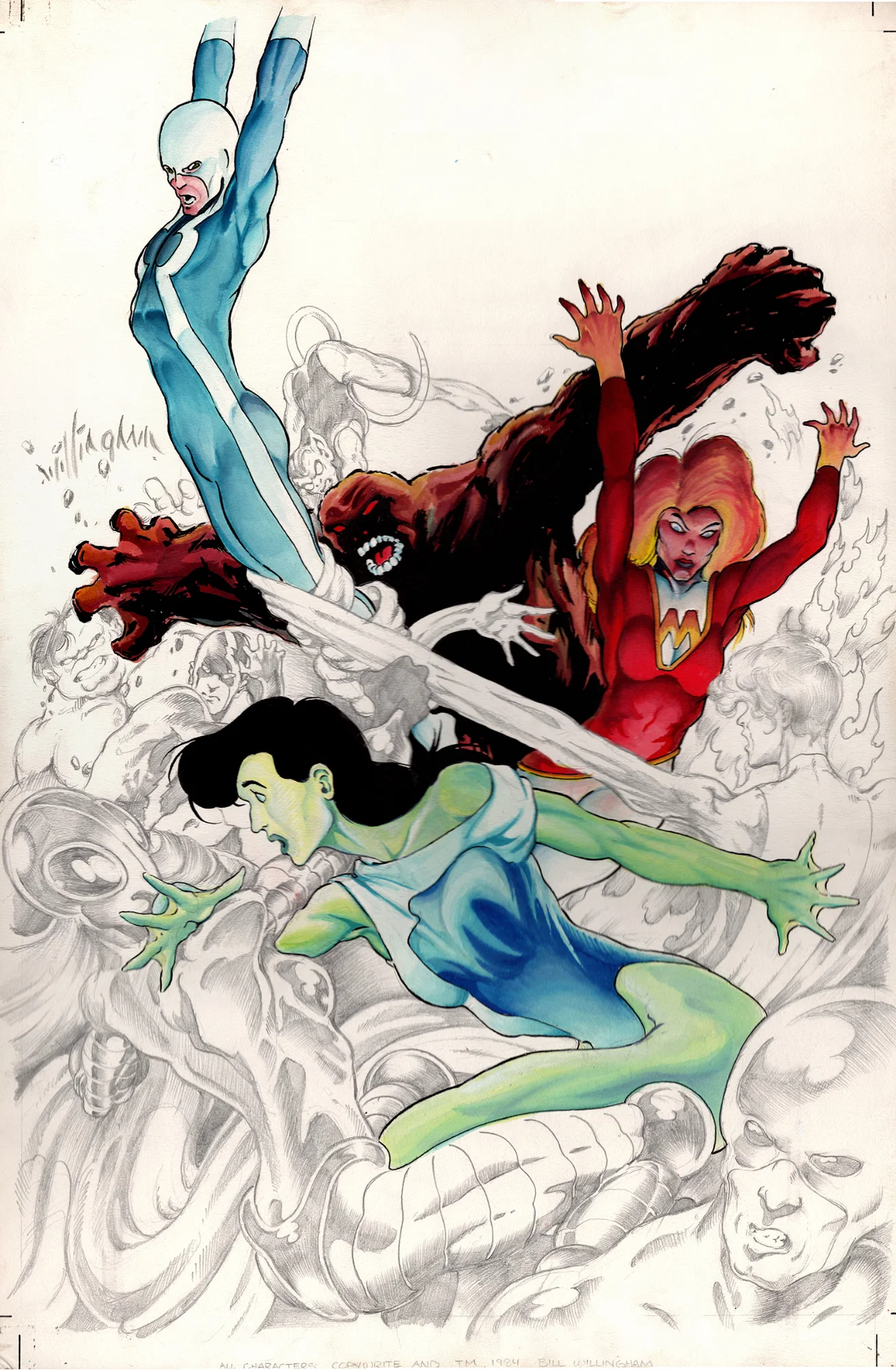
Morningstar, Jeanette Crane, a Los Angeles homicide detective killed by fire. She returns with control over flame and immunity to it.
Vortex, Jeff Murphy, a Coast Guard pilot and Vietnam veteran who dies from asphyxiation after a helicopter crash. He returns with powers over air, including flight and the ability to generate powerful winds.
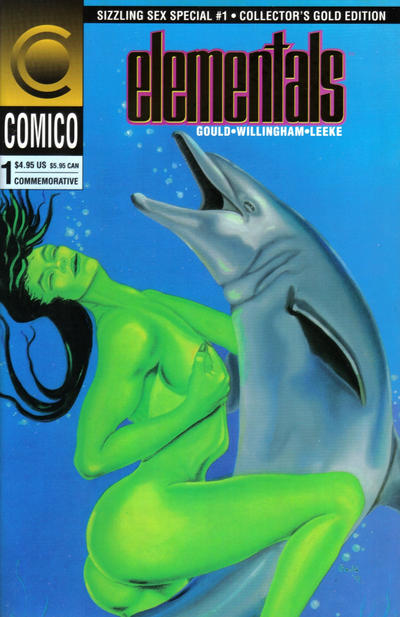
Fathom, Becky Golden, a young woman who drowns after falling from a boat. She returns with control over water, green skin, webbed fingers, and the ability to transform her body into living water.
Monolith, Tommy Czuchra, a brilliant teenager crushed in a landslide. He returns with the ability to transform into an enormous, tremendously powerful stone form.
Superheroes had died and returned before, but in The Elementals, death was not an occasional plot twist.
Death was the origin.
These weren’t people who narrowly escaped tragedy and decided to become heroes.
 They had already crossed the line.
They were dead people walking around among the living.
That idea gave Willingham’s series an atmosphere very different from the mainstream superhero books being published alongside it.
The Elementals’ creation is connected to Lord Saker, an ancient sorcerer whose attempts to manipulate supernatural forces disrupt the natural order.
Saker creates the Shadowspear, a device intended to harness supernatural power. Instead, his actions unleash forces he cannot fully control.
The elemental spirits respond by selecting their four champions.
That places the Elementals in a conflict fara larger than stopping robberies or costumed criminals.
They are representatives of nature itself.
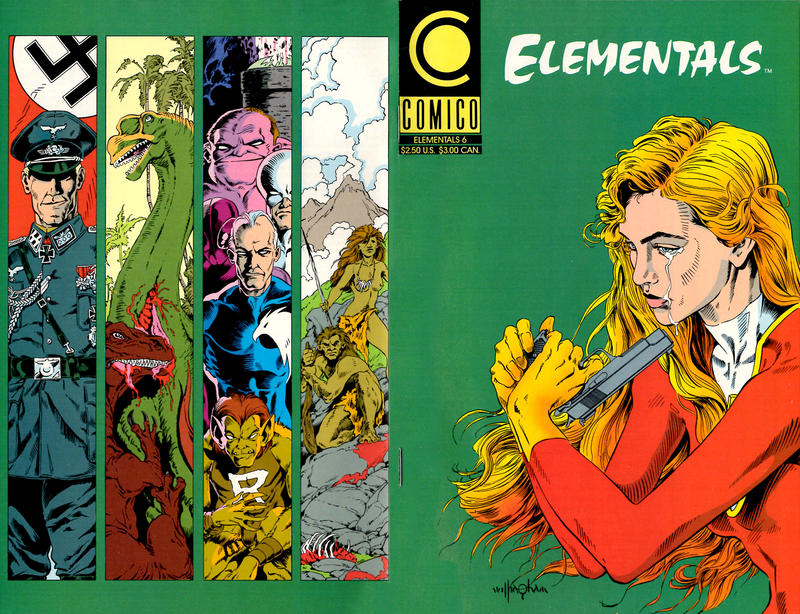
Their enemies include Saker and the Destroyers, a group consisting of Shapeshifter, Annihilator, Chrysalis, Behemoth, Ratman, and Electrocutioner.
The Destroyers were not entirely new creations when the comic appeared. Earlier versions of the characters, along with an early version of Saker called Doctor Apocalypse, had appeared in superhero role-playing material Willingham wrote for Villains and Vigilantes.
Those gaming roots make sense.
Willingham approached the Elementals as though he were building an entire world rather than simply creating four superheroes.
There were rules.
There was history.
Supernatural forces were operating behind the visible universe.
And actions had consequences.
At first glance, the Elementals fit a very familiar superhero pattern.
 Four characters.
Four different powers.
Four distinct personalities.
A headquarters.
Enemies.
Team battles.
But Willingham continually complicated the formula.
The Elementals weren’t always comfortable being heroes.
They weren’t always comfortable being alive.
Their relationships changed.
Their personalities developed.
People made bad decisions.
Characters could become disillusioned, angry, or corrupted.
Even membership in the team was not necessarily permanent.
Monolith eventually became particularly important in this regard. Tommy Czuchra came to sympathize with Saker’s belief that supernatural beings should rule over ordinary humanity, ultimately leaving the Elementals and becoming associated with Saker.
That kind of development made Elementals feel less like a traditional superhero property, where everything returned to normal at the end of an issue.
Things changed.
And sometimes they stayed changed.
 Ironically, for a comic about heroes who had already returned from the dead, The Elementals treated death seriously.
The four central characters possessed extraordinary regenerative abilities and effectively stopped aging, but immortality wasn’t necessarily portrayed as a gift.
Being unable to move naturally through life changes the way a person views humanity.
Friends age.
Relationships change.
The world moves forward.
The Elementals remain.
That allowed Willingham to explore ideas that superhero comics often avoided.
What happens to someone psychologically when death is no longer the ultimate threat?
What happens when a person begins to see ordinary human life as temporary?
And how far removed from humanity can a superhero become before he or she stops thinking like a human being at all?
Those questions were often sitting underneath the monsters, explosions, and superhero fights.
The history of The Elementals is also tied closely to the history of Comico.
During the 1980s, Comico became one of the most visible alternatives to Marvel and DC, publishing titles including Mage, Grendel, The Rocketeer, Justice Machine and licensed properties such as Robotech.
The Elementals became one of the company’s signature original superhero books.
The first Comico series began with Elementals #1 in 1984. The opening storyline, The Natural Order, established the characters, their world, and their conflict with the Destroyers and Saker. The original series eventually reached 29 issues.
A second Elementals series launched in 1989 and ultimately ran 26 issues. Numerous specials and spin-offs followed, including solo projects featuring Fathom, Monolith and Vortex, as well as a Morningstar Special.
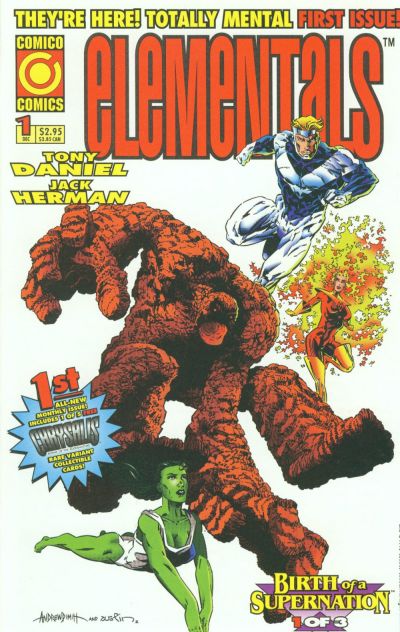 There was even a Justice Machine Featuring the Elementals limited series, bringing the characters back together with the property in which they had originally debuted.
Of the four original Elementals, Fathom became perhaps the most visually distinctive.
Rebecca “Becky” Golden returned from drowning with bright green skin and powers over water.
She could manipulate water, fire concentrated streams, and eventually transform herself into living water.
Fathom received her own three-issue limited series in 1987 and another series in 1992.
But much of her appeal came from the contrast between her personality and her condition.
Becky had been a young woman with an ordinary future ahead of her.
Now she couldn’t even pass unnoticed among ordinary people.
She had been given enormous power, but there was no way for her to simply return to the life she once had.
That mixture of power and loss was central to The Elementals.
Even after Saker was confronted, the consequences of his actions did not simply disappear.
The Shadowspear itself became a continuing threat, developing into a massive supernatural storm that circled the planet.
Where it travelled, bizarre things could happen.
Animals could become monsters.
Corpses could be transformed.
The supernatural could intrude violently upon everyday reality.
This allowed the series to move easily between superheroics, fantasy and horror.
One issue might feel like a traditional superhero battle.
Another could become a monster story.
Another could explore mythology.
 Another could become something considerably darker.
That flexibility was one of the book’s strengths.
As the series continued, its scale became increasingly ambitious.
The later Oblivion War storyline expanded the Elementals’ world dramatically, moving into mythology and larger supernatural conflicts.
By that point, the series was no longer simply about four people fighting villains associated with the elements.
Willingham had developed an entire supernatural cosmology around them.
An issue from the storyline could send Monolith to Asgard and put him face-to-face with Thor.
That willingness to expand the mythology was typical of Elementals.
The concept never needed to remain small.
Today, Bill Willingham is inevitably associated with Fables, the long-running Vertigo series that reimagined characters from folklore and fairy tales.
But many of the storytelling interests that would later appear in Fables can already be seen in The Elementals.
Mythology.
Magic operating according to rules.
Immortal beings.
Ordinary people interacting with ancient supernatural forces.
Characters whose morality can change over time.
Large casts whose actions have lasting consequences.
And, perhaps most importantly, the idea that fantastic characters still have to live with the results of their choices.
The Elementals was not Fables before Fables.
It was very much its own creation.
But readers familiar with Willingham’s later work can see an artist and writer already experimenting with concepts he would continue exploring for decades.
For a series that once had multiple ongoing titles and spin-offs, The Elementals has become surprisingly difficult for modern readers to discover.
Willingham addressed the situation directly in 2024, explaining that he no longer owns the property. According to Willingham, he sold The Elementals to Comico when he ended his relationship with the publisher, and the rights ultimately passed to Comico owner Andrew Rev. Willingham also said the original production film for the comics was discarded, making a high-quality restoration considerably more difficult.
Asked whether the original stories might be collected again, Willingham described that possibility as extremely unlikely.
That means readers interested in the series generally have to search for the original issues or older collections.
Comico did publish Elementals: The Natural Order in 1988, collecting the team’s introductory story from Justice Machine Annual #1 together with Elementals #1 through #5.
It is easy to look at independent superhero comics of the 1980s as simply alternatives to Marvel and DC.
The Elementals deserve more credit than that.
Willingham wasn’t merely creating another superhero team.
He was questioning some of the assumptions behind superhero comics.
What if gaining powers required dying?
What if resurrection permanently separated heroes from ordinary humanity?
What if supernatural forces followed their own rules instead of existing simply to provide villains?
What if heroes changed sides?
What if immortality was less of a reward than it appeared?
Those ideas gave The Elementals a personality entirely their own.
The series could be colourful, funny and packed with superhero action.
It could also be violent, strange, philosophical and uncomfortable.
Sometimes all in the same issue.
More than 40 years after their debut, Morningstar, Vortex, Fathom and Monolith remain fascinating examples of what happened when the independent comics explosion of the 1980s allowed creators to take familiar superhero ideas somewhere new.
 They died.
They came back.
And they became The Elementals.
About Author
