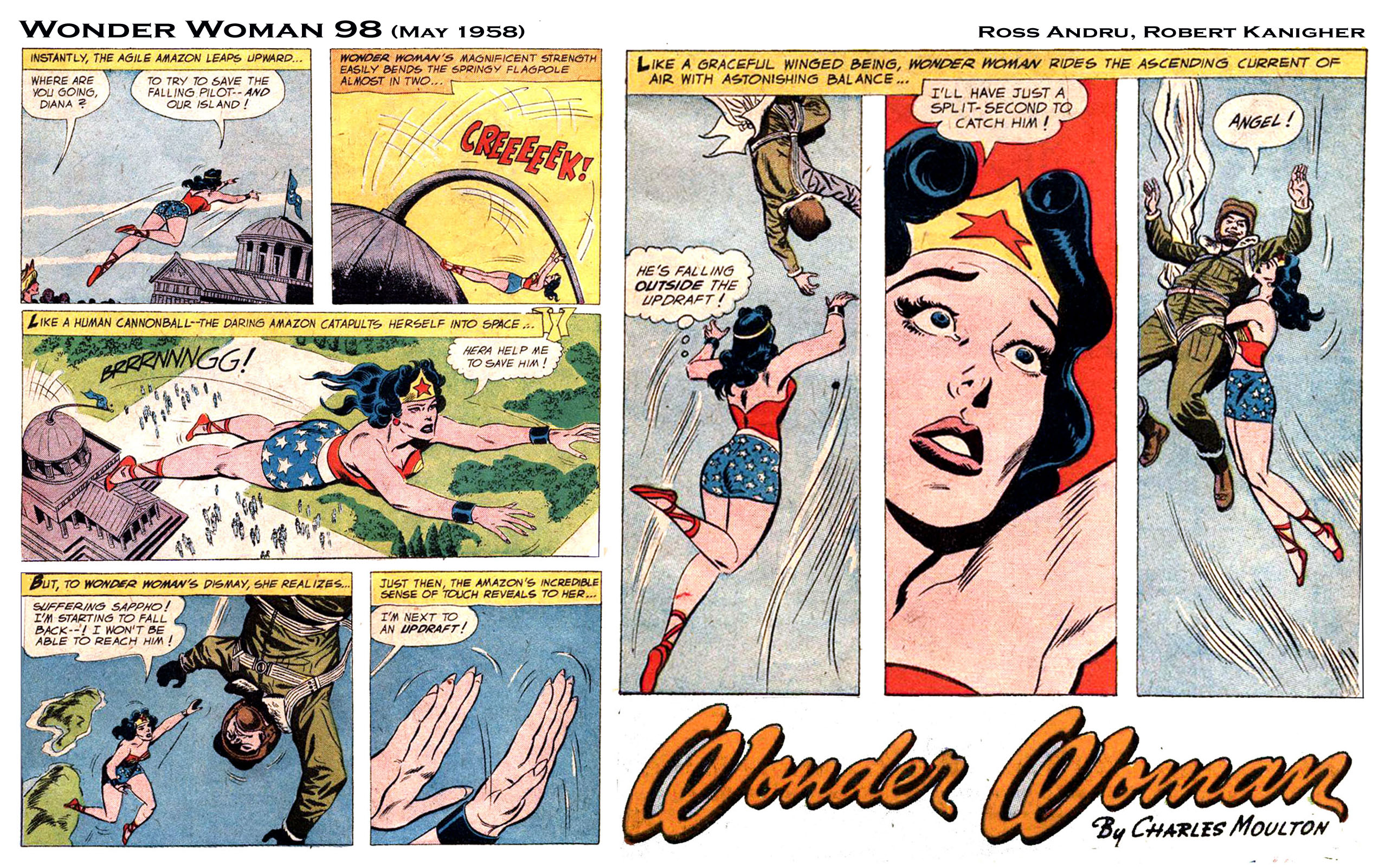
As a kid, while I had no problem with Superman’s unexplained — and frankly inexplicable — power of flight, Wonder Woman’s chancy ability to glide along on updrafts didn’t sit well with me.
The stories made it seem that Diana’s “flight” must be an acquired skill, like surfing. Even at age 5, I couldn’t buy that.
She’d become, as journalist Kevin Phelan put it, “…a superhuman kite.”
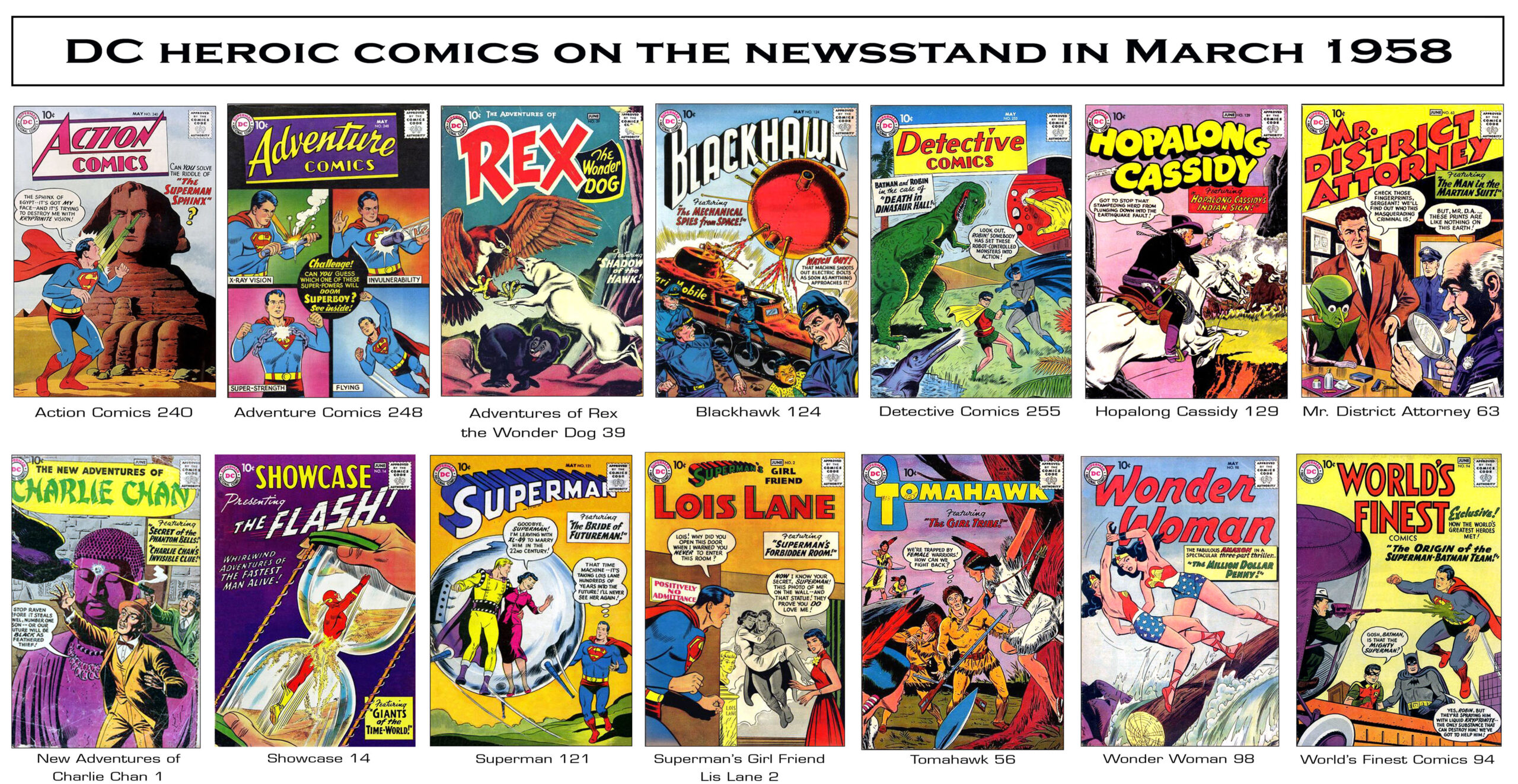
Research revealed that Wonder Woman’s human-glider abilities had nothing to do with her original 1940s’ iteration, but appeared in 1958 when writer Robert Kanigher refurbished her origin for the emerging Silver Age — an era he’d actually kicked off with his Flash revamp in 1956.
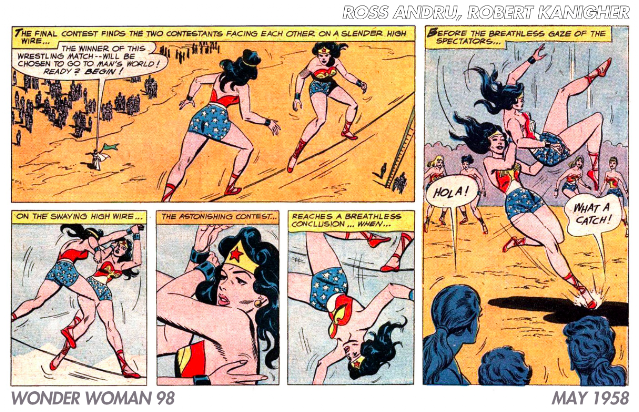
In Wonder Woman 98, artist Ross Andru replaced the Art Nouveau-influenced Harry Peter after his long run on the character (from 1941 until his death on Jan. 2, 1958, at age 78).
Diana’s mother Queen Hippolyta is now blonde, not brunette.
To compete for the right to fight injustice in man’s world (a mission Pallas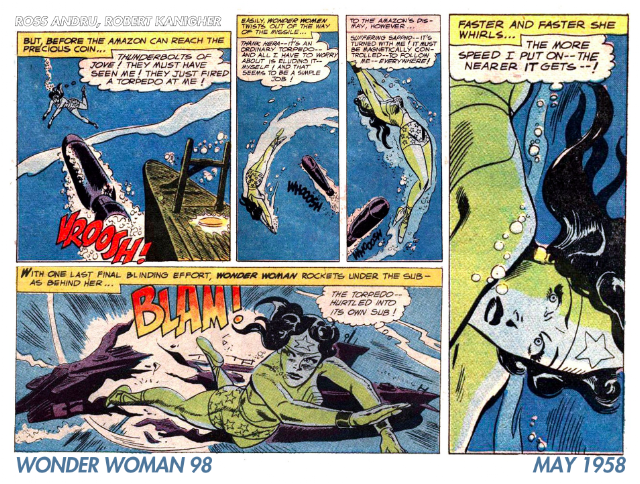
 -Athena entrusts to Hippolyta in a dream), Wonder Woman disguises the other Amazons to look exactly like her, complete with costume, so that her mother will be impartial.
This also satisfies that odd but persistent need for superheroes to encounter mirror images of themselves.
Diana’s ultimate victory causes the other Amazons to exclaim that “She is a Wonder Woman … Aye, aWonder Woman indeed!”
With the feature’s milieu now the Cold War and not World War II, Col. Steve Trevor’s plane simply explodes over Paradise Island. When Trevor’s parachute fails, Wonder Woman hurls herself skyward to the rescue, maneuvering on updrafts to intercept him.
She uses her “wonder breath” to propel his chute away from circling sharks (and Paradise Island, where Aphrodite has forbidden men to set foot on pain of revoking the Amazons’ super powers).
“Angel! You’re an angel,” exclaims the smitten intelligence officer, safe in Diana’s arms.
“I’m just an Amazon,” replies Wonder Woman, matter of factly.
The Amazing Amazon’s new gliding ability may have been Kanigher’s way of letting her “fly” without abandoning her need for her invisible robot plane, a long-established part of the mythos.
“She also gained super cold breath (like Superman), mental telepathy, microscopic vision and the ability to vibrate into other dimensions (like the Flash),” noted journalist Matthew Candelaria. “These powers were used inconsistently, as with many Silver Age heroes’ powers, so her powers of flight would sometimes fail her whenever it was convenient for the story.”
Diana’s tremulous flights on the wind seemed to mirror other equally shaky elements of her personality. She appeared to be much more self-confident over in the Justice League of America, where Gardner Fox was writing her dialogue.
Although she invariably got the job done, Kanigher’s Wonder Woman always seemed to be telegraphing her anxieties in a way that male superheroes never would.
“Hera help me hold on!” she’d exclaim, or “But if I hadn’t (succeeded)? Oh – it makes me shiver – to think of it!”
This story, The Million-Dollar Penny, included some internal contradictions.
Why do we find Princess Diana wearing her star-spangled costume on Paradise Island before she has anything to do with the USA?
And if Amazons have been living in secret for centuries, why does everyone Wonder Woman meets seem to know all about them, and that they possess vast superhuman powers?
The tale also includes Kanigher’s weird rapid-fire coincidences. While pursuing a hawk that has snatched the penny she must turn into a million dollars within a day (don’t ask), Wonder Woman plunges into a river right on top of an enemy submarine that’s about to fire a nuclear missile at the city.
In defense of Kanigher, comics historian Paul Zuckerman observed that “…his Wonder Woman was operating under a lot of restraints. They really directed the strip to the youngest readers, and when I was young was when I enjoyed his Wonder Woman the most.
“They had long since eliminated much of what made (William Moulton) Marston’s Wonder Woman so… unique, and of course, the romance was at a very simplistic level, though here it was the man, Steve, throwing himself at Diana. And then came the endless parade of silly-looking monsters.
“I didn’t know from her original origin, so I accepted the late ’50s revised one. But when Kanigher tried to return Wonder Woman to a Golden Age style and restored her true origin, I really liked it for a while until the stories again got silly.
“Egg Fu, anyone?”
About Author
