
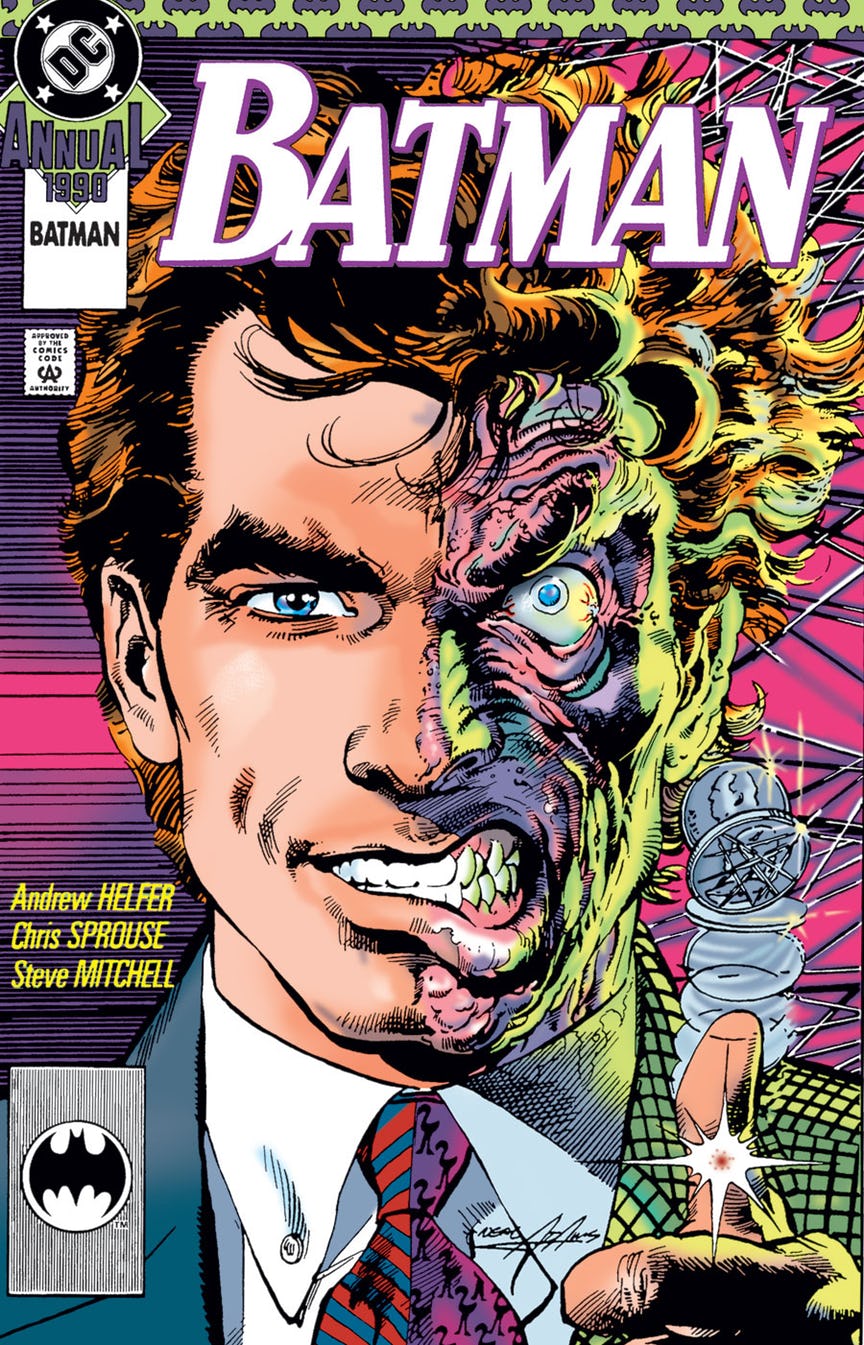
 Most writers get Harvey Dent wrong, and the mistake is always the same. They treat the coin as randomness, as chaos, as a man who has abandoned reason and now lets fate decide.
That reading makes him a lesser Joker, which is both boring and wrong. The Joker is chaos. Harvey Dent is something considerably more interesting and considerably rarer in fiction: a man who understands exactly what a fifty-fifty proposition is and has built his entire operating system around refusing to override it.
The coin is not an abdication of judgement. It is a commitment device, and it works because he will not overrule it.
It is also, and this is the part nobody says out loud, one of the only genuinely fair propositions in fiction. A fair coin delivers exactly the odds it claims, with no operator, no margin, and no party benefiting from either outcome. Almost nothing else does, which is why regulated gaming ended up as an industry of verification rather than an industry of games.
Virginia is a decent illustration of how varied that gets. The state authorised casino gaming city by city, putting the question to a local referendum in each proposed host city rather than settling it centrally, and Richmond voted no twice. It then licensed statewide mobile sports betting under the Virginia Lottery in 2021 without ever authorising online casino play, so anyone comparing Virginia online casinos is looking at three separate channels running under three different sets of rules (source: https://www.metrotimes.com/discover/virginia-online-casinos/).
Harvey would approve of the referendum part. A fixed procedure, applied identically in each city, resolved by a count nobody was permitted to overrule. He would have rather more to say about the other two.
What a Commitment Device Actually Is
 The concept has a name in decision theory, and it predates the character by a long way.
A commitment device is a mechanism you put in place in advance, specifically to remove a future decision from yourself, because you do not trust the version of you that will be making it. Ulysses ordering his crew to tie him to the mast and ignore anything he says afterwards is the founding example. He is not trying to hear the sirens less. He is arranging things so that hearing them cannot change the outcome.
Harvey’s coin does the same job. The decision is made before the situation arrives, the mechanism resolves it, and the man carrying it out has no input.
What makes this genuinely uncomfortable, and what the better stories understand, is that this is not obviously irrational. Harvey Dent was a district attorney who spent his career watching discretion produce injustice. Prosecutors choosing which cases to pursue. Judges applying sentences unevenly. A system that claimed to be neutral and demonstrably was not.
The coin is his answer to that. A rule that cannot be lobbied, bribed, threatened, or charmed. Applied identically to everyone, including him.
Where the Writing Goes Wrong
 Two failure modes recur, and both stem from treating the coin as a plot device rather than as a principle.
Flipping until he gets the answer he wants. This is the most common and the most damaging, because it destroys the entire character. If Harvey re-flips, the coin is theatre, and he is simply a man doing what he wanted while claiming otherwise. The whole point is that he abides by the first result, including when the result costs him something.
Flipping for decisions that have no binary structure. The coin resolves genuine two-outcome questions. Using it for everything reduces it to a tic, and the stories that do this tend to be the ones that also write him as merely unstable.
The versions that work are strict about both. Harvey flips once, on a real binary, and follows it. Nolan’s film understood this well enough to build its final act on it. So did Batman: The Animated Series, which spent an entire origin establishing that the man had a suppressed second self long before the acid, so that the coin became a way of managing something that already existed.
Every new Two-Face appearance gets measured against that standard, which is why DC Comics news and announcements tend to draw scrutiny the moment a creative team is named for a Harvey Dent arc.
The Probability Is the Point
 Here is what separates Harvey from every other villain who uses a gimmick.
A fair coin is genuinely fifty-fifty. Not approximately, not as a figure of speech.
In a city where every institution is compromised, Harvey is carrying the only genuinely fair mechanism in Gotham, and he sanded one face of it so you can tell which side is which.
That detail is not decoration. He scarred the coin so the outcome would be legible, which is a transparency requirement. He is running an audited process.
Why the Scarred Face Matters
 The physical object does more work than most readers notice.
An unmarked coin gives you a result nobody can verify after the fact. Harvey’s has one clean face and one defaced face, which means anybody watching can see what came up and confirm the result matches the action taken.
That is the difference between saying “I flipped for it” and demonstrating the flip. He is not asking to be believed. He is showing the working.
Which is entirely consistent with a former prosecutor. The man spent his professional life on evidentiary standards, and when he stopped trusting judgement he did not stop trusting proof.
What Other Characters Get for Comparison
Set him against the obvious alternatives and the distinction sharpens.
The Joker has no system. Whatever internal logic exists is not available to anyone else and is not stable across appearances, which is the point of him.
The Riddler has rules, but they are his rules, designed so he wins. The puzzle always has an author, and the author has an interest.
The Penguin is a businessman with an edge, which makes him the house rather than a player.
Harvey built a mechanism that treats him exactly as it treats everyone else, and then submitted to it. The coin has cost him things. That is the evidence it is real.
The Version Worth Reading
 If the character interests you, the through-line is consistency of the rule rather than volume of coin flips.
A good Two-Face story establishes a binary, flips once, and follows through when the result is the harder one. A bad one uses the coin as a countdown timer before a fight scene.
The reason he endures across eighty-odd years is not the scar or the suit. It is that he poses a question most fiction avoids: if human judgement is corruptible and a fair procedure is not, what exactly is wrong with deferring to the procedure?
The stories that take that question seriously are the good ones. The ones that treat him as a man who lost his mind and started flipping a coin have not understood what he is doing, and neither has anyone who thinks the coin is about luck.
About Author
