
A gigantic being with a face of a human and the body of a lion? Naturally, children would be fascinated, and so they have been for many centuries.
The 66-foot-tall, 240-foot-long Great Sphinx of Giza, adjacent to the Great Pyramids on the west bank of the Nile, has been an attention-getter for at least 4,500 years.
Comic book companies have cashed in on that interest numerous times over the decades by presenting variations on the theme of the sphinx.
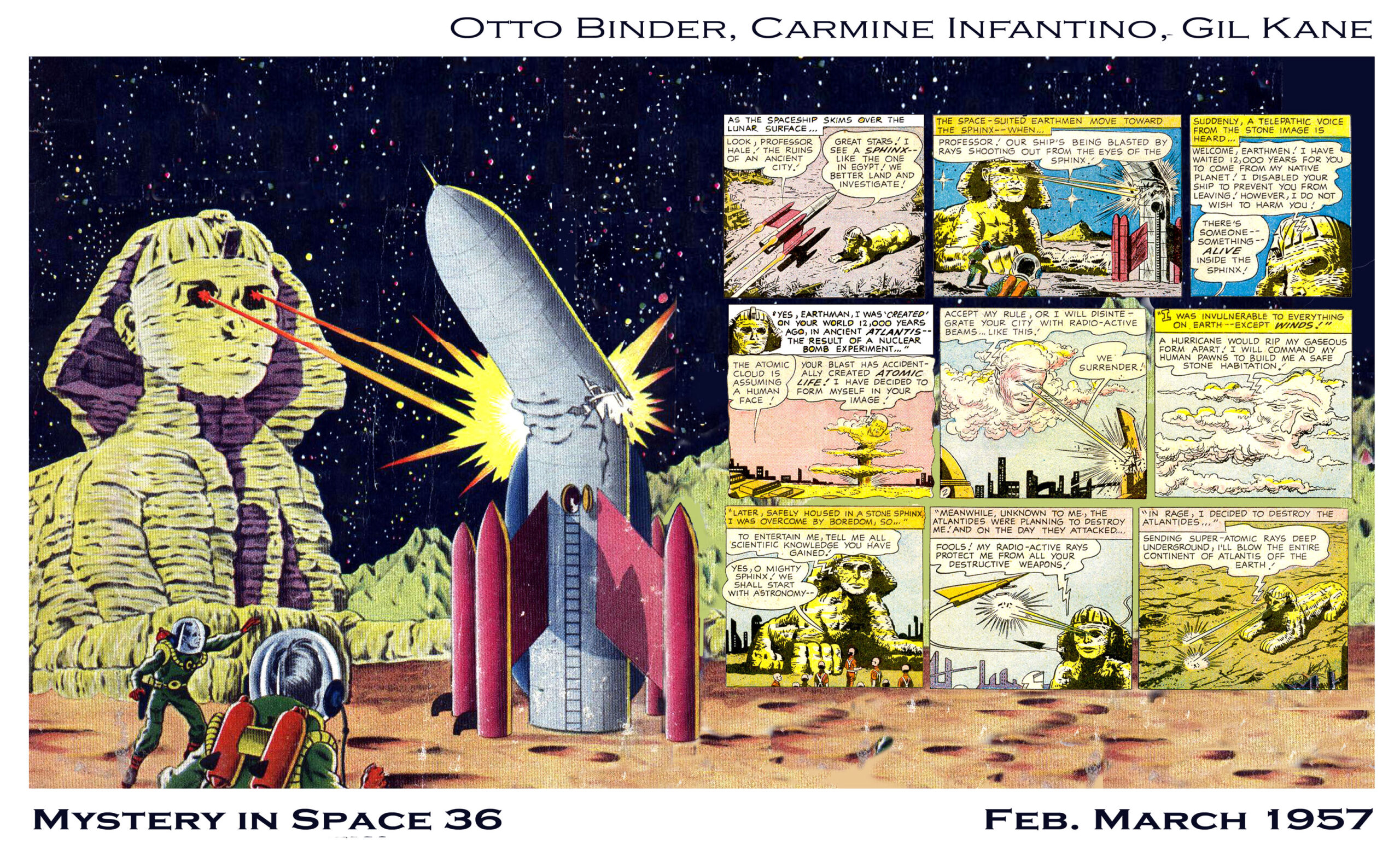
In Secret of the Moon Sphinx (Mystery in Space 36, Feb.-March 1957), this space sphinx turns out to have picked up the Egyptian Sphinx’s habit of playing quizmaster.
The year before this story, the sphinx popped up in Marvel’s Uncanny Tales 40, Pines’ Adventures of Mighty Mouse 129, and on the cover of DC’s first issue of House of Secrets.
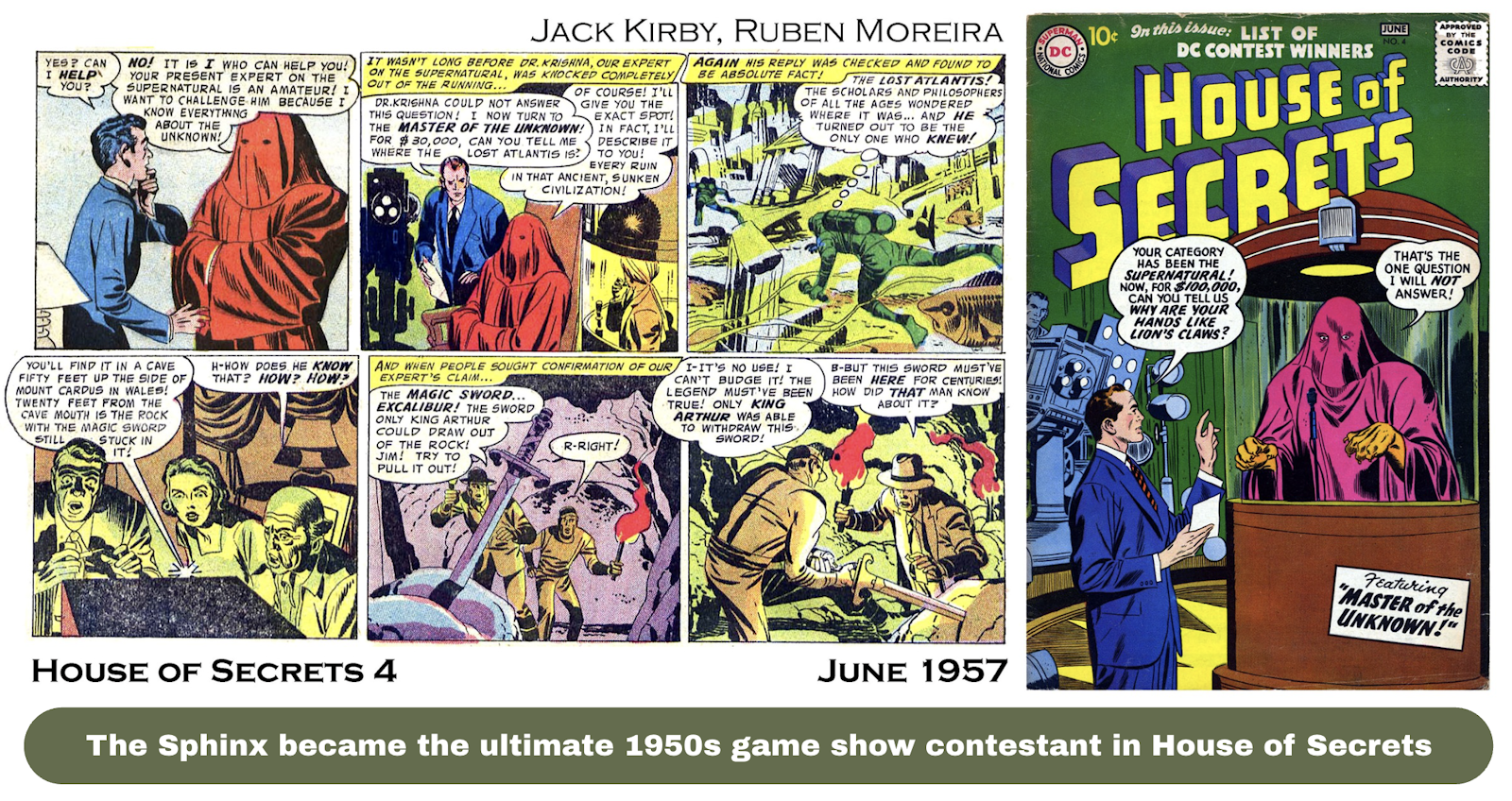
In 1957, a sphinx appeared again in House of Secrets 4. In 1959, we got Secret of the Superman Sphinx in Action Comics 240, and more sphinxes in Charlton’s Atomic Mouse 28 and a Space Ranger story in Showcase 16.
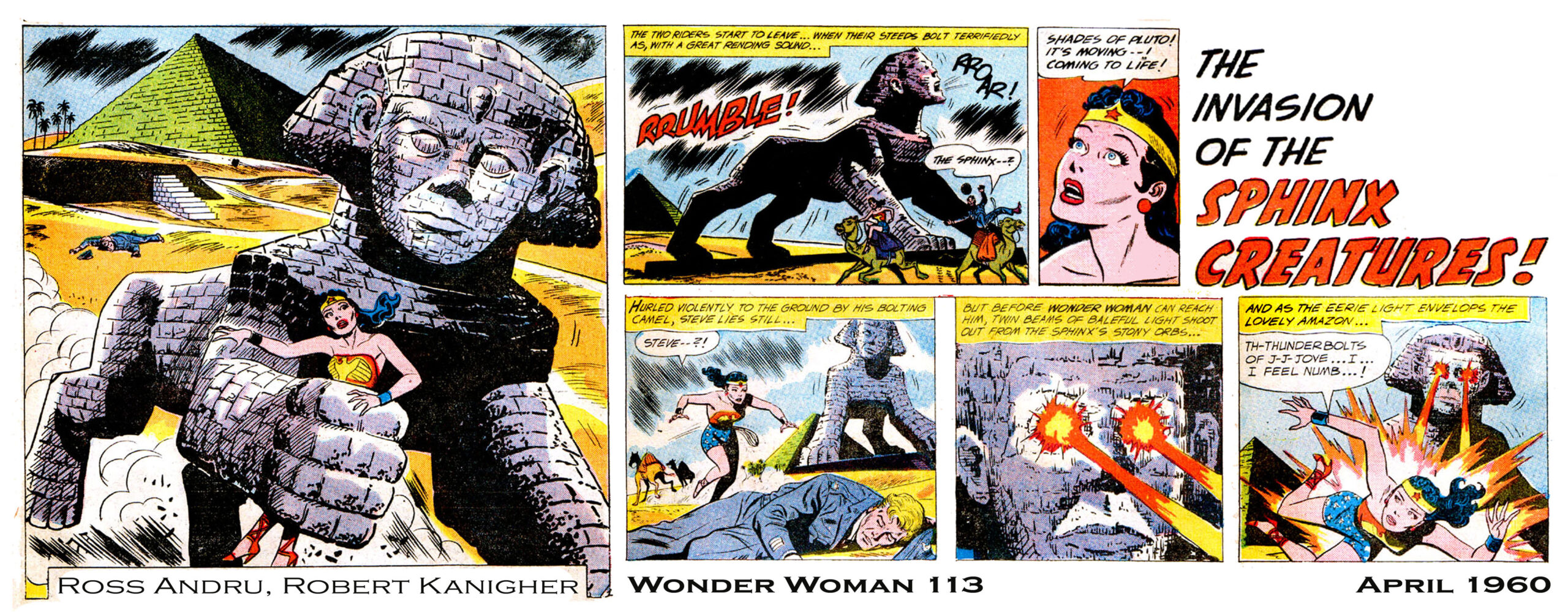
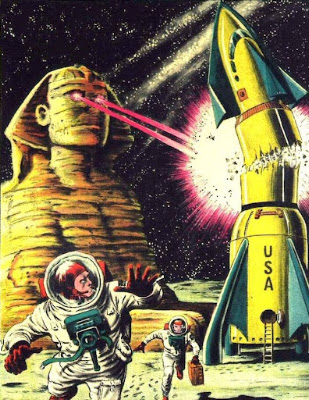 In 1960, in Wonder Woman 113, the Amazing Amazon fended off The Invasion of the Sphinx Creatures. And in Journey Into Mystery 59, the Sphinx turns out to be a robot warrior named Shagg.
At around the same time, the Archie Comics superheroes the Fly and the Jaguar would face Cat Girl, a powerful opponent who actually was the Sphinx.
Mystery in Space 36 is set in the future year 1975 (which seemed distant in 1957). After crippling an astronaut team’s spaceship, the Moon Sphinx reveals that it’s really an energy cloud spontaneously spawned in a nuclear bomb experiment 12,000 years earlier in Atlantis.
Although it is able to strike terror into humanity by firing radioactive beams, the entity has a serious Achilles’ heel.
“I was invulnerable to everything on Earth — except winds,” the being discloses telepathically. “A hurricane would rip my gaseous form apart!”
The entity commanded its human minions to build him the solid sanctuary of a sphinx, but it turns out it’s not much fun being a statue. So the entity quizzes the Atlanteans on their advanced scientific knowledge simply to relieve its boredom.
When the Atlanteans mount a rebellion, the enraged being
sends “super-atomic beams underground” to “blow the entire continent of Atlantis off the Earth!”
That’ll show ‘em!
Having wiped out Atlantean civilization, the being ends up on the Moon. The astronauts speculate that “some Atlantide survivors reached Africa, and passed on the ‘legend’ of the all-powerful Sphinx,” explaining the statue we’re familiar with.
In exchange for the answer to a single question, the Moon Sphinx offers to share his vast knowledge with the astronauts. He informs them, for example, that flying saucers do exist but merely carry tourists from a dull mono-color world who want to take movies of Earth’s vivid colors back home.
And what does the Moon Sphinx want to know?
Where’s Earth?
Amazed that it doesn’t already know, the astronauts foolishly tell it that Earth is only 240,000 miles away. When the radioactive intelligence announces plans to invade, the protagonists manage to seal him up in the statue with lead, noting that the entity’s long half-life will eventually result in its death.
They also figured out that when the entity blasted Atlantis from Earth, the continent became our moon, but the entity was left dazed and confused. Being on the dark side of the satellite, it never realized where Earth was.
“This is one of (writer Otto) Binder’s tales of Cosmic Consciousness. The Earth, the Moon, and geological and astronomical events on both play a role in this tale,” noted comics historian Michael Grost. “So does what you can see from various positions in space, always a favorite Binder subject in such tales.
“The story also has elements of another Binder specialty: First Contact and how differences in perceptions between humans and aliens play a role. There is some good humor in this story, especially in Binder’s explanation of why alien UFO’s are coming to Earth. Binder always had humane values, and the UFO episode here stands in charming contrast to all the horror fantasies that fill X-Files-style television shows today.”
By the way, the sphinx in Greek mythology, as opposed to Egyptian, had a woman’s face, the body and tail of a lion, and the wings of a bird.
Even better!
About Author
