
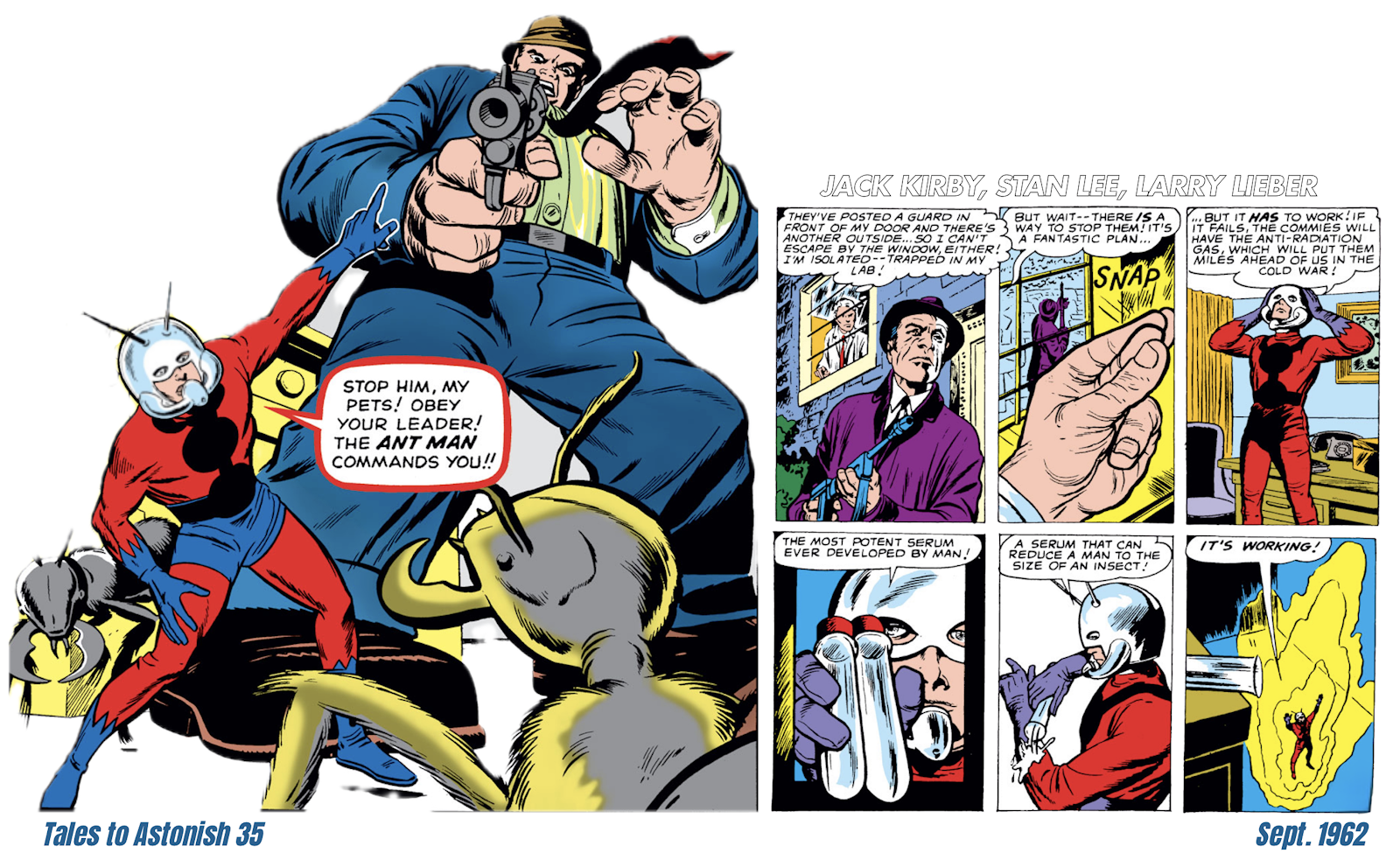
Ant Man was sort of an afterthought superhero, a surprise holdover from another genre entirely.
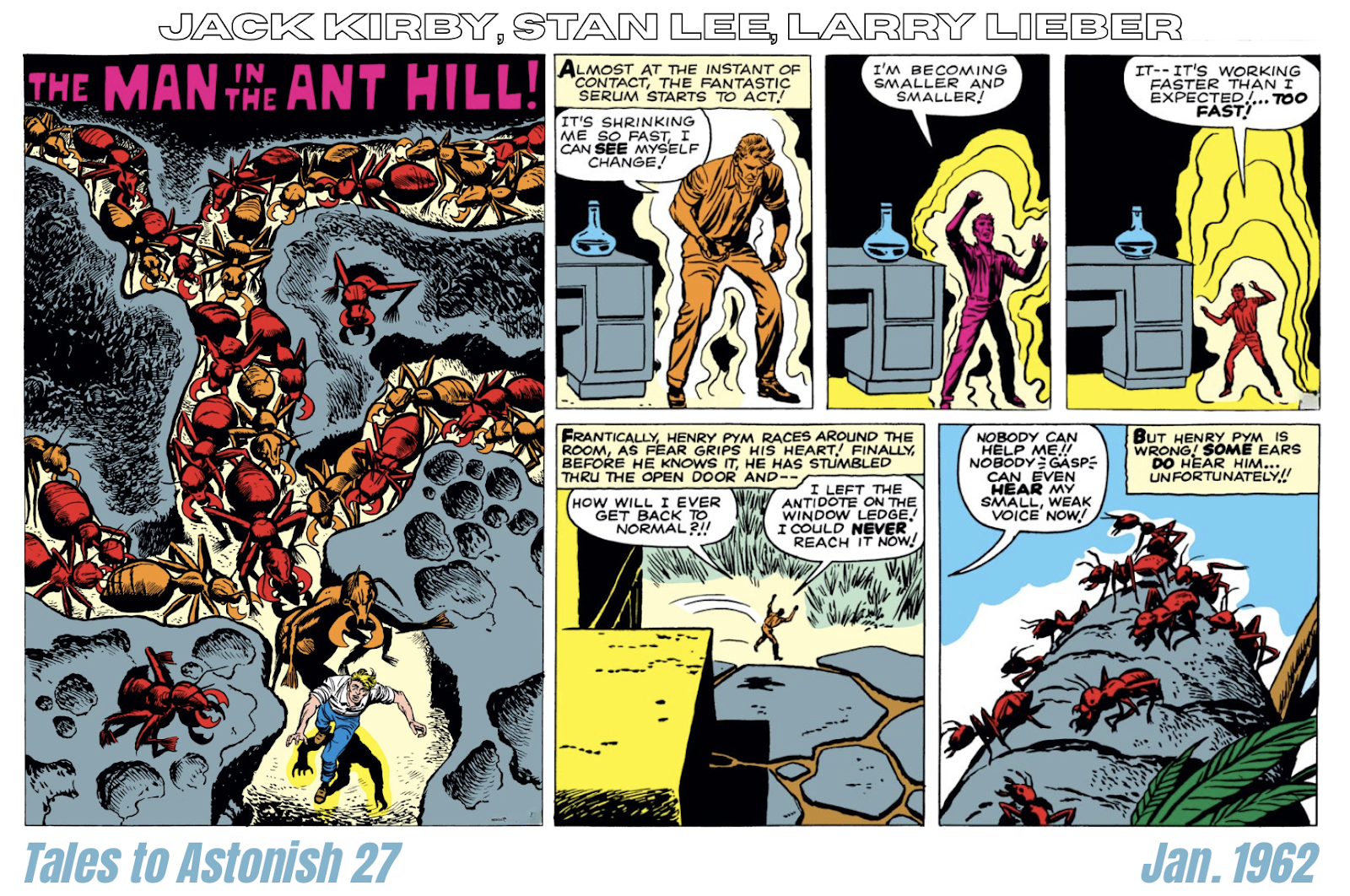
Henry Pym had been introduced in Tales to Astonish 27 (Jan. 1962) as The Man in the Ant Hill, a chemist who, in his exuberance at having discovered a formula to shrink things, recklessly decided to test it on himself and ended up menaced by insects.
Although Pym destroyed his shrinking formula at the end of his harrowing exploit in the ant hill, the story’s resolution hinted that future cooperation between man and ant was possible. Pym had been rescued by a friendly ant who saved him from being drowned in honey and provided him access to his regrowth formula.
The concluding narration underlines the point: “Never again did Henry Pym knowingly step upon an anthill, for he knew that somewhere beneath him, unknown, and unrecognized, was one little insect — one small ant, to whom he owed his very life.”
“Plotted by (Stan) Lee, scripted by Larry Lieber, and drawn by Jack Kirby and Dick Ayers, the tale’s focus on the terrors of size reduction likely owed more to the 1957 film The Incredible Shrinking Man than it did to DC’s sunnier 1961 re-creation of the Atom,” observed John Wells in The American Comic Book Chronicles.
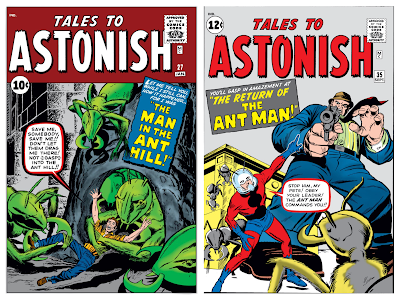 That first story had appeared on the newsstands alongside Fantastic Four 2. Eight issues later, with the new popularity of superheroes now apparent, Pym was retooled for a new role in The Return of the Ant Man! (Tales to Astonish 35, Sept. 1962).
“One by one, Marvel’s fantasy/monster books were given over to new superhero features: Journey Into Mystery had Thor, Tales to Astonish had Ant-Man and Strange Tales had the Human Torch,” noted Pierre Comtois. “Slowly, the non-superhero features were being squeezed out and would soon become irrelevant.”
We learned that in the intervening months, Pym had developed an antennaed helmet to permit him to electronically communicate with ants. So when communist spies kidnap Pym and his assistants to steal his new “radiation immunity” gas, the scientist becomes Ant Man to thwart them. His costumed identity debuted the same month as Thor and Spider-Man.
“As a first adventure, it was strictly routine. But the ideas were novel,” observed popular culture historian Will Murray. “Jack Kirby designed a striking red-and-blue costume with an abstract black chest design for Pym that puzzled me as a kid. I think it’s supposed to represent an ant’s segmented body. But the best part was Pym’s cybernetic helmet. It resembled a metallic ant’s head with twin antennae and a microphone suspended between stylized mandibles.”
While Henry Pym initially lacked personality, his features made up for it in visual interest.
And in his second outing, Pym himself was even somewhat better-looking. The conventions of the day required that while mad scientists did not need to have even features, superheroes must.
“Larry Lieber, who’d named Henry Pym in the earlier story, continued to script over Stan Lee’s plots in the ongoing Ant Man series with art by Kirby and (Dick) Ayers,” Wells wrote. “Feeling its way, the team tossed failsafe communist villains at the new hero in issues 35 and 36 and introduced a generic costumed crook called the Protector in 37. Only in Tales To Astonish 38 (Dec. 1962) would Ant-Man acquire his true arch-nemesis, the blacklisted atomic scientist Egghead.”
“Kirby stayed for only six issues before Don Heck — who called himself Stan’s ‘utility man’ — jumped hastily in,” wrote Will Jacobs and Gerard Jones in their book The Comic Book Heroes. “A flirtatious female sidekick called the Wasp didn’t help much (TTA 44, June 1963), nor did the conversion of the hero into Giant-Man (TTA 49, Nov. 1963). At any size, this was the least of Marvel’s successes.”
But even the least of Marvel’s successes was successful enough to warrant my investment, 12 cents at a time.
Both Ant-Man and the Atom were counterintuitive superheroes who turned their small stature, which would ordinarily be considered a weakness, into a considerable strength. And Ant Man included a worm’s-eye perspective that offered strong visual variety.
About Author
