 The idea of games where the field of battle is not balanced from the outset has always fascinated me in general terms.
Certainly, they are more realistic if you put a board game—say, chess—in the context of a battle. Sides are never exactly “even” in a battle, and the goal is not the same either. One side defends a hill while the other side battles to take it, for example.
So, that brings us to Brandubh, one of a number of games in the “tafl” family.
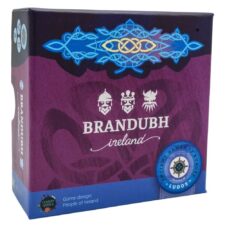
In this review, we are looking at a version from newventuregames.com, so out of the box, it is a nicely made wooden board with peg pieces that, given some care, should last virtually from generation to generation. You have to love the idea of purchasing an heirloom version of a game your great-great-grandkids might play one day.
In this case, the version has very nice painted graphics in a Celtic theme, which enhance the aesthetic, too.
Virtually, it’s a big win.
So, for a bit more on the game, I go to the rule book, where it describes it this way:
“The game Brandubh (pronounced ‘bran-duve’) is descended from the Norse tafl games, and probably a variant of the Welsh game called tawlbrrd.
“This theory is supported by a 10th-century artifact found in Ballinderry, Ireland, consisting of a wooden board with a seven-by-seven grid, marked off by holes suitable for playing pegs, and it has Celtic symbols on it.
“The modern rules are conjecture based on surviving tafl rules adapted to the smaller board.”
As you might expect, the setup is super quick and easy here.
One player, the defender, controls the king at the center position (the red peg), and eight guards (black pegs) are placed in a cross pattern with the king at the center.
The other player positions 12 attackers (white pegs) in the three central points on each edge of the board.
The center point, where the king starts, is known as the throne. The king is the only piece that may stop on the throne, although other pieces can cross over it.
From there, players focus on divergent game goals.
The object of the defender is to move the king to safety off the board, while the attacker tries to stop the king by surrounding him, or on three sides and the throne. (The king is not captured—as in “removed from the game”—like other pegs.)
Now, since the goals are different, and the in-game resources in terms of the number of pieces each player has are different, one side has a built-in advantage. For that reason, players should play each side once in a back-to-back set—easily done, as Brandubh plays in less than half an hour (usually 15–20 minutes).
Now, leaving a new player to determine which side has the advantage on their own, I will say a win with one side is far more gratifying than with the side that is “supposed” to win.
The game may seem, in a way, flawed initially because of the imbalance, but therein lies the challenge: Can you overcome the odds and defeat a force that has you at a disadvantage?
Buy this beauty from NewVenture Games and find out.
About Author
Calvin Daniels is a Saskatchewan-born, self-taught journalist. He is currently Editor of Yorkton This Week, with 35-years in the newspaper business.

Brandubh
Certainly, they are more realistic if you put a board game—say, chess—in the context of a battle. Sides are never exactly “even” in a battle, and the goal is not the same either. One side defends a hill while the other side battles to take it, for example.
So, that brings us to Brandubh, one of a number of games in the “tafl” family.
In this review, we are looking at a version from newventuregames.com, so out of the box, it is a nicely made wooden board with peg pieces that, given some care, should last virtually from generation to generation. You have to love the idea of purchasing an heirloom version of a game your great-great-grandkids might play one day.
In this case, the version has very nice painted graphics in a Celtic theme, which enhance the aesthetic, too.
Virtually, it’s a big win.
So, for a bit more on the game, I go to the rule book, where it describes it this way:
“The game Brandubh (pronounced ‘bran-duve’) is descended from the Norse tafl games, and probably a variant of the Welsh game called tawlbrrd.
“This theory is supported by a 10th-century artifact found in Ballinderry, Ireland, consisting of a wooden board with a seven-by-seven grid, marked off by holes suitable for playing pegs, and it has Celtic symbols on it.
“The modern rules are conjecture based on surviving tafl rules adapted to the smaller board.”
As you might expect, the setup is super quick and easy here.
One player, the defender, controls the king at the center position (the red peg), and eight guards (black pegs) are placed in a cross pattern with the king at the center.
The other player positions 12 attackers (white pegs) in the three central points on each edge of the board.
The center point, where the king starts, is known as the throne. The king is the only piece that may stop on the throne, although other pieces can cross over it.
From there, players focus on divergent game goals.
The object of the defender is to move the king to safety off the board, while the attacker tries to stop the king by surrounding him, or on three sides and the throne. (The king is not captured—as in “removed from the game”—like other pegs.)
Now, since the goals are different, and the in-game resources in terms of the number of pieces each player has are different, one side has a built-in advantage. For that reason, players should play each side once in a back-to-back set—easily done, as Brandubh plays in less than half an hour (usually 15–20 minutes).
Now, leaving a new player to determine which side has the advantage on their own, I will say a win with one side is far more gratifying than with the side that is “supposed” to win.
The game may seem, in a way, flawed initially because of the imbalance, but therein lies the challenge: Can you overcome the odds and defeat a force that has you at a disadvantage?
Buy this beauty from NewVenture Games and find out.
About Author
Calvin Daniels
Calvin Daniels is a Saskatchewan-born, self-taught journalist. He is currently Editor of Yorkton This Week, with 35-years in the newspaper business.
See author's posts