
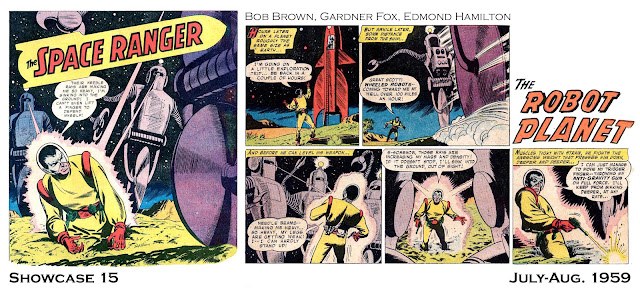
Okay, he was no Adam Strange or even a Captain Comet. But Space Ranger managed to hold down the fort in DC’s Tales of the Unexpected and then Mystery in Space for half a decade.
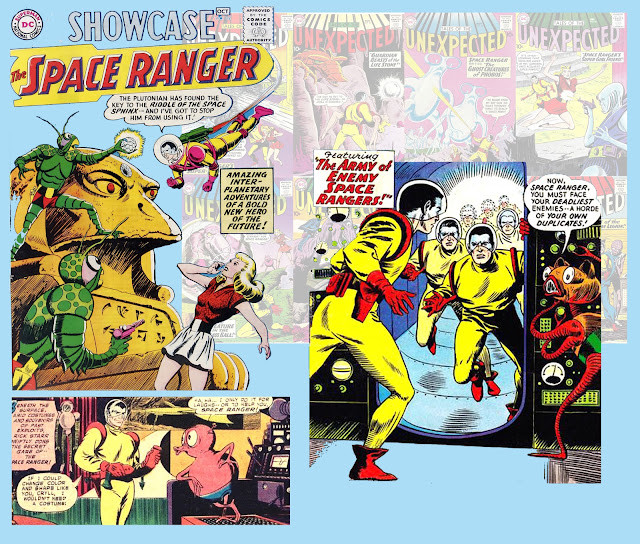
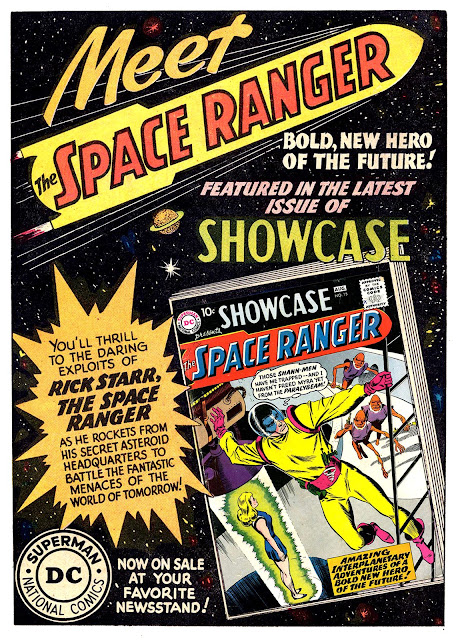
“DC editor Jack Schiff unveiled the Space Ranger in Showcase 15 (1958),” notes the Ultimate Encyclopedia of Comic Book Icons and Hollywood Heroes. “The Ranger had a secret identity — business heir Rick Starr — and donned a red-and-yellow space suit with a bubble helmet and a rocket pack to fight futuristic bad guys (the Jungle Beasts of Jupiter and the Alien Brat from Planet Byra, among others, with a cutesy alien pal, Cryll, by his side.”
“The use of a space helmet to disguise the hero’s identity recalls the Moon Man pulp magazine short stories (1933-1937) by Frederick C. Davis,” noted comics historian Michael E. Grost.
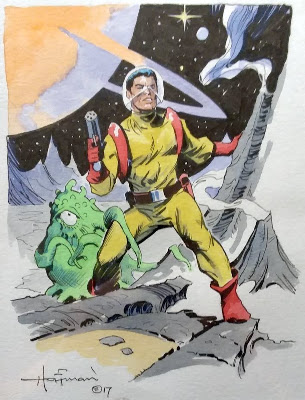 However, by the time I started reading Space Ranger, his secret identity had been largely abandoned as superfluous (a character who was always on yet another weird planet hardly needed a disguise).
Like Batman, Space Ranger had no superpowers, but Cryll did, being able to transform himself into any animal, like the later Beast Boy. Since Cryll had the whole densely inhabited universe to choose from, he could essentially transform himself into anything. The Martian Manhunter’s super-powered alien pet/pal Zook was similar.
In place of powers or a utility belt, the yellow-clad, translucent-helmeted Ranger had his all-purpose multi-raygun, which seemingly could emit any kind of beam: heat, ice, disintegration, and so forth. Space Ranger’s infinitely versatile raygun anticipated Space Ghost’s multi-beam power bands.
Space Ranger and his super-powered assistant echoed the pulp magazine feature Captain Future, created for Thrilling Publications by Mort Weisinger and written by Edmond Hamilton from 1940 through 1944.
“In fact, Hamilton is credited with writing the first two Space Ranger stories from (Gardner) Fox’s plots (The Great Plutonium Plot and The Robot Planet),” noted Bill Schelly in American Comic Book Chronicles.
About Author
