
 First Comics News: How will The Trail of Blood enrich the readers’ lives?
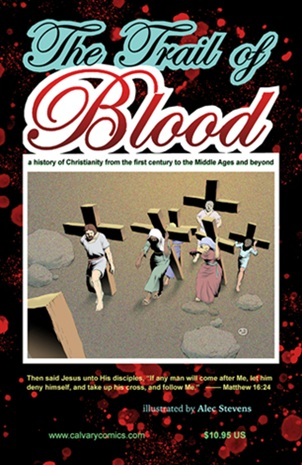
Alec Stevens: I suspect that will depend upon how attentive and receptive they are to the material. This 88-page comics anthology covers historical events from the first to the sixteenth century in a linear fashion, beginning with the public ministry of Jesus Christ in Israel, then His crucifixion, resurrection, and ascension. The accounts that follow are of Christians in subsequent generations and the challenges they faced from various governments and prevailing religious institutions. The Middle Ages, in particular, is a period that so many people in this day and age have little or no knowledge of, and I have endeavored to show how the Gospel message has continuously impacted generations over the past two millennia.
 1st: Will The Trail of Blood focus on more unknown religious people and groups?
Alec: Yes and no. Christ is known worldwide (except perhaps among the most remote tribes), and I illustrated “The Real St. Patrick,” taken from his own writings. Aside from scholars of church history, I would say that most of the people and groups whose accounts I illustrated are not well known to the general public.
1st: Which story from The Trail of Blood has the most meaning for you?
Alec: That’s a difficult question. In many ways, they are all the same story, but with different people and events. 2 Timothy 3:12 says, “…all that will live godly in Christ Jesus will suffer persecution.” In every era, even to this day, there are martyrs (and near-martyrs). Oppressors and opponents of the Messianic claims of Christ continue to come and go as well. In John 15:18-21, Jesus said to His disciples, “If the world hate you, ye know that it hated Me before it hated you. If ye were of the world, the world would love his own, but because ye are not of the world, but I have chosen you out of the world, therefore the world hateth you. Remember the word that I said unto you, the servant is not greater than his lord. If they have persecuted Me, they will also persecute you. If they have kept My saying, they will keep yours also. But all these things will they do unto you for My name’s sake, because they know not Him that sent Me.”
1st: Which characters from The Trail of Blood are most inspiring?
Alec: The first two stories are taken directly from the New Testament of the Bible, so I would have to say the Lord Jesus Christ, firstly. As for the other people whom I have depicted, there are certain cultures and historical periods that will resonate with readers differently.
 1st: How did you come up with the title The Trail of Blood?
Alec: The full title is The Trail of Blood: A History of Christianity From the 1st Century to the Middle Ages and Beyond. There is an old saying that goes back to the 2nd century: “The blood of the martyrs is the seed of the church.” Jesus shed His blood, nailed to Calvary’s cross, as the payment for the sins of mankind, the Just for the unjust, for all those who put their trust in Him. Even many Old Testament prophets were put to death for withstanding wicked despots and upholding the truths of God. This has subsequently continued across the generations. There is an old book from 1931 called The Trail of Blood: Following Christians Down Through the Centuries by James Milton Carroll. The theme of his book is much the same as mine, and I cite his volume, as well as other publications, both older and newer, in a bibliography at the end of my comics anthology.
1st: What is the biggest selling point of The Trail of Blood?
Alec: I have been publishing Christian books, graphic novels, tracts, and posters under my Calvary Comics imprint for the past twenty-six years. Many of my readers have been purchasing my material for a long time. Even those who newly encounter my work quickly ascertain that my efforts are reverent, faithful to the Word of God, and carefully researched. This is very appealing to Christians who are tired of poor teaching, worldliness, and gross compromise found in so many of today’s churches, or of dead religious formalism. My work and my values are not of either camp, but are bathed in much prayer and ongoing study of the Scriptures. For someone who is not a follower of Christ but is curious, a book like this one is a concise, consolidated historical account of born-again believers across the generations.
 1st: What is the theme of The Trail of Blood?
Alec: Revelation 2:10 says, “Fear none of those things which thou shalt suffer. Behold, the devil shall cast some of you into prison, that ye may be tried, and ye shall have tribulation ten days. Be thou faithful unto death, and I will give thee a crown of life.” These are the words of the risen Christ to the church of Smyrna (near Izmir, Turkey) in 1st-century Asia Minor, delivered through the apostle John, who himself was in exile on the isle of Patmos. This prophecy was an encouragement and a call to endure for those saints in Smyrna, and most of the testimonies in my book carry a similar theme.
1st: Who are the Bogomils?
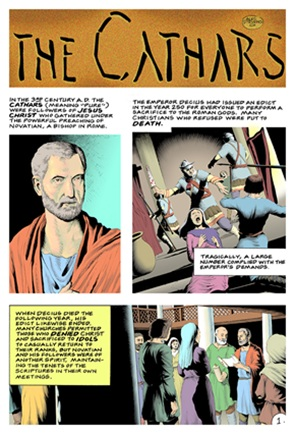
Alec: If you consulted the Encyclopedia Britannica, Wikipedia, or any number of books on the subject, you would read that they were Gnostic dualists in the Middle Ages who were mostly killed off by the Roman Catholic and Orthodox churches, sending secular armies under their command. Further reading would tell you that the Bogomils, who largely resided in Bulgaria, Turkey, and former Yugoslavia, had been proselytized by the Paulicians, also from Asia Minor (now Turkey). The Paulicians and Bogomils were called “Cathars” (meaning “pure” in Greek) and were deemed heretical by the religious establishment of the 7th through 14th centuries.
The only problem is that they were not. These people were genuine followers of Jesus Christ and His tenets, but they rejected the extra-Biblical teachings found in Roman Catholicism and Orthodoxy (for example, praying to “Mary” and to “saints,” bowing to statues and/or icons, believing that infant baptism saves a child from “limbo” should there be an untimely death, and the non-Biblical concepts of purgatory, transubstantiation, etc.).
Yes, the Paulicians did lead the Bogomils (so-called because of an early leader in the movement’s name) to Christ, and the Bogomils, in turn, evangelized throughout western Europe, leading the Albigenses in the south of France to the saving knowledge of Jesus Christ. Because the Catholic Church and state were allied from the time of Constantine the Great in the 4th century A.D. until roughly the 17th century, persecutions against Christians who met apart from their institutions were severe.
The Paulicians: Heresy, Persecution, and Warfare on the Byzantine Frontier, c. 750-880 is a scholarly volume by Carl Dixon, PhD, from 2022. In it, he conclusively proves that the Paulicians were evangelical Christians, based on writings and evidence from that time frame, and that they had been slandered by the religious establishment for well over a millennium. If these “Cathars” (Paulicians) were not heretical, then how would their converts have been, and the converts of their converts? The lies begin to fall like a house of cards once the facts come to light, as well as the true motives behind them.
First Comics News: How do superheroes from comic books compare to Biblical heroes?
Alec: That’s quite a topic shift! Superhero comics originated in New York City in the 1930s, and for decades they displayed Judeo-Christian ethics (by varying degrees). Writer-editor Stan Lee and artist-plotter Steve Ditko hit upon the idea of having a flawed superhero in the early 1960s with Spider-Man. His troubled teen alter ego, Peter Parker, unlike the impeccable Superman character, has fits of anger, doubt, angst, worry over his aunt, finances, failing grades in school, upset girlfriends, etc. In this regard, he seemed quite human, and the initial and ongoing success of the character inspired others, from Marvel Comics and other companies, to follow suit with “flawed heroes.”
The Bible is filled with “flawed heroes.” Humanity, since the fall of Adam, is deeply flawed and in need of a Saviour. There have been Messianic prophecies throughout the Bible, beginning in Genesis and culminating in the New Testament when Christ is born in Bethlehem. Here at last is the perfect Man, the long-awaited Redeemer, but He doesn’t deliver Israel from the clutches of the Roman Empire. There is another matter to be dealt with first: the sins of mankind. God cannot look upon sin, and it had to be dealt with through His Son’s sacrifice on the cross. Under this new covenant between Father and Son, flawed (but redeemed) mankind can enter into God’s presence through the blood covering of His Son, His engrafted Word, and the indwelling Holy Spirit, without fear of damnation. Otherwise…
1st: Would you say a religious comic book can turn people away from it?
Alec: Yes, absolutely. The Gospel is offensive to many. Secular humanism teaches that man is ever reaching upward, from the primordial ooze to lofty heights of nobility of mind. The Gospel of Jesus Christ teaches quite the opposite: that man was created in the image of God, but, after willful disobedience, he brought sin and death into the world. Men were subsequently born in the image of fallen man, not God, and even genetic deterioration became evident in shortened lifespans, aging, susceptibility to disease, etc. Man cannot “clean himself up” and be acceptable to a perfect, almighty God. He needs an Intercessor, and this is provided to us in the Person of Jesus Christ, Who is seated at the right hand of the Father.
1st: You both write and illustrate comics; does this make it easier or better than having two people do it?
Alec: In secular comics and films, there is the concept of the “auteur,” a singular visionary. After all, the prefix in division is “di,” meaning “two.” Amos 3:3 says, “Can two walk together except they be agreed?” Commercial comics are created by committee out of necessity, to hit deadlines and have regular, ongoing publications released on a monthly or bi-monthly basis. My books are “one-shots,” which need not be read in sequence. However, they do tie together, obviously, and resonate more richly when read and considered as a whole. I have worked with other artists in the past, but have handled the writing chores myself.
1st: Would you like to see more religion in the Big Two comic book companies?
Alec: No. Does that surprise you? They’ve been secular publishers all along. Yes, there have been a few brief efforts with Biblical material in years past: in the 1950s, Marvel (previously called Timely and Atlas) published five issues of Bible Tales for Young Folk, and in the early 1990s had a brief collaboration with Thomas Nelson Publishers on The Life of Christ, Pilgrim’s Progress, In His Steps, and similar titles. DC Comics published the oversized The Bible in 1975, with a Joe Kubert wraparound cover and Nestor Redondo interior art, and the Left Behind graphic novels, circa 2000-01, released in collaboration with Tyndale House Publishers. I was offered the writing chores on that series, but turned it down, not wanting to fictionalize the events of Revelation.
1st: What is next for your comic career?
Alec: I have more books in the queue for my Calvary Comics imprint, and usually publish two per year these days. Perhaps I’ll slow down a bit in coming years, but this is where I am at present.
1st: What last words do you have for your readers?
Alec: The apostle Paul wrote in 2 Corinthians 5:20-21, “Now then we are ambassadors for Christ, as though God did beseech you by us. We pray you in Christ’s stead, be ye reconciled to God. For He hath made Him to be sin for us, Who knew no sin, that we might be made the righteousness of God in Him.”
About Author
