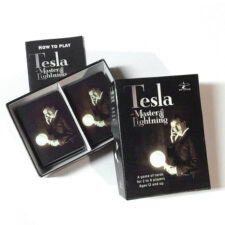
 Out of the box, Tesla: Master of Lightning should have been a dream game for The Meeple Guild.
While our individual levels of enthusiasm may vary, it is safe to say that we generally enjoy deck-building games, and at least a couple of us rate trick-taking games very highly. Tesla: Master of Lightning, a 2012 design by prolific game designer David McCord of New Venture Games, combines elements of both styles, so we went into it expecting it might become a highly favored game at our table.
Reading through the rules, which were generally easy to follow, only one question came up that we could not find an answer to: what happens if you still have cards left in your hand at the end of a round? We decided to follow a typical deck-builder approach, discarding any remaining cards and starting the next round with a fresh hand.
In this game, McCord does two things of note.
First, he fully commits to the Tesla theme, using card values based on “millions of volts.” It is a clever idea and fits the concept, although after repeated plays it can become a little more distracting than engaging.
Second, McCord attempts to add some unique twists to the traditional mechanics.
For example, “power” cards are generally played at the start of a round and affect gameplay in different ways. They may provide an advantage or create an additional strategic choice for players to consider.
There are also straight scoring cards within the 144-card deck. Some provide points, while others create negative scores. The negative cards are generally the ones you hope to avoid.
Gameplay begins with each player receiving a hand of 12 cards. You choose three cards to return to the bottom of the draw pile. These are usually the weaker cards, but that decision can come back to haunt you later, since those discarded cards eventually return and may impact the final round.
Players then shuffle their remaining nine cards and draw six to use during the round.
Three cards are drawn from the common deck and placed face up. Players bid from their six-card hand, with the highest bidder taking the face-up cards and adding them to their personal stack. Those collected cards become part of your deck for future hands, creating the deck-building element of the game.
The process continues with players bidding for two cards, using up to two cards from their remaining hand, followed by a final one-card “pot.”
This repeats until the common deck is exhausted.
At this point, I was satisfied with the game. It had interesting ideas, although Guilder Adam felt the power cards did not add enough to the overall experience.
Then came the scoring.
Players take their collected cards and add up their positive points. The problem is that those scores are often surprisingly small, and sometimes even negative. For me, that left a bad taste after investing the time to build a deck and compete for cards. Playing through the entire game only to finish with little or no score is one of the least satisfying endings a game can deliver.
I understand the concept behind the negative cards. They are meant to create tension and force players to make strategic decisions about what cards they pursue or avoid. However, they also become the game’s biggest limitation in terms of enjoyment.
Trick-taking fans will probably appreciate Tesla: Master of Lightning the most, but even among that audience there are stronger options available.
The game has some interesting ideas and a clever theme, but for The Meeple Guild, the final scoring experience kept it from reaching the level we hoped it would.
About Author
Your First Place For Comics News since October 18, 1998
Tesla: Master of Lightning Mixes Card Game Mechanics
While our individual levels of enthusiasm may vary, it is safe to say that we generally enjoy deck-building games, and at least a couple of us rate trick-taking games very highly. Tesla: Master of Lightning, a 2012 design by prolific game designer David McCord of New Venture Games, combines elements of both styles, so we went into it expecting it might become a highly favored game at our table.
Reading through the rules, which were generally easy to follow, only one question came up that we could not find an answer to: what happens if you still have cards left in your hand at the end of a round? We decided to follow a typical deck-builder approach, discarding any remaining cards and starting the next round with a fresh hand.
In this game, McCord does two things of note.
First, he fully commits to the Tesla theme, using card values based on “millions of volts.” It is a clever idea and fits the concept, although after repeated plays it can become a little more distracting than engaging.
Second, McCord attempts to add some unique twists to the traditional mechanics.
For example, “power” cards are generally played at the start of a round and affect gameplay in different ways. They may provide an advantage or create an additional strategic choice for players to consider.
There are also straight scoring cards within the 144-card deck. Some provide points, while others create negative scores. The negative cards are generally the ones you hope to avoid.
Gameplay begins with each player receiving a hand of 12 cards. You choose three cards to return to the bottom of the draw pile. These are usually the weaker cards, but that decision can come back to haunt you later, since those discarded cards eventually return and may impact the final round.
Players then shuffle their remaining nine cards and draw six to use during the round.
Three cards are drawn from the common deck and placed face up. Players bid from their six-card hand, with the highest bidder taking the face-up cards and adding them to their personal stack. Those collected cards become part of your deck for future hands, creating the deck-building element of the game.
The process continues with players bidding for two cards, using up to two cards from their remaining hand, followed by a final one-card “pot.”
This repeats until the common deck is exhausted.
At this point, I was satisfied with the game. It had interesting ideas, although Guilder Adam felt the power cards did not add enough to the overall experience.
Then came the scoring.
Players take their collected cards and add up their positive points. The problem is that those scores are often surprisingly small, and sometimes even negative. For me, that left a bad taste after investing the time to build a deck and compete for cards. Playing through the entire game only to finish with little or no score is one of the least satisfying endings a game can deliver.
I understand the concept behind the negative cards. They are meant to create tension and force players to make strategic decisions about what cards they pursue or avoid. However, they also become the game’s biggest limitation in terms of enjoyment.
Trick-taking fans will probably appreciate Tesla: Master of Lightning the most, but even among that audience there are stronger options available.
The game has some interesting ideas and a clever theme, but for The Meeple Guild, the final scoring experience kept it from reaching the level we hoped it would.
About Author
First Comics News
Your First Place For Comics News since October 18, 1998
See author's posts