Porcus: A Dungeon Adventure
 There are times when a game arrives with considerable hype, only for everyone around the table to finish wondering what all the excitement was about.
That was the experience for The Meeple Guild with Porcus: A Dungeon Adventure.
First, the good news.
Porcus earned First Place for Best Prototype at Meeple Factory 2025, Second Place for Best Prototype at Concurs Ciutat de Granollers 2025, and was a Top 4 Finalist for Best Prototype at Verkami Dau Barcelona 2025. Its Kickstarter campaign also raised more than $130,000 CAD. Those are impressive credentials by any measure.
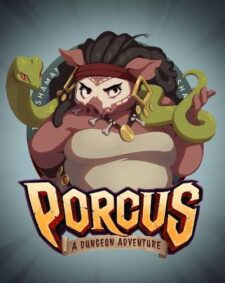
The Meeple Guild also tips its hat to artists Ana Viana Serván (Zaiisey) and César Ruelas Espinosa (Tlich), whose pig-inspired artwork gives the game plenty of personality and charm.
Designers Oscar Martín Cester, Breogan Ramírez Domínguez, and Iván García Márquez have also created something that feels a little different from the typical dungeon crawler. Players take the role of adventurers delving into a dungeon in search of monsters. Each round a random monster is revealed, and everyone secretly commits cards to the encounter. Once revealed, the combined value of those cards must exceed the monster’s health to defeat it and earn various rewards.
So, it’s a cooperative game… well, not exactly.
Like many adventuring parties, everyone ultimately has their own agenda. While players usually need to work together to defeat monsters, victory belongs to the individual with the most points after eight rounds.
That creates an interesting tension. Some monsters are actually better left undefeated, while others reward the player who contributes the highest card, and still others favor the lowest. Playing a weak card can sometimes be the smartest move, but only if the rest of the table picks up the slack. Balancing personal gain against the group’s success creates some genuinely clever decision-making.
Reading that description, Porcus sounds like an excellent filler game. It plays quickly, accommodates two to five players, and offers just enough tactical choices to keep each round interesting.
Unfortunately, our table never really connected with it.
Whether that’s a shortcoming of Porcus itself or simply a matter of timing is difficult to say. We couldn’t identify a specific flaw that kept us from becoming invested. It may simply be that our group has reached a point of filler fatigue. The market is currently flooded with light, quick-playing games, and perhaps we’re just looking for experiences with a little more depth. If that’s the case, then an apology is owed to Porcus—it may simply have landed on our table at the wrong time.
Not every well-designed game is the right game for every group, every night. For us, Porcus: A Dungeon Adventure was enjoyable enough, but ultimately left us wanting something more.
About Author
Calvin Daniels is a Saskatchewan-born, self-taught journalist. He is currently Editor of Yorkton This Week, with 35-years in the newspaper business.

Porcus: A Dungeon Adventure
Porcus: A Dungeon Adventure
That was the experience for The Meeple Guild with Porcus: A Dungeon Adventure.
First, the good news.
Porcus earned First Place for Best Prototype at Meeple Factory 2025, Second Place for Best Prototype at Concurs Ciutat de Granollers 2025, and was a Top 4 Finalist for Best Prototype at Verkami Dau Barcelona 2025. Its Kickstarter campaign also raised more than $130,000 CAD. Those are impressive credentials by any measure.
The Meeple Guild also tips its hat to artists Ana Viana Serván (Zaiisey) and César Ruelas Espinosa (Tlich), whose pig-inspired artwork gives the game plenty of personality and charm.
Designers Oscar Martín Cester, Breogan Ramírez Domínguez, and Iván García Márquez have also created something that feels a little different from the typical dungeon crawler. Players take the role of adventurers delving into a dungeon in search of monsters. Each round a random monster is revealed, and everyone secretly commits cards to the encounter. Once revealed, the combined value of those cards must exceed the monster’s health to defeat it and earn various rewards.
So, it’s a cooperative game… well, not exactly.
Like many adventuring parties, everyone ultimately has their own agenda. While players usually need to work together to defeat monsters, victory belongs to the individual with the most points after eight rounds.
That creates an interesting tension. Some monsters are actually better left undefeated, while others reward the player who contributes the highest card, and still others favor the lowest. Playing a weak card can sometimes be the smartest move, but only if the rest of the table picks up the slack. Balancing personal gain against the group’s success creates some genuinely clever decision-making.
Reading that description, Porcus sounds like an excellent filler game. It plays quickly, accommodates two to five players, and offers just enough tactical choices to keep each round interesting.
Unfortunately, our table never really connected with it.
Whether that’s a shortcoming of Porcus itself or simply a matter of timing is difficult to say. We couldn’t identify a specific flaw that kept us from becoming invested. It may simply be that our group has reached a point of filler fatigue. The market is currently flooded with light, quick-playing games, and perhaps we’re just looking for experiences with a little more depth. If that’s the case, then an apology is owed to Porcus—it may simply have landed on our table at the wrong time.
Not every well-designed game is the right game for every group, every night. For us, Porcus: A Dungeon Adventure was enjoyable enough, but ultimately left us wanting something more.
About Author
Calvin Daniels
Calvin Daniels is a Saskatchewan-born, self-taught journalist. He is currently Editor of Yorkton This Week, with 35-years in the newspaper business.
See author's posts