
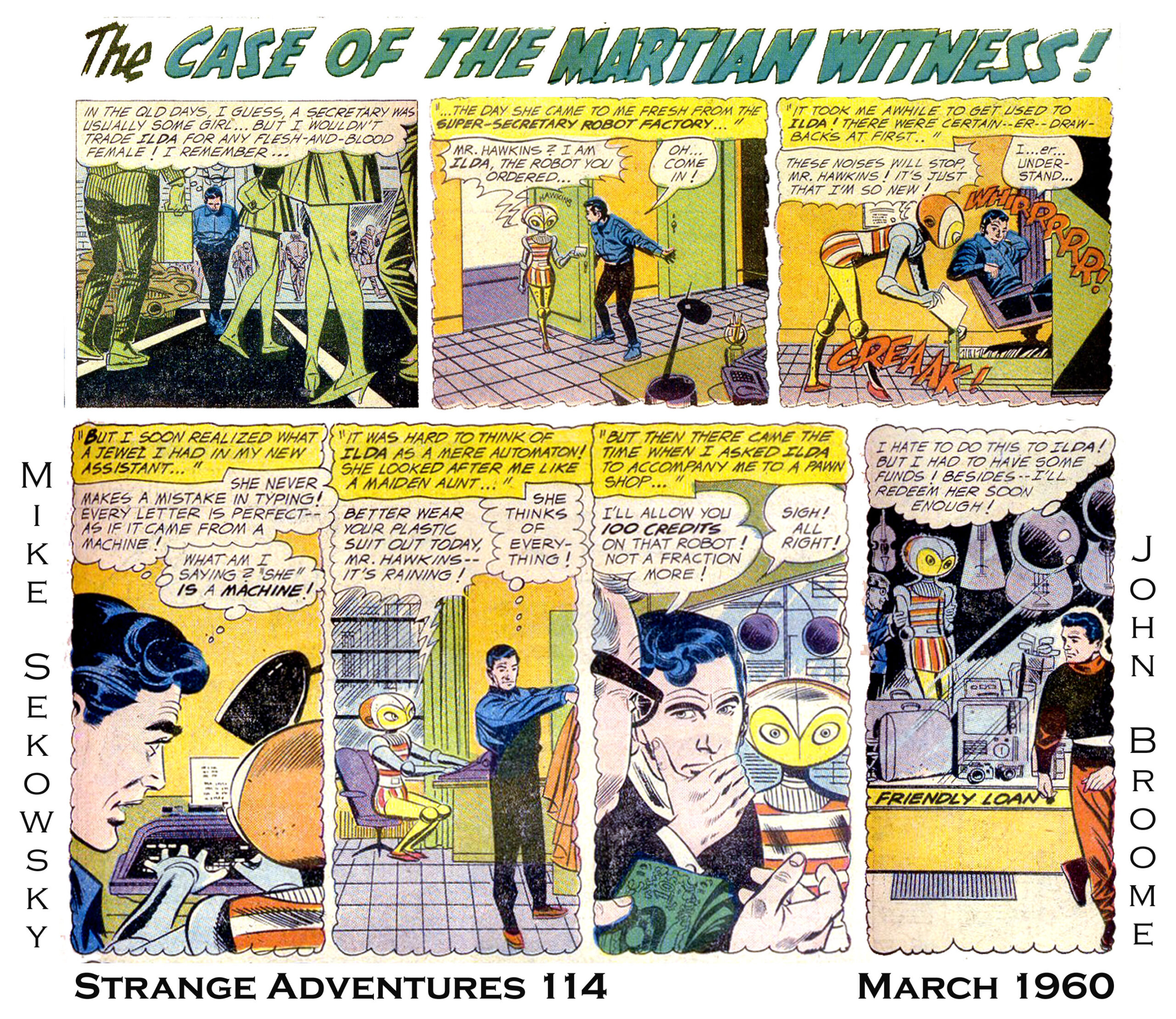
Not all of the many fictional private eyes operating in the 1940s and 1950s were the cynical, bittersweet noir types. Some, like Richard S. Prather’s Shell Scott, were more light-hearted, and DC Comics’ Star Hawkins was one of those.
Amiable and perpetually poor, Star Hawkins was a private detective who operated in the exciting future milieu of the 21st century.
Naturally, like so many of us in the 21st century, Hawkins owned his own humanoid robot, Ilda, who was as loyal a secretary to him as Velda had been to Mike Hammer or Effie had been to Sam Spade.
In truth, the touchingly truehearted Ilda was probably the main attraction of the series, which appeared semi-regularly in Strange Adventures.
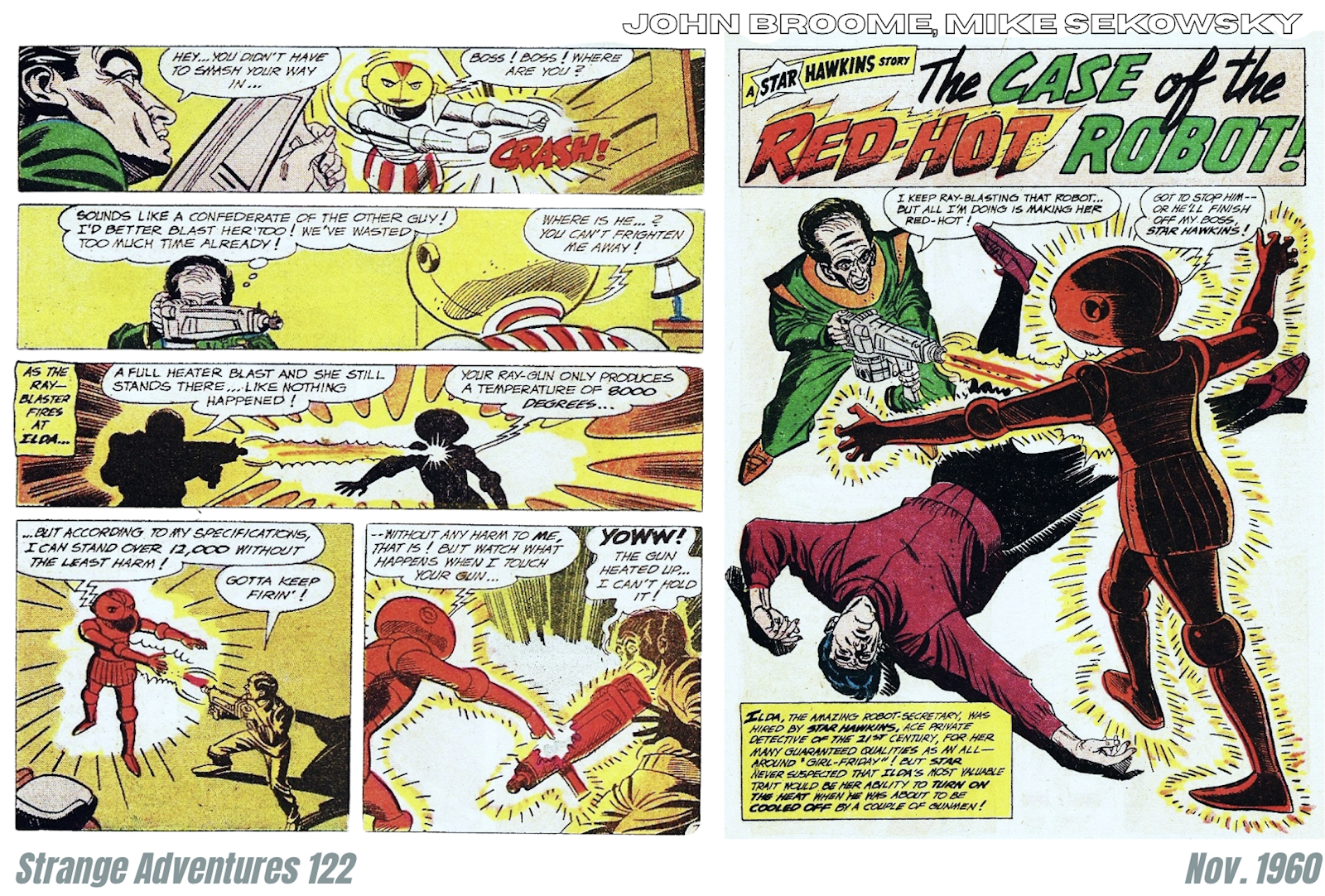
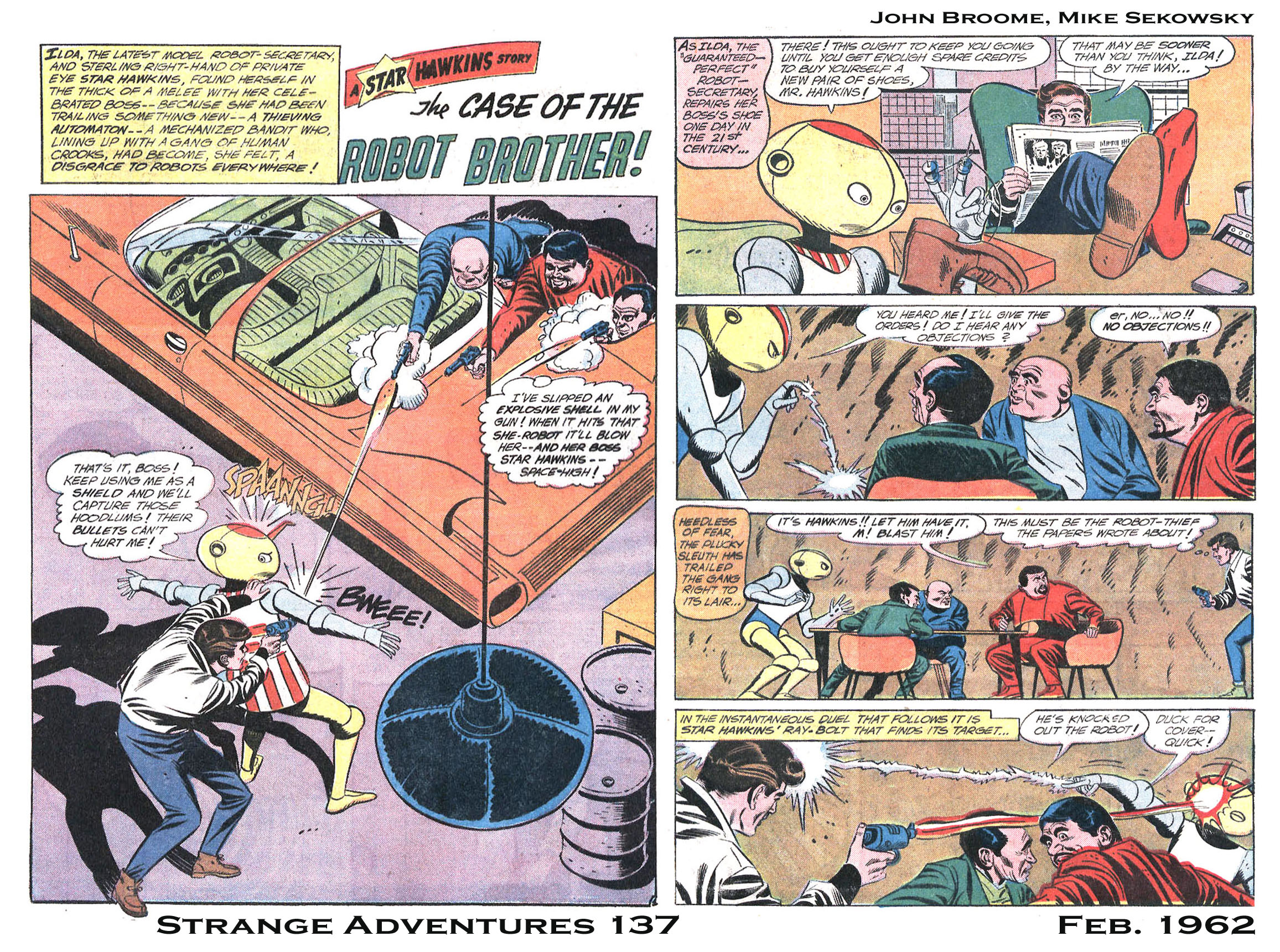
“Despite being the title character, Star Hawkins is clearly a mock-heroic figure of fun here,” observed comics historian Michael E. Grost. “He gets the build-up: the title billing, the glamorous private eye job, the handsome portraiture. But all of this just comically underscores the fact that the long-suffering Ilda has all of the talent, and does most of the detective work.
“There is more than a bit of social satire here. In the 1960s, women were mainly restricted to lower-level jobs, such as secretaries. Many of these women were far more talented than the men they worked for. In many cases, it was their ability that was actually running the business and keeping it afloat.
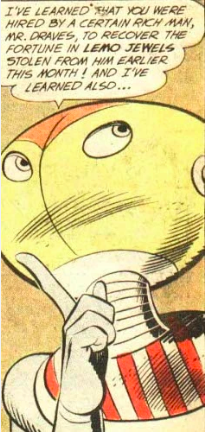 “Ilda is in a popular tradition of highly intelligent, decent but naive intellectuals who innocently get involved with crooks, and who defeat them in the end,” Grost noted. “I always enjoyed such tales, partly because I am an intellectual myself, and can identify with the heroes. The intellectuals in these tales are always mild-mannered, and lacking in street smarts. They have formidable brain power, here represented by Ilda’s robotic brain.”
Created by writer John Broome and artist Mike Sekowsky for Strange Adventures 114 (March 1960), Hawkins and Ilda appeared in every third issue until 1963, and were briefly revived in 1965-66.
“Sekowsky’s depiction of Ilda is a comic gem,” Grost noted. “She is purely geometric, contrasting with all the realistically drawn humans around her. She has considerable feelings, even though she is a robot.”
“Many is the time she saved her employer from being worked over or killed by criminals (or, as they call them in the 21st century, ‘zips’),” noted Mike W. Barr in The Silver Age Sci-Fi Companion. “If The Atomic Knights, to debut three months later, was as serious as a comic book series could be in 1960 and still be approved by the Comics Code Authority, Star Hawkins took the opposite tack… (the detective) was always a day late and a space credit short. A recurring gag was his frequent pawning of Ilda to pay the rent or his creditors.”
DC’s delightful, ovoid-headed automaton wasn’t alone. Female robot sidekicks were more common than you’d think back then. Rosey the Robot on The Jetsons had a similar but even more cartoony vibe, and Tina the platinum robot in Metal Men had a vaguely analogous relationship with her creator, Dr. Will Magnus (although Ilda wasn’t so desperately in love). And then Rhoda the Robot arrived in 1964 on the sitcom My Living Doll, in the statuesque person of Julie Newmar, to add some tame sexual innuendo and frustration to the comic mixture.
About Author
