
Charlton Comics apparently had a thing against the letter G. The publisher’s titles included Fightin’ Air Force, Fightin’ Army, Fightin’ Marines, Fightin’ Navy and Fightin’ Five.
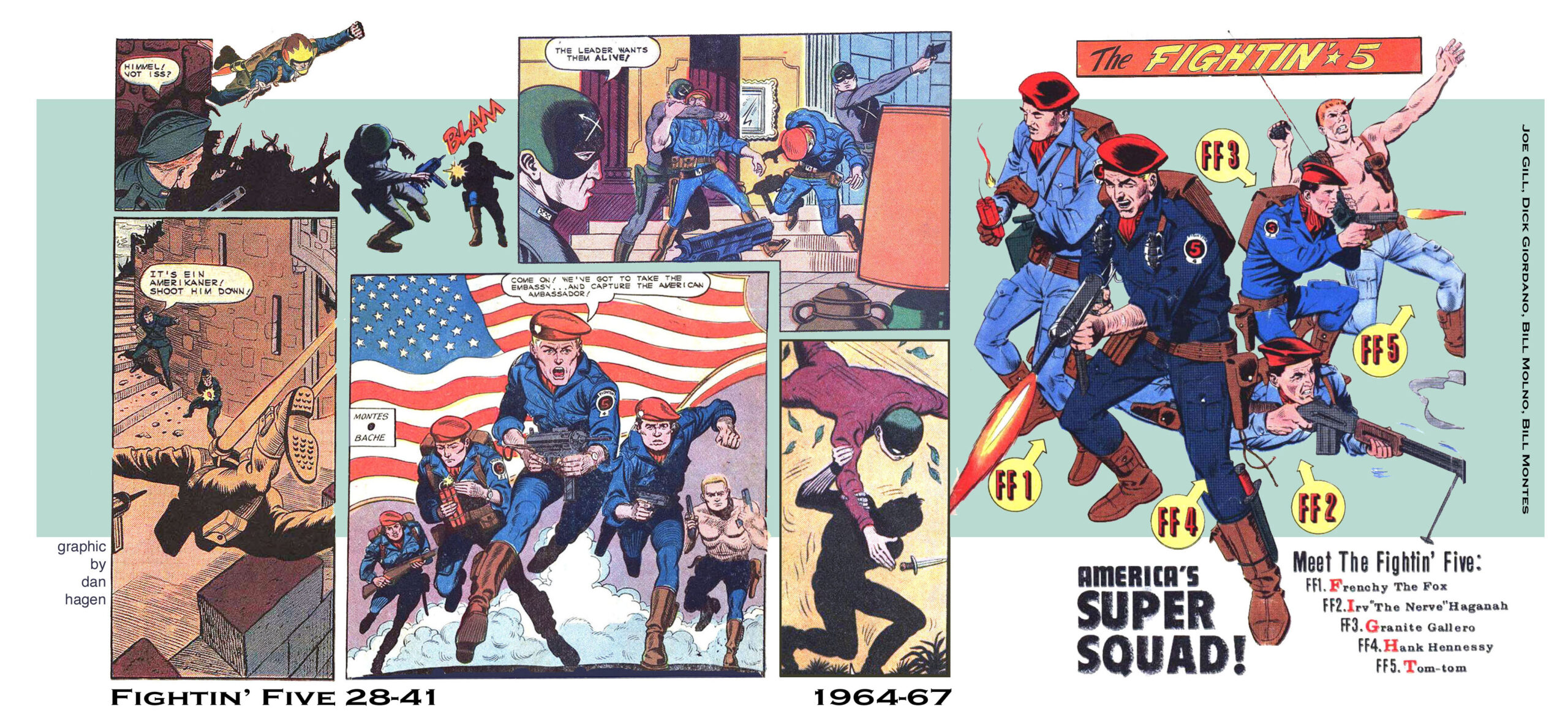
But since my interest in war comics was largely confined to those that co-starred dinosaurs, I bought only that last title. The military specialist commandos of the Fightin’ Five — Hank Hennessy, Irv “the nerve” Haganah, Granite Gallero, Frenchy the Fox and Tom-Tom — split the difference between superhero, secret agent and military comics. By the way, their initials spelled “FIGHT.”
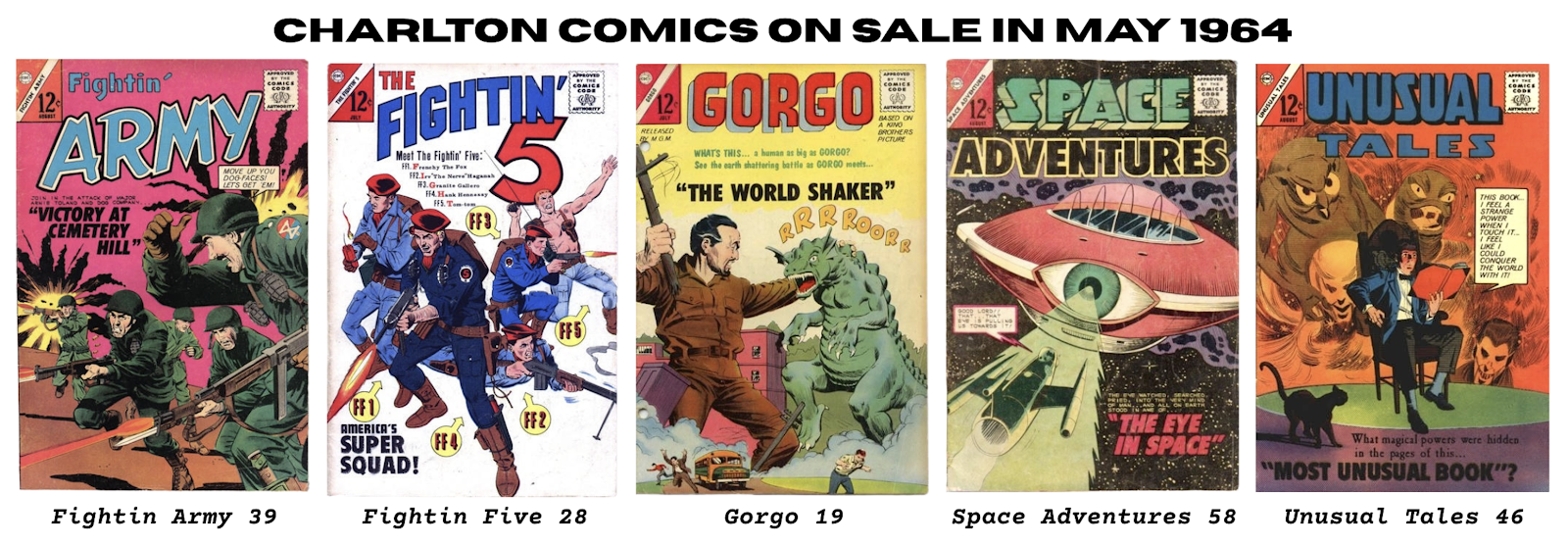
Taking over Charlton’s Space War numbering, the paramilitary team debuted in Fightin’ Five 28 (July 1964).
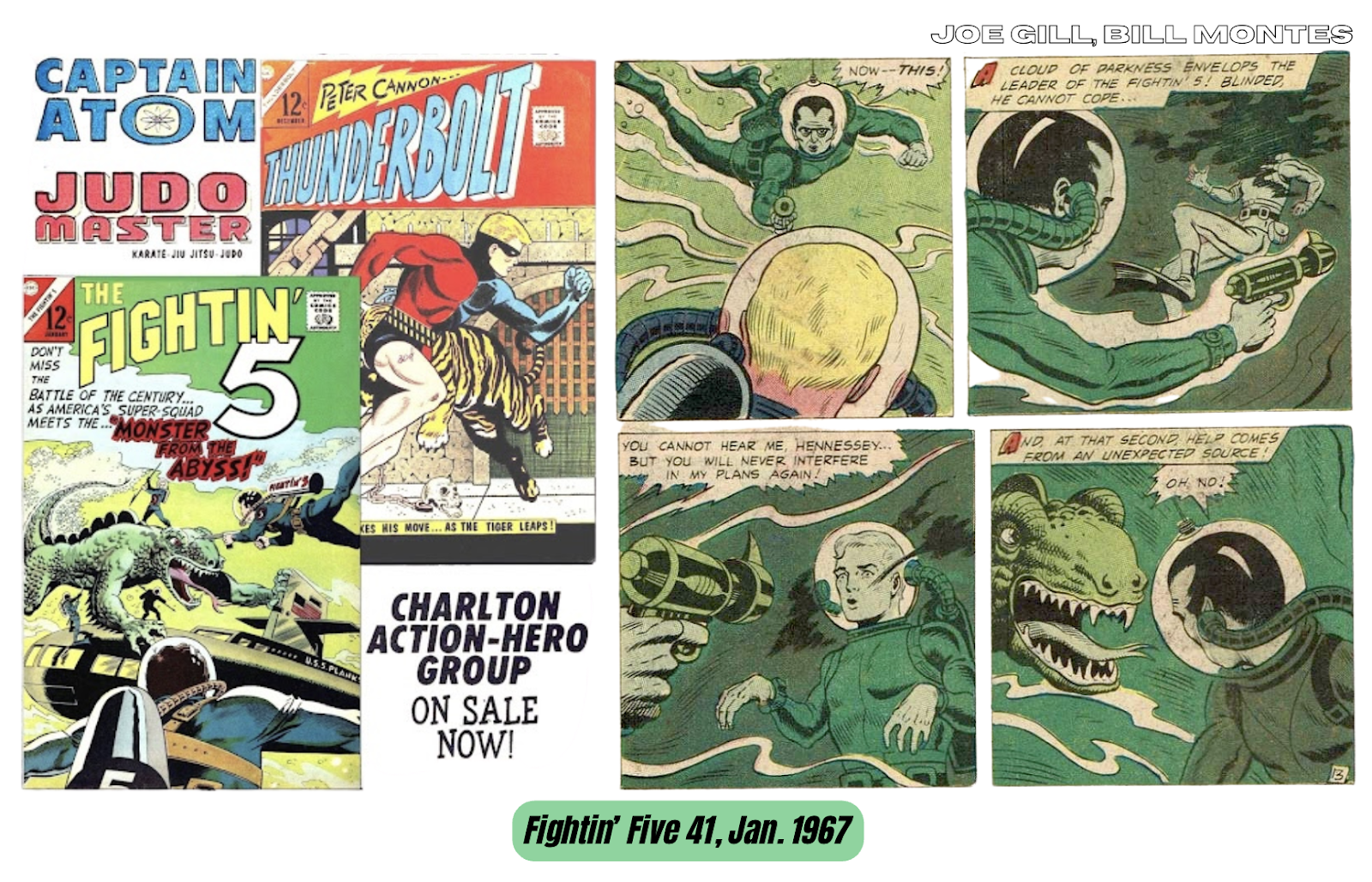
Charlton had previously offered the nuclear-powered Captain Atom and the magically powered Blue Beetle. Still, by 1964 the publisher was pushing for more relatively “realistic” protagonists, not called superheroes but “Action Heroes.”
Those included Thunderbolt, Peacemaker, the Question, the World War II-era Judomaster, a non-superpowered Blue Beetle, the Vietnam vet-turned-private eye Sarge Steel and the Fightin’ Five.
 In the Five’s case, the new verisimilitude extended even to mortality, as we shall see.
Created by Joe Gill and Bill Montes, the CIA originally recruited the Five to free a kidnapped physicist, something “…the CIA, the Army, Navy, Air Force, Marines and all other agencies” hadn’t been able to accomplish.
The individualistic appeal of these commandos caused me to part with a dozen pennies more than once. Superhero fans could appreciate the jet packs they sometimes used, and their trusty machine guns could always be relied upon to rattle out “Budda! Budda! Budda!” and “Ratatatatat!”
Like the Blackhawks, they fought ex-Nazis, ancient Aztecs, Arab terrorists, the Viet Cong, a Chinese dragon cult, a billionaire despot with a private army, the volcano-based criminal agency S.A.T.A.N., the hypnotic Lady Dawn and her agents of D.E.A.T.H. (“Dedicated Enemies of And Traitors To Humanity”) a telepathic mad scientist oceanographer who could breathe underwater and Joshua Forbes, an American fascist demagogue who intended to become president of the United States. Not every member of the team was convinced Forbes was dangerous, though.
“He’s just another long-winded crackpot, isn’t he?” Granite said. “He’s ridiculous, contradicts himself about every other sentence.”
The Five also fought what was clearly Gorgo, the giant monster Charlton licensed from the movies.
After a 14-issue run, the team became a backup feature in Peacemaker’s title and apparently ran out of luck. Irv was murdered, Hennessey lost an eye and an arm, and Sonya, a former Russian spy, joined the group. Only her hair remained red.
“This gallant little band saved the world … but at an awful price!” wrote Gill in Peacemaker 1 (March 1967). “Irv the Nerve is dead … Hennessy’s right arm is terribly injured … and none of them know if he will ever see again! Yet, not one of them regrets doing what had to be done!”
About Author
