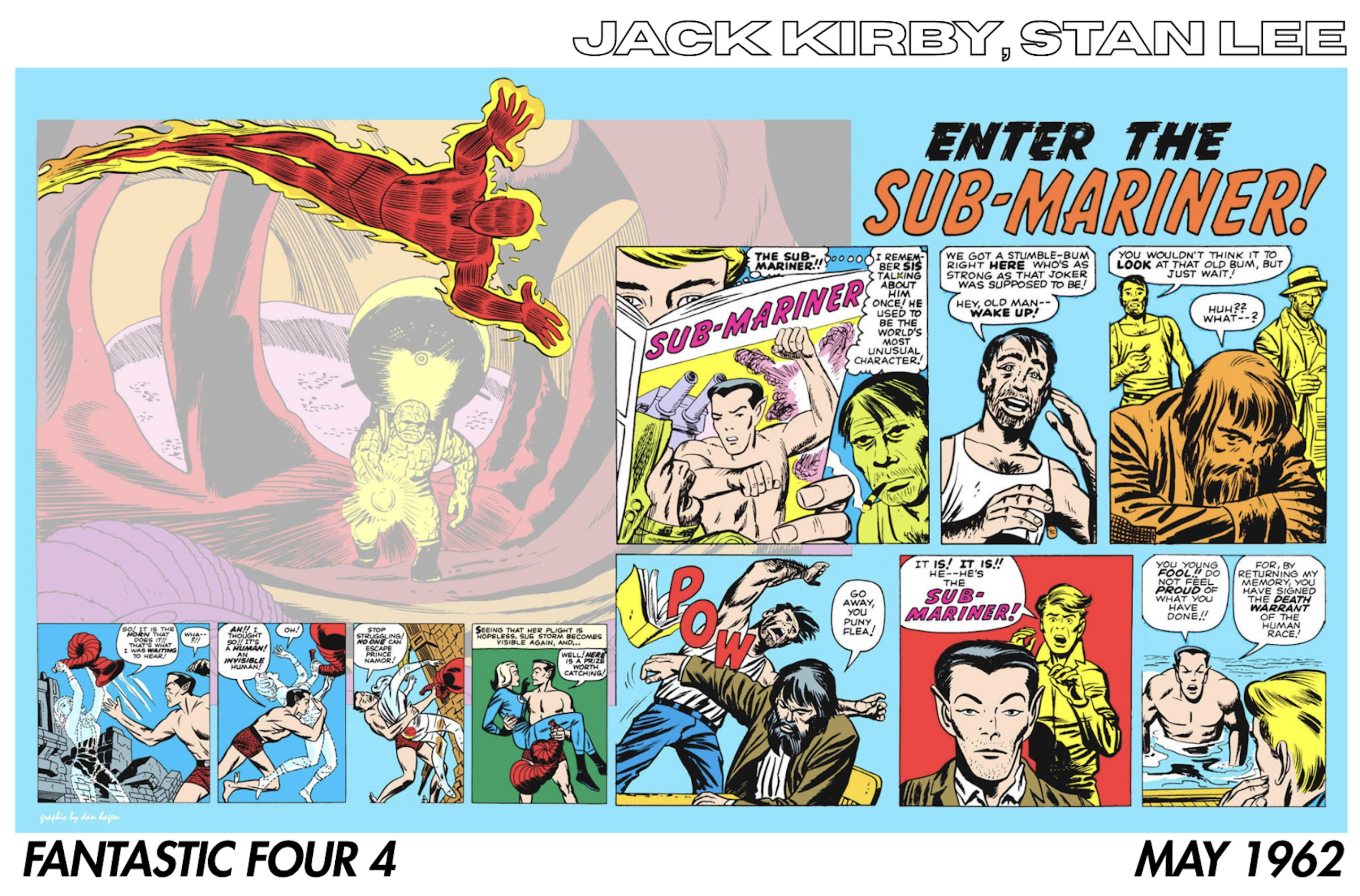
Here in the fourth issue of Fantastic Four (May 1962) was yet another Marvel innovation — a major superhero from the past reintroduced as having been embittered and maybe even deranged by tragedy.
Because I was too young to know anything about the Sub-Mariner, I didn’t understand how original Stan Lee and Jack Kirby’s approach was at the time.
“(I)n tracking Stan Lee’s gradual realization of the world-building possibilities, this is a big one,” wrote comics historian Don Alsafi.
“Subby and the Torch, along with Captain America … were the ‘Big Three’ around which Timely’s successful Golden Age superheroes were built, and although they were almost totally absent from the ‘50s, there had been enough adventures during the 1940s to create a mostly consistent world.
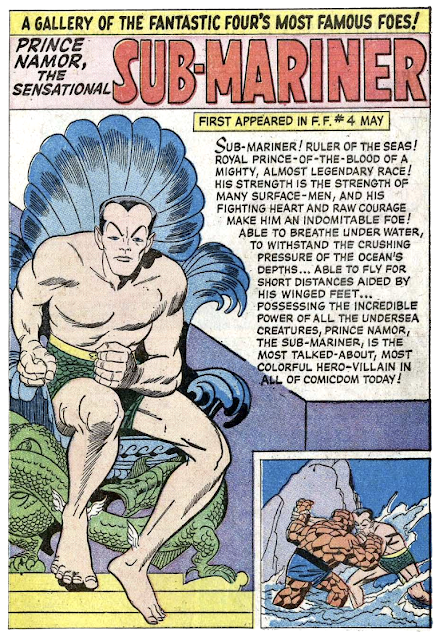 “As Stan had started working at Timely almost from its very beginning, this meant he had seen firsthand how the 1940s superhero comics had succeeded, and how having solo characters sometimes pop up in each other’s strips had excited the readers. By bringing back one of Marvel’s very first heroes after a virtual 10-year absence, he sought to both legitimize this new comic by attaching it to something once remembered (even if only by your parents), and instantly broaden the scope of the world that the FF lived in. But, Stan must have wondered, will it work?
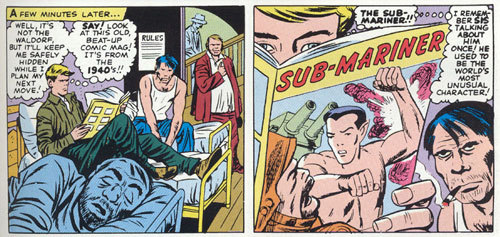
Marvel’s innovations began showing up even in minor ways. Here, rebellious Johnny Storm discovers the amnestic Namor among the homeless men in a Bowery “flophouse.” No squeaky-clean DC superhero would be caught dead in a “flophouse.”
The volatile and manic Sub-Mariner had made war on the human race in his first appearances during the late 1930s and early 1940s, so returning him to that role wasn’t too great a dramatic stretch.
With his memory restored by the Human Torch, Prince Namor discovers that his Atlantean homeland has been irradiated by atomic testing, and that his people have been scattered. His alienation and rage are understandable.
So Marvel gains a new knight for its plotting chessboard, a piece free to make unexpected moves as either hero or villain whenever the situation required.
And from the first, the FF’s appeal was enhanced by both the grandeur and the moodiness of Kirby’s art. Just look at that scene where the Thing is carrying an atom bomb strapped to his back into the cavernous, eerily shadowed innards of the giant whale monster. You knew you weren’t going to see that elsewhere.
For whatever reason, “fantastic fourth” issues often contained notable surprises during the Silver Age — the induction of Green Arrow in the Justice League of America 4 and the discovery and rescue of the lost Captain America in Avengers 4, for example.
About Author
