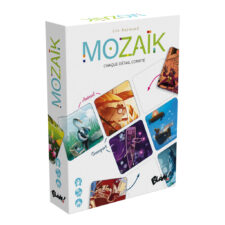
 Sometimes a game comes along that completely catches you off guard. That was Mozaik.
From the moment it hit our table, this little game far exceeded our expectations.
Like so many modern releases, Mozaik, designed by Léo Raynaud and published by BLAM! (with Canadian distribution through Ilo307.com), comes in a compact box filled primarily with cards and promises a 30-minute playtime. At first glance, it looked like just another filler game designed for today’s culture of constantly moving on to the next website, TV show, or board game.
Even as Meeple Guild member Trevor explained the rules during the drive over one Sunday evening, I couldn’t help wondering if a game this simple could really be that much fun.
I was pleasantly surprised.
A game of Mozaik lasts nine rounds, with each player building a personal 3×3 grid of artwork cards. That sounds straightforward enough, but this is where the game starts to shine.
The artwork is simply stunning.
Each card feels like a miniature work of art, and many deserve to be printed as full-sized posters for a game room wall. The deck features illustrations from a collective of 33 artists, creating an incredible variety of artistic styles. Every card rewards close inspection because tiny hidden details scattered throughout the artwork are essential to scoring. Rather than simply glancing at your cards, you’re encouraged to study every illustration, discovering new little elements each time you play.
Each player begins a round with three numbered artwork cards. Everyone secretly chooses one card, places it face down, and then reveals it simultaneously. Starting with the lowest-numbered card played and continuing upward, players take turns selecting one of four available word cards.
Those word cards are placed around your growing grid and determine how you score. If one of the words is “moon,” for example, you’ll want as many moon images as possible in the corresponding row or column. The clever part is that those moons—and many other symbols—aren’t obvious. They’re often tucked away in the illustrations, rewarding players who really immerse themselves in the artwork.
After nine rounds, the player with the highest score wins.
Despite its accessibility, Mozaik offers more meaningful decisions than first appear. Going first isn’t automatically the best option. Sure, you get the first choice of word cards, but that only matters if you already have—or expect to have—the matching images in your grid. Sometimes it’s more important simply to play the right artwork card, even if that means choosing your word later. Since there is always one more word card available than there are players, even the last player still has a choice.
The scoring cards also introduce interesting twists. Some reward collecting multiple matching images, while others actually score better if you have only a single matching symbol. Those subtle differences create satisfying tactical decisions throughout the game. The strategy isn’t overwhelmingly deep, but it’s certainly more engaging than you might expect from a 30-minute filler.
In the end, Mozaik is an immersive little gem. The artwork alone draws you in, but the gameplay keeps you coming back. Every session feels just short enough that you’re immediately tempted to play “just one more.”
That’s perhaps the highest compliment I can give it.
Mozaik is already seeing more table time than almost any other filler game we’ve played this year, and around our group it’s quickly becoming part of the conversation for one of the top five games of 2026.
About Author
Calvin Daniels is a Saskatchewan-born, self-taught journalist. He is currently Editor of Yorkton This Week, with 35-years in the newspaper business.

Mozaik: The Surprise Game of 2026 So Far
From the moment it hit our table, this little game far exceeded our expectations.
Like so many modern releases, Mozaik, designed by Léo Raynaud and published by BLAM! (with Canadian distribution through Ilo307.com), comes in a compact box filled primarily with cards and promises a 30-minute playtime. At first glance, it looked like just another filler game designed for today’s culture of constantly moving on to the next website, TV show, or board game.
Even as Meeple Guild member Trevor explained the rules during the drive over one Sunday evening, I couldn’t help wondering if a game this simple could really be that much fun.
I was pleasantly surprised.
A game of Mozaik lasts nine rounds, with each player building a personal 3×3 grid of artwork cards. That sounds straightforward enough, but this is where the game starts to shine.
The artwork is simply stunning.
Each card feels like a miniature work of art, and many deserve to be printed as full-sized posters for a game room wall. The deck features illustrations from a collective of 33 artists, creating an incredible variety of artistic styles. Every card rewards close inspection because tiny hidden details scattered throughout the artwork are essential to scoring. Rather than simply glancing at your cards, you’re encouraged to study every illustration, discovering new little elements each time you play.
Each player begins a round with three numbered artwork cards. Everyone secretly chooses one card, places it face down, and then reveals it simultaneously. Starting with the lowest-numbered card played and continuing upward, players take turns selecting one of four available word cards.
Those word cards are placed around your growing grid and determine how you score. If one of the words is “moon,” for example, you’ll want as many moon images as possible in the corresponding row or column. The clever part is that those moons—and many other symbols—aren’t obvious. They’re often tucked away in the illustrations, rewarding players who really immerse themselves in the artwork.
After nine rounds, the player with the highest score wins.
Despite its accessibility, Mozaik offers more meaningful decisions than first appear. Going first isn’t automatically the best option. Sure, you get the first choice of word cards, but that only matters if you already have—or expect to have—the matching images in your grid. Sometimes it’s more important simply to play the right artwork card, even if that means choosing your word later. Since there is always one more word card available than there are players, even the last player still has a choice.
The scoring cards also introduce interesting twists. Some reward collecting multiple matching images, while others actually score better if you have only a single matching symbol. Those subtle differences create satisfying tactical decisions throughout the game. The strategy isn’t overwhelmingly deep, but it’s certainly more engaging than you might expect from a 30-minute filler.
In the end, Mozaik is an immersive little gem. The artwork alone draws you in, but the gameplay keeps you coming back. Every session feels just short enough that you’re immediately tempted to play “just one more.”
That’s perhaps the highest compliment I can give it.
Mozaik is already seeing more table time than almost any other filler game we’ve played this year, and around our group it’s quickly becoming part of the conversation for one of the top five games of 2026.
About Author
Calvin Daniels
Calvin Daniels is a Saskatchewan-born, self-taught journalist. He is currently Editor of Yorkton This Week, with 35-years in the newspaper business.
See author's posts