An abstract strategy game with depth for two to four players
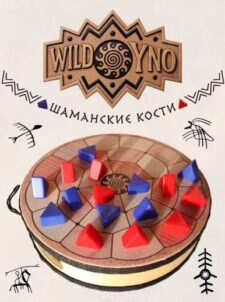 Wild Oyno: Shaman Bones, designed and illustrated by Artem Borovkov, has the feel of a game from another era, even though it is a modern design.
Borovkov has successfully created a vintage aesthetic, thanks in part to the game’s unique board. Instead of a traditional game board, play takes place on the face of a hand drum. The game even includes a drumstick, although just how much sound you can produce—or how hard you dare strike the drum—was not something The Meeple Guild chose to test.
That said, the drums are undeniably eye-catching. If you were playing at a convention or coffee shop, they would almost certainly attract attention.
There are actually two drums included with Wild Oyno. The smaller drum is designed for two players, which is likely the game’s sweet spot—as is often the case with abstract strategy games. The second drum is larger and double-sided, with one side designed for three players and the reverse for four. Having both drums gives the game welcome versatility.
Players place “bones,” triangular game pieces that are somewhat reminiscent of dice. Produced in several colors, the components are excellent and feel satisfying to handle.
At the start of the game, the drum is empty, and each player has a set of eight bones off the board. On your first turn, you simply pick up a bone to hold. If you are holding a bone, you place it in the upright position on any space.
Otherwise, you remove one of your bones from the drum, flip all adjacent bones, move your bone to any space, place it upright, and then flip all adjacent bones again.
If every one of your bones already on the drum is standing upright, you instead pick up a new bone from your supply to hold for your next turn.
The objective is to become the first player to have all eight of your bones standing upright.
During your first game, that goal feels nearly impossible. However, somewhere around the middle of the game, the strategies begin to reveal themselves, and suddenly you can start to see a path toward victory.
The unfortunate aspect of Wild Oyno is its endgame. From roughly the point where players have placed their sixth bone until someone finally wins, the game tends to drag a little. Because the board is relatively small, players often find themselves repeating similar moves, making the closing turns feel somewhat repetitive.
The multiplayer mode is also a game of elimination. The first player to achieve the winning condition is declared the winner, while the remaining players continue until their own placements are decided. While functional, this means the winner can spend several minutes simply watching everyone else finish. Idle time is rarely a positive feature in a board game.
Like many modern strategy titles, Wild Oyno also includes a solo puzzle mode for players looking to test themselves without opponents.
If the endgame were streamlined, this would be an exceptionally solid two-player abstract strategy game with a distinctive old-world charm. As it stands, the unique presentation, excellent components, and satisfying strategic decisions make it worth exploring, even if the final stretch lingers a bit longer than it should.
About Author
Calvin Daniels is a Saskatchewan-born, self-taught journalist. He is currently Editor of Yorkton This Week, with 35-years in the newspaper business.

Wild Oyno: Shaman Bones Review
An abstract strategy game with depth for two to four players
Borovkov has successfully created a vintage aesthetic, thanks in part to the game’s unique board. Instead of a traditional game board, play takes place on the face of a hand drum. The game even includes a drumstick, although just how much sound you can produce—or how hard you dare strike the drum—was not something The Meeple Guild chose to test.
That said, the drums are undeniably eye-catching. If you were playing at a convention or coffee shop, they would almost certainly attract attention.
There are actually two drums included with Wild Oyno. The smaller drum is designed for two players, which is likely the game’s sweet spot—as is often the case with abstract strategy games. The second drum is larger and double-sided, with one side designed for three players and the reverse for four. Having both drums gives the game welcome versatility.
Players place “bones,” triangular game pieces that are somewhat reminiscent of dice. Produced in several colors, the components are excellent and feel satisfying to handle.
At the start of the game, the drum is empty, and each player has a set of eight bones off the board. On your first turn, you simply pick up a bone to hold. If you are holding a bone, you place it in the upright position on any space.
Otherwise, you remove one of your bones from the drum, flip all adjacent bones, move your bone to any space, place it upright, and then flip all adjacent bones again.
If every one of your bones already on the drum is standing upright, you instead pick up a new bone from your supply to hold for your next turn.
The objective is to become the first player to have all eight of your bones standing upright.
During your first game, that goal feels nearly impossible. However, somewhere around the middle of the game, the strategies begin to reveal themselves, and suddenly you can start to see a path toward victory.
The unfortunate aspect of Wild Oyno is its endgame. From roughly the point where players have placed their sixth bone until someone finally wins, the game tends to drag a little. Because the board is relatively small, players often find themselves repeating similar moves, making the closing turns feel somewhat repetitive.
The multiplayer mode is also a game of elimination. The first player to achieve the winning condition is declared the winner, while the remaining players continue until their own placements are decided. While functional, this means the winner can spend several minutes simply watching everyone else finish. Idle time is rarely a positive feature in a board game.
Like many modern strategy titles, Wild Oyno also includes a solo puzzle mode for players looking to test themselves without opponents.
If the endgame were streamlined, this would be an exceptionally solid two-player abstract strategy game with a distinctive old-world charm. As it stands, the unique presentation, excellent components, and satisfying strategic decisions make it worth exploring, even if the final stretch lingers a bit longer than it should.
About Author
Calvin Daniels
Calvin Daniels is a Saskatchewan-born, self-taught journalist. He is currently Editor of Yorkton This Week, with 35-years in the newspaper business.
See author's posts