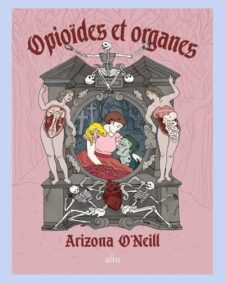
 Opioids and Organs
Writer/Artist: Arizona O’Neill
Published: 2026 by Drawn and Quarterly
First of all, a great big tip of the reviewer’s chapeau to Montreal-based publisher Drawn and Quarterly. Dating back to 1989, D&Q has become a graphic-novel publishing powerhouse with a distinct identity.
The books D&Q publishes come from an international roster of creators, each offering stories that are strange, weird, wild, unusual, and, more often than not, equally wonderful and thoroughly engaging.
That brings me to Opioids and Organs by Montreal-based writer and illustrator Arizona O’Neill.
In typical D&Q fashion, this book is beautifully produced. The hardcover features raised embossing on the front cover, giving it an immediate sense of quality. It feels like something special the moment you lift it off the shelf.
As I mentioned, D&Q books often embrace the unconventional, and this one certainly fits that description.
O’Neill pairs the book’s main character with two unusual companions who exist primarily in her thoughts: a wisecracking yellow gecko and Frankenstein’s monster. It makes for an odd trio, but somehow they work remarkably well together.
The story begins after Arizona’s father dies from a drug overdose. His organs are harvested for transplantation, a decision Arizona consented to. However, she soon finds herself wrestling with the uncomfortable reality that someone who struggled with addiction and received limited help during his lifetime could suddenly become so valuable after death, providing organs that would likely benefit people from far more privileged circumstances.
From there, Arizona’s deeply personal journey begins.
As Drawn and Quarterly describes it:
“Her parents were bohemian wild kids of ’90s Montreal. He was a talented skateboarder, charming guitarist, and visual artist. She was an aspiring writer and outcast. They lived with other teenagers in the Plateau in a messy apartment filled with drugs, alcohol, and black-market animals. The city’s macabre history, McGill University Faculty of Medicine and Health Sciences, Mount Royal Cemetery, and the ancient cadavers at the Maude Abbott Medical Museum, takes center stage as Arizona sorts out fact from fiction.”
Along the way, O’Neill uncovers some startling historical revelations.
One of the most disturbing involves Vladimir Demikhov, the pioneering Soviet surgeon whose groundbreaking organ transplant experiments in the 1950s included grafting the head and front legs of a small puppy onto the neck of a full-grown German Shepherd.
It’s a gruesome chapter in medical history, educational, certainly, but one you almost wish you had never learned.
That perfectly captures the power of Opioids and Organs. It forces readers to confront difficult realities surrounding addiction, organ donation, medical ethics, grief, and the value society places on human life. It asks uncomfortable questions without pretending to have easy answers, and that’s one of the highest compliments I can pay any book.
As O’Neill’s graphic novel debut, Opioids and Organs was a genuinely pleasant surprise.
I appreciated its offbeat sense of humor, imaginative storytelling, and willingness to tackle emotionally complex issues while weaving in fascinating historical and medical information. By the time I finished reading, I found myself thinking about organ transplantation, addiction, and the ethical questions surrounding both in ways I never had before.
Ultimately, Opioids and Organs is an intelligent, emotionally honest, and unexpectedly compelling graphic novel. It’s another excellent example of Drawn and Quarterly’s knack for publishing books that challenge readers, expand perspectives, and linger in the mind long after the final page is turned.
About Author
Calvin Daniels is a Saskatchewan-born, self-taught journalist. He is currently Editor of Yorkton This Week, with 35-years in the newspaper business.

Opioids and Organs
Writer/Artist: Arizona O’Neill
Published: 2026 by Drawn and Quarterly
First of all, a great big tip of the reviewer’s chapeau to Montreal-based publisher Drawn and Quarterly. Dating back to 1989, D&Q has become a graphic-novel publishing powerhouse with a distinct identity.
The books D&Q publishes come from an international roster of creators, each offering stories that are strange, weird, wild, unusual, and, more often than not, equally wonderful and thoroughly engaging.
That brings me to Opioids and Organs by Montreal-based writer and illustrator Arizona O’Neill.
In typical D&Q fashion, this book is beautifully produced. The hardcover features raised embossing on the front cover, giving it an immediate sense of quality. It feels like something special the moment you lift it off the shelf.
As I mentioned, D&Q books often embrace the unconventional, and this one certainly fits that description.
O’Neill pairs the book’s main character with two unusual companions who exist primarily in her thoughts: a wisecracking yellow gecko and Frankenstein’s monster. It makes for an odd trio, but somehow they work remarkably well together.
The story begins after Arizona’s father dies from a drug overdose. His organs are harvested for transplantation, a decision Arizona consented to. However, she soon finds herself wrestling with the uncomfortable reality that someone who struggled with addiction and received limited help during his lifetime could suddenly become so valuable after death, providing organs that would likely benefit people from far more privileged circumstances.
From there, Arizona’s deeply personal journey begins.
As Drawn and Quarterly describes it:
Along the way, O’Neill uncovers some startling historical revelations.
One of the most disturbing involves Vladimir Demikhov, the pioneering Soviet surgeon whose groundbreaking organ transplant experiments in the 1950s included grafting the head and front legs of a small puppy onto the neck of a full-grown German Shepherd.
It’s a gruesome chapter in medical history, educational, certainly, but one you almost wish you had never learned.
That perfectly captures the power of Opioids and Organs. It forces readers to confront difficult realities surrounding addiction, organ donation, medical ethics, grief, and the value society places on human life. It asks uncomfortable questions without pretending to have easy answers, and that’s one of the highest compliments I can pay any book.
As O’Neill’s graphic novel debut, Opioids and Organs was a genuinely pleasant surprise.
I appreciated its offbeat sense of humor, imaginative storytelling, and willingness to tackle emotionally complex issues while weaving in fascinating historical and medical information. By the time I finished reading, I found myself thinking about organ transplantation, addiction, and the ethical questions surrounding both in ways I never had before.
Ultimately, Opioids and Organs is an intelligent, emotionally honest, and unexpectedly compelling graphic novel. It’s another excellent example of Drawn and Quarterly’s knack for publishing books that challenge readers, expand perspectives, and linger in the mind long after the final page is turned.
About Author
Calvin Daniels
Calvin Daniels is a Saskatchewan-born, self-taught journalist. He is currently Editor of Yorkton This Week, with 35-years in the newspaper business.
See author's posts