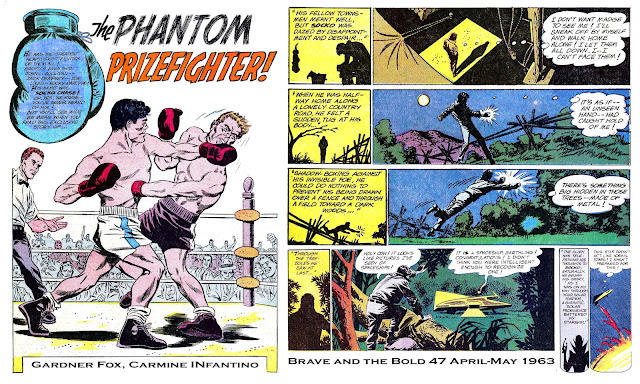
“Like all comics readers, I was allergic to sports, but I LIKED Strange Sports Stories!” recalled Robert Rivard.
“I first saw them in the 25-cent DC Special that reprinted some B&B stories, and then bought the series when it came out a few years later. I thought it was a great change of pace with some interesting sci-fi twists!”
Editor Julius Schwartz clearly enjoyed the concept, and promoted the series’ five Brave and the Bold tryout issues heavily in house ads. But the series never landed its own title during the 1960s, and this handful of stories by DC’s top talents remains a pleasant curiosity.
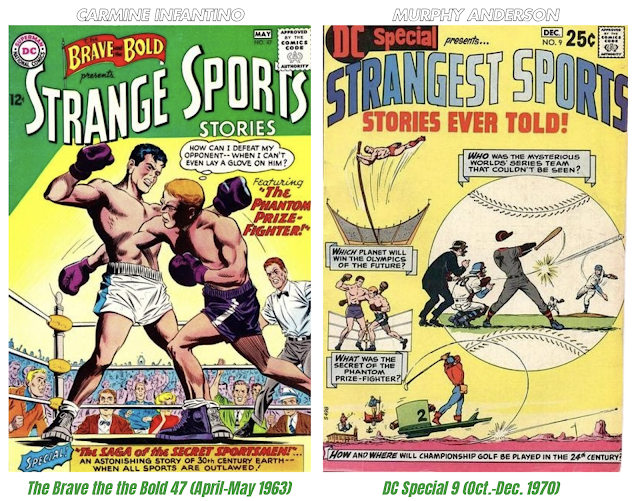
In The Phantom Prizefighter (Brave and the Bold 47, April-May 1963), artist Carmine Infantino and writer Gardner Fox introduce us to Paul “Socko” Chase, a farmer who longs to be a heavyweight boxing champion.
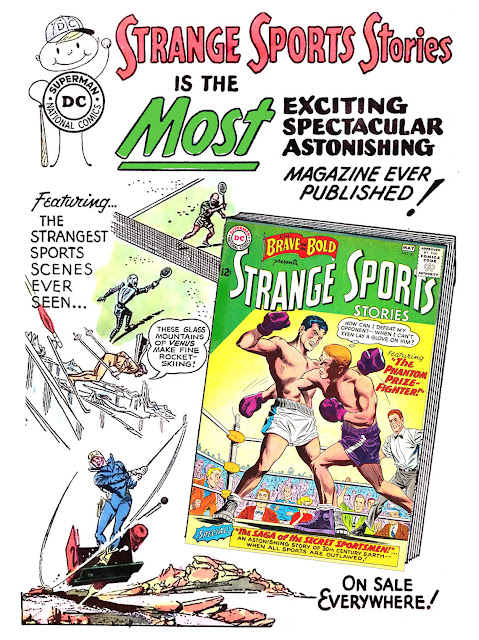 Walking home along a lonely country lane, dejected because of his loss in a carnival boxing match, Chase encounters an invisible alien stranded on Earth by a damaged space ship.
Significantly, the alien turns out to be tall, arrogant and red-skinned — a devil of a fellow who wants not Chase’s soul but his body, which he needs to pass safely through a radiation belt. In exchange, he’ll first make Chase an invincible prizefighter.
Weirdly, Chase agrees, but he gets angry when he learns that his invulnerability consists of being made intangible in the ring.
Socko Chase’s origin story — a crashed spaceship carrying a red-skinned alien who bears superhuman gifts — carries strong echoes of another origin from four years before, that of Green Lantern Hal Jordan (Showcase 24, Sept.-Oct. 1959). But where Abin Sur was benevolent, Socko’s alien is quite the other thing, pointedly a stand-in for Satan.
And unlike Hal Jordan, Socko’s ambitions are purely selfish, a fact that results in his super powers bringing him only bitterness.
 When Socko complains to the alien that his freakish powers have actually cheated him out of any opportunity of becoming a champion boxer, the alien replies, “Stupid earthling! Of what concern is that to me? I care nothing about you. You’re a lower life form, anyhow! I thought I’d have some fun with you while waiting to take over your body!”
Socko is able to defeat the alien, however, with a semantic trick and a fistfight.
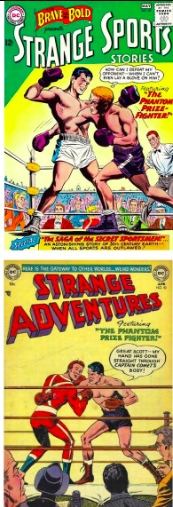
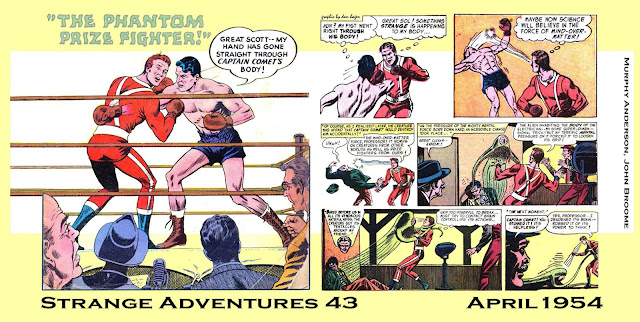
The cover image, of a prizefighter’s fist slipping through his opponent’s ghostly body, might well have looked familiar to older readers.
Captain Comet had found himself in exactly the same position nine years before (Strange Adventures 43, April 1954) when he suddenly became intangible while fighting the world’s heavyweight champ.
The superhero discovered that the anomaly was the result of an assassination attempt when a one-eyed, slug-like alien enemy, disguised as an electrical technician, had tried to disperse his atomic structure.
About Author
