 First Comics News: We are at the seventh edition of the grading guide. What’s new, what has changed in the world of grading?
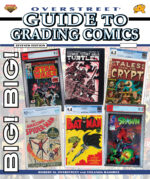
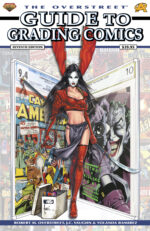
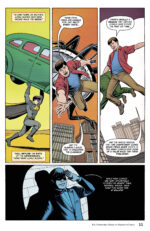
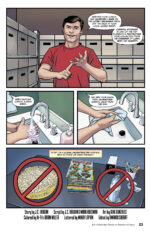
JC Vaughn: Since we’re in an era where most of the grades have been defined for a long time, what’s changed in that regard are some of the visual examples we use for them. That said, the introductory front matter is almost entirely new. We’ve been creating it for several years as part of our Free Comic Book Day issues, so it’s in comic story form. It ranges from taking care of your comics to establishing a good working relationship with your retailer to not falling for deals that are too good to be true. After the grade descriptions, we address the evolution of grading over the years and more.
1st: There is an increased market for custom signatures and remarks. How does this edition address those? Do they increase or decrease value?
 JCV:
JCV: In the past, the Guide’s position was from neutral to negative on autographs, but the market has dictated otherwise. There are still plenty of folks who don’t want any writing or marks on their comics, but now there is a large number of others who really enjoy getting their comics signed and getting those signatures certified along with the comics. There’s not a lot of overlap between the two groups, but they both have a place in the hobby.
1st: What feedback from collectors influenced changes in this edition?
JCV: We are always in the position of listening to constructive feedback, out-of-the-box thinking, or questions about grading issues. It’s not only when we’re preparing a new edition of this book. That said, we’re going to be running some thought-provoking stuff on Overstreet Access after this edition is released. That will be an ongoing process until the next edition, which will be a few years off.
1st: For readers new to comic book grading, is there one established set of rules that everyone agrees with?
 JCV:
JCV: Our Overstreet grading standards took a long time to develop with input from a truly wide spectrum of collectors, dealers, and historians. There has always been some fluctuation, but it’s less volatile today than it was 15 years ago. The general agreement about grading, however, doesn’t mean that there aren’t things still subject to interpretation. That’s why we always advocate for learning what’s in this book and coupling it with as much experience as you can get.
1st: If you get your comics “slabbed” are they using the same grading scale?
JCV: The grading companies have their own interpretations of what is broadly accepted. I think in most cases one would find that there are no seismic differences. CGC published their grading guide, and it offers some good insight into their thinking. Increasing your own knowledge is always the best way to have accurate expectations of what grades you’ll get back from any third-party company.
1st: What are the most common grading mistakes collectors make?
JCV: The most common is letting a passion for the comic in question dictate what you think the grade is. Grading is a time for less passion and more clinical thinking. The goal should be accuracy.
1st: How can collectors improve their grading skills?
 JCV: Practice, practice, practice. Read this book. Internalize it. Get as much experience as you can. You’ll make mistakes, but so what? Just keep at it.
1st: What role does restoration play in grading today? What is acceptable and what is cheating?
JCV: It’s still a tricky question, but we’ve seen some change. True scarcity has made restored copies of issues like Action Comics #1 and Detective Comics #27 more appealing in restored conditions than they have been in the past. Does that signify a sea change or merely the realities of supply and demand? The market will tell us, but it may take a few more years.
1st: Has the rise of third-party grading changed how collectors approach comics?
JCV: For some people, certainly. For others, no. It has definitely enhanced liquidity through the ability to sell comics online or over the phone with people you’ve never met. Before third-party grading, you’d hesitate to buy something sight unseen unless you already knew the seller.
1st: Are collectors becoming more knowledgeable about grading or more dependent on grading companies?
 JCV:
JCV: That’s a great question! Unfortunately, the answer is “both.” Some people have used this era as a time to become highly aware of grading. Others, though, simply rely on the grading service and are surprised by what they get back.
1st: How has the speculation market impacted grading?
JCV: In terms of the sheer numbers of certain issues getting certified, it’s pretty easy to see, but in terms of the long-term impact, that’s more difficult to assess.
1st: Do modern comics require different grading considerations than Golden Age books?
JCV: Ask three different dealers, and you’ll get five different answers. Many believe that we should be more charitable toward the older material. I don’t agree with that, but it’s about what the market accepts, not what I think should happen.
1st: What role does grading play in preserving comic history?
JCV: For non-certified or “non-slabbed” comics, archival practices are essential to preserving this great pop culture heritage. For certified comics, you’d have to ask the respective companies for the archival status of their holders.
1st: What first sparked your interest in comic book grading?
 JCV: When we got the assignment to translate the original 100-point grading system into the 10-point grading system in use today, I had to get familiar with the first edition of The Overstreet Guide To Grading Comics in a hurry. Up to that point, I was mainly a writer and comics historian. In that process, though, I learned grading was nowhere near as hard as I thought. It just requires lots of practice. That’s how I got drawn into it.
1st: Have you ever disagreed with a professional grading assessment?
JCV: Oh, sure. In as much as there’s a solid baseline for understanding grades, there are still human beings involved. My reactions range from “Spot on!” to “#@&*!” but there’s a lot more agreement than negative reactions.
1st: Why was Zoop chosen as the crowdfunding platform for this project?
JCV: Each of the crowdfunding platforms has something to offer. Zoop has some very passionate people behind it, and I greatly appreciated their enthusiasm for working with us. We really wanted to test out this format for The Overstreet Guide To Grading Comics since The Big, Big Overstreet Comic Book Price Guide has been a strong limited-edition seller for years.
1st: What exclusive items or rewards can backers look forward to?
JCV: The main thing is the book itself. We have a retailer-friendly category, but The Big, Big Overstreet Guide To Grading Comics is only available through this offer. It’s really a test case. We’ve wanted to do this for years, but we don’t know if it’s something consumers will really want. This is how we’re testing this one, with an eye toward the future after we see the results.
 1st
1st: What does a successful campaign look like to you beyond funding?
JCV: We have several spin-off specialty books from the Price Guide that we’d like to try. This could create additional opportunities.
About Author
Rik Offenberger has worked in the comic field as a retailer, distributor, reporter, public relations coordinator, writer and publisher since 1990. He owns and operates the e-mail bases Super Hero News service, and his published works in print can be seen in The Comics Buyers Guide, Comic Retailer, Borderline Magazine, and Comics International. On the internet he has worked as a writer and/or editor for Silver Bullet Comicbooks, Comic Book Resources, Newsarama and First Comics News. He was the Public Relations Coordinator at Archie Comics for a decade. He is currently the Editor-In-Chief at G-Man Comics. For TwoMorrows Publications, Rik co-wrote The MLJ Companion with Paul Castiglia and Jon B. Cooke, charting the history of Archie’s superheroes, and for Gemstone Publishing wrote chapters of The Overstreet Comic Book Price Guide to Lost Universes.

 First Comics News: We are at the seventh edition of the grading guide. What’s new, what has changed in the world of grading?
 JCV: In the past, the Guide’s position was from neutral to negative on autographs, but the market has dictated otherwise. There are still plenty of folks who don’t want any writing or marks on their comics, but now there is a large number of others who really enjoy getting their comics signed and getting those signatures certified along with the comics. There’s not a lot of overlap between the two groups, but they both have a place in the hobby.
 JCV: Our Overstreet grading standards took a long time to develop with input from a truly wide spectrum of collectors, dealers, and historians. There has always been some fluctuation, but it’s less volatile today than it was 15 years ago. The general agreement about grading, however, doesn’t mean that there aren’t things still subject to interpretation. That’s why we always advocate for learning what’s in this book and coupling it with as much experience as you can get.
 JCV: Practice, practice, practice. Read this book. Internalize it. Get as much experience as you can. You’ll make mistakes, but so what? Just keep at it.
 JCV: That’s a great question! Unfortunately, the answer is “both.” Some people have used this era as a time to become highly aware of grading. Others, though, simply rely on the grading service and are surprised by what they get back.
 JCV: When we got the assignment to translate the original 100-point grading system into the 10-point grading system in use today, I had to get familiar with the first edition of The Overstreet Guide To Grading Comics in a hurry. Up to that point, I was mainly a writer and comics historian. In that process, though, I learned grading was nowhere near as hard as I thought. It just requires lots of practice. That’s how I got drawn into it.
 1st: What does a successful campaign look like to you beyond funding?