
By 1949, the American mass audience was pretty familiar with invisible avengers.
After all, by that time, the Shadow had been pulling that trick on radio for 11 years.
Lamont Cranston’s popularity prompted other radio protagonists to experiment with the unseen.
In 1945-46’s The Avenger, criminologist-biochemist Jim Brandon used a “Black Light of Invisibility” to turn himself invisible. Brandon could also read minds, for good measure. Even The Blue Beetle resorted to an invisibility fluid in a 1940 radio episode.
On screen, in the 1940 sequel The Invisible Man Returns, the protagonist uses the formula discovered in the original 1933 film to clear himself of false murder charges.
 Some 1940s comic book superheroes relied on the power, including the Invisible Hood, Captain Triumph and the Invisible Boy. Invisible Scarlet O’Neil appeared in newspaper comics.
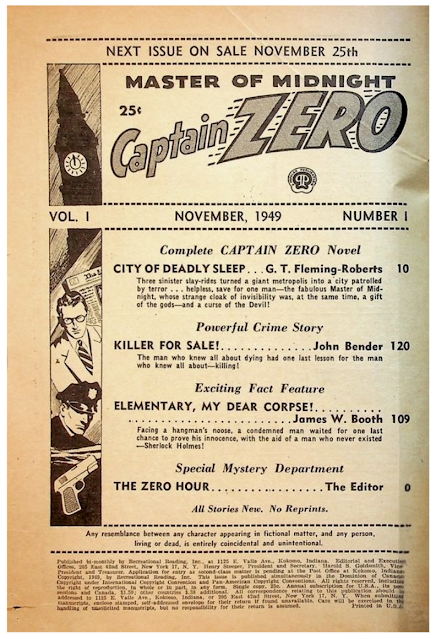
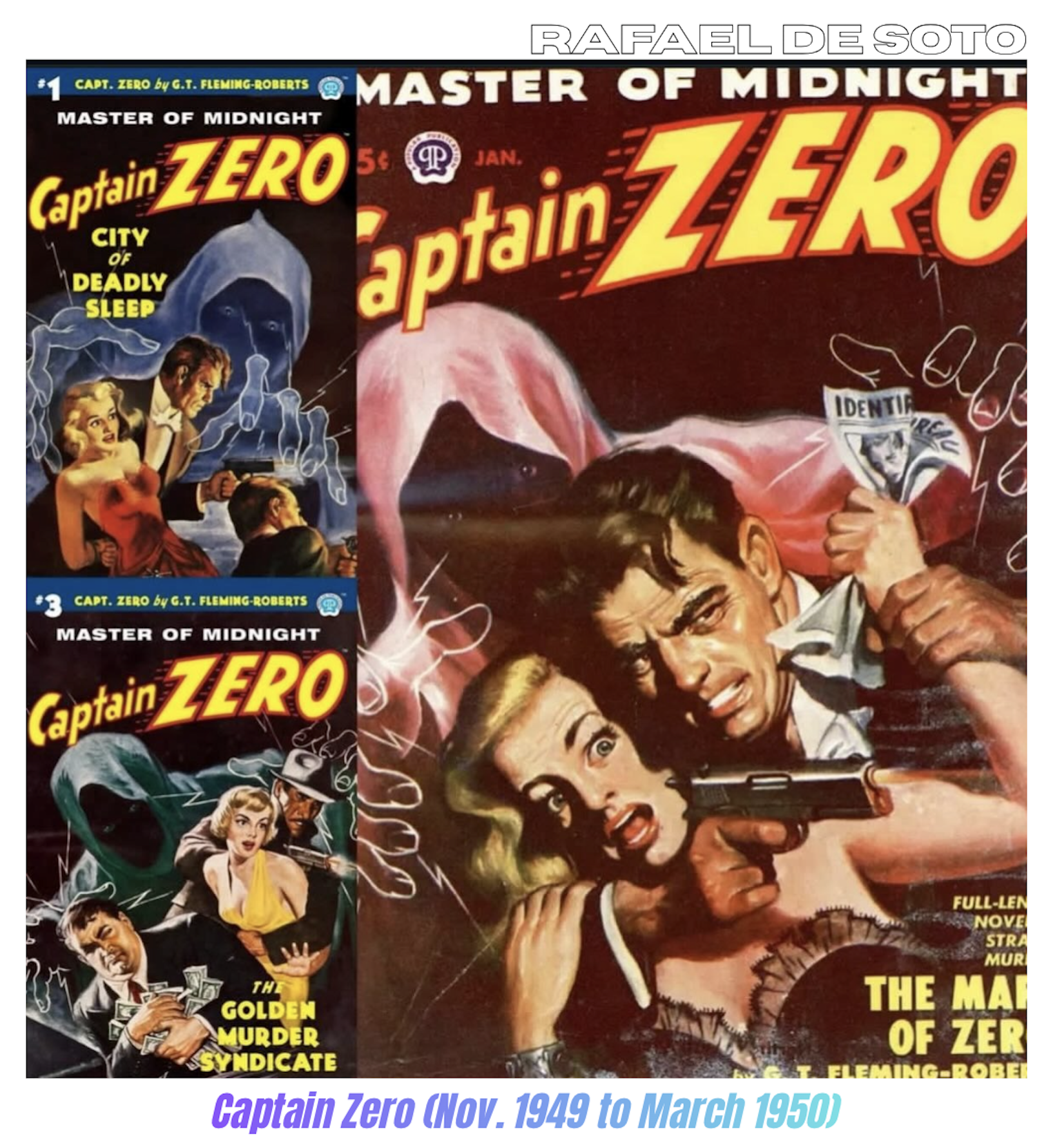
And while pulp magazine protagonists often stopped just short of actual super powers, a latecomer called Captain Zero crossed the line. Debuting in 1949, Captain Zero ran for three issues.
Captain Zero, the Master of Midnight, wasn’t so impressive in person. “Lee (Allyn) was just a little squirt — only five-feet-four — bland of personality, uncoordinated under stress and blind as a bat without his glasses,” noted Don Hutchinson in The Great Pulp Heroes.
“What happened was that editor Alden Norton instructed author G.T. Fleming-Roberts to produce a pulp character with more human characteristics.”
“Zero … turned invisible every night at midnight,” popular culture historian Ron Goulart recalled. “This happened, an unfortunate side effect of some experiments at the famed Lockridge Research Foundation near Chicago, whether Allyn wanted to disappear or not. He’d considered his wild talent a liability until Steve Rice, reform-minded publisher of the World, had said to him, ‘I can use you, Allyn, in my cleanup campaign. You’ll be my captain. Captain Zero. How’s that for a name for nothingness?’ Allyn worked as a reporter on the World and both he and his boss were impatient with the law’s delays.”
The series subverts some of the conventions already established by the more stalwart superheroes.
“His author has him trapped in the real world — our world — where nothing goes smoothly,” Hutchinson observed. “Wherever he walks, somebody is always noticing his footprints from depressions in the grass or carpets. He can’t carry a weapon because weapons aren’t invisible. Because his eyeglasses would also reveal his presence, he substitutes contact lenses; but the light keeps striking them, alerting cops and crooks to his presence.”
Captain Zero wasn’t the first invisible avenger in the pulps. In the May 1939 issue of Fantastic Adventures magazine, Earl and Otto Binder published The Invisible Robinhood, a story about a scientist who used his invisibility suit to fight crime.
Perhaps most satisfying to fans was mystery writer Bill Pronzini’s story in the June 1971 issue of The Magazine of Fantasy & Science Fiction. In The Man Who Collected the Shadow, Pronzini introduces us to Theodore Conway, a mild-mannered law clerk/fanboy who is obsessed with the Shadow. To his surprise, he finds that his single-mindedness has granted him the power to cloud men’s minds, and he proceeds to fight crime, accompanied by a sinister laugh…
While invisible crimefighters are common in fiction, Plato suggested that the opposite would be true in real life.
“For Plato, … invisibility was not a wonderous power but a moral challenge — to which none of us is likely to prove equal,” wrote Philip Ball in The Dangerous Allure of the Unseen. “Invisibility corrupts; nothing good could come of it. In particular, invisibility will tempt us toward three things: power, sex and murder. This is the promise which has lured people to seek invisibility throughout time, whether by magical spells or esoteric arts or devices and garments that confer the ability to vanish.”
About Author
