
 Twenty-first century superhero movies often feature villains for whom we can have some sympathy. Even Thanos, the alien death god who snuffed out the lives of half the sentient beings in the universe in a single moment, had reasons that he thought valid.
But even in the innocent Silver Age of the 1960s, some of the better superhero comic book stories sometimes took a more nuanced view of good and evil.
Take writer John Broome’s early Green Lantern tales, for example.
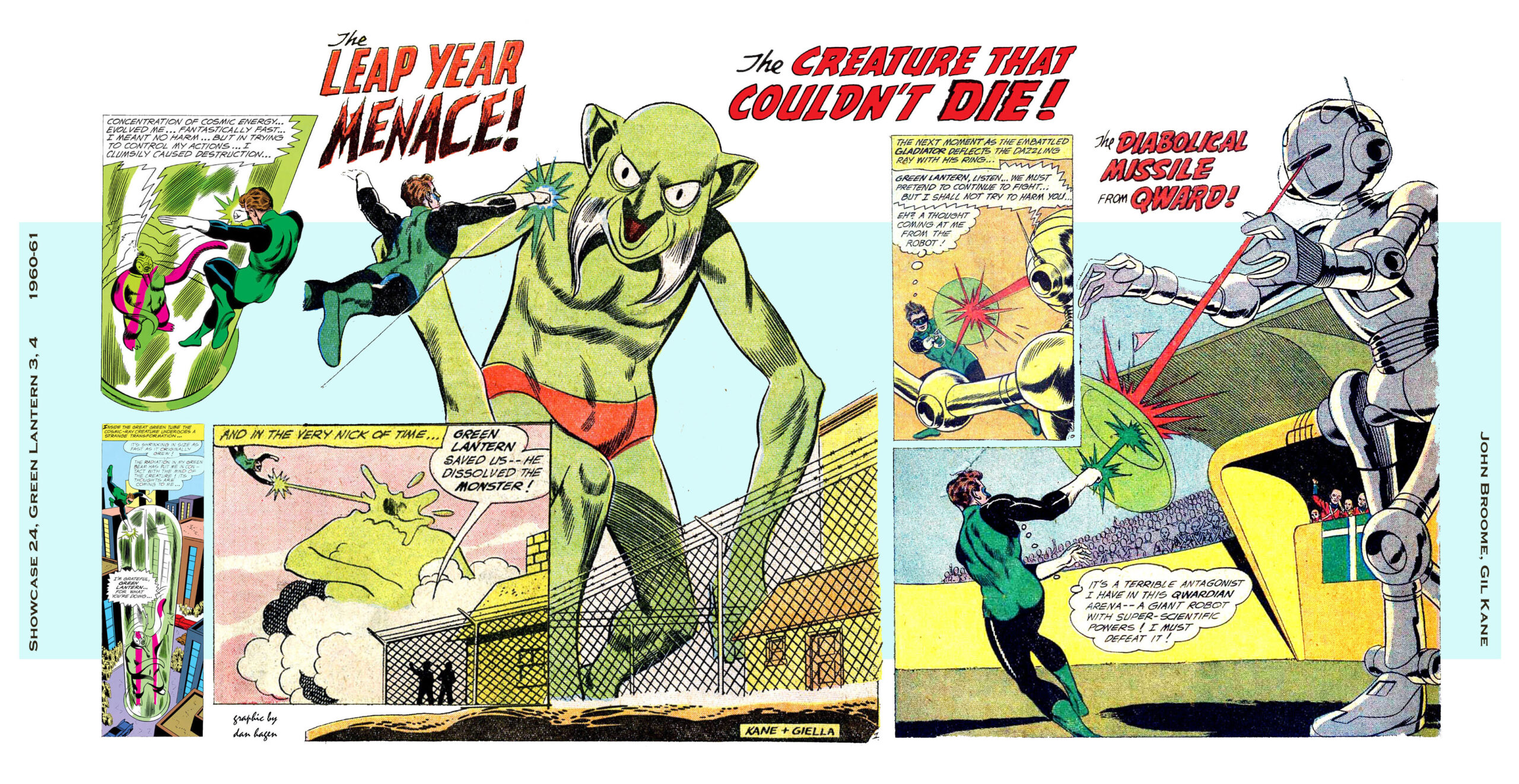
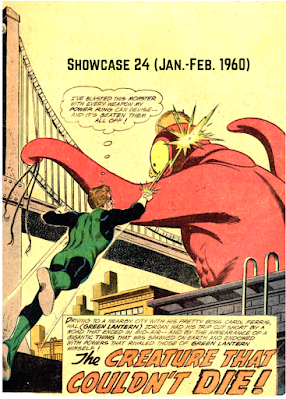
In GL’s third tryout issue, Showcase 24 (Jan.-Feb. 1960), he faced the threat of The Creature That Couldn’t Die. Scientists testing the effects of cosmic rays accidentally grow a giant, red, tentacled menace out of a test tube, a creature invulnerable even to Green Lantern’s power ring. The Green Champion hits on the idea of forming his own giant test tube to cut off the cosmic rays that power the entity.
“I’m grateful, Green Lantern, for what you’re doing,” the creature tells him as it shrinks. “Concentration of cosmic energy … evolved me … fantastically fast … I meant no harm … but in trying to control my actions … I clumsily caused destruction.
“Now at last … thanks to you … I am no longer a menace to myself … or world.”
“Dead,” thinks Green Lantern. “It’s become a lifeless blob.”
This surprisingly thoughtful note — the menace’s acceptance of its own execution, a kind of stoic suicide — left readers with a poignant respect for the “monster.”
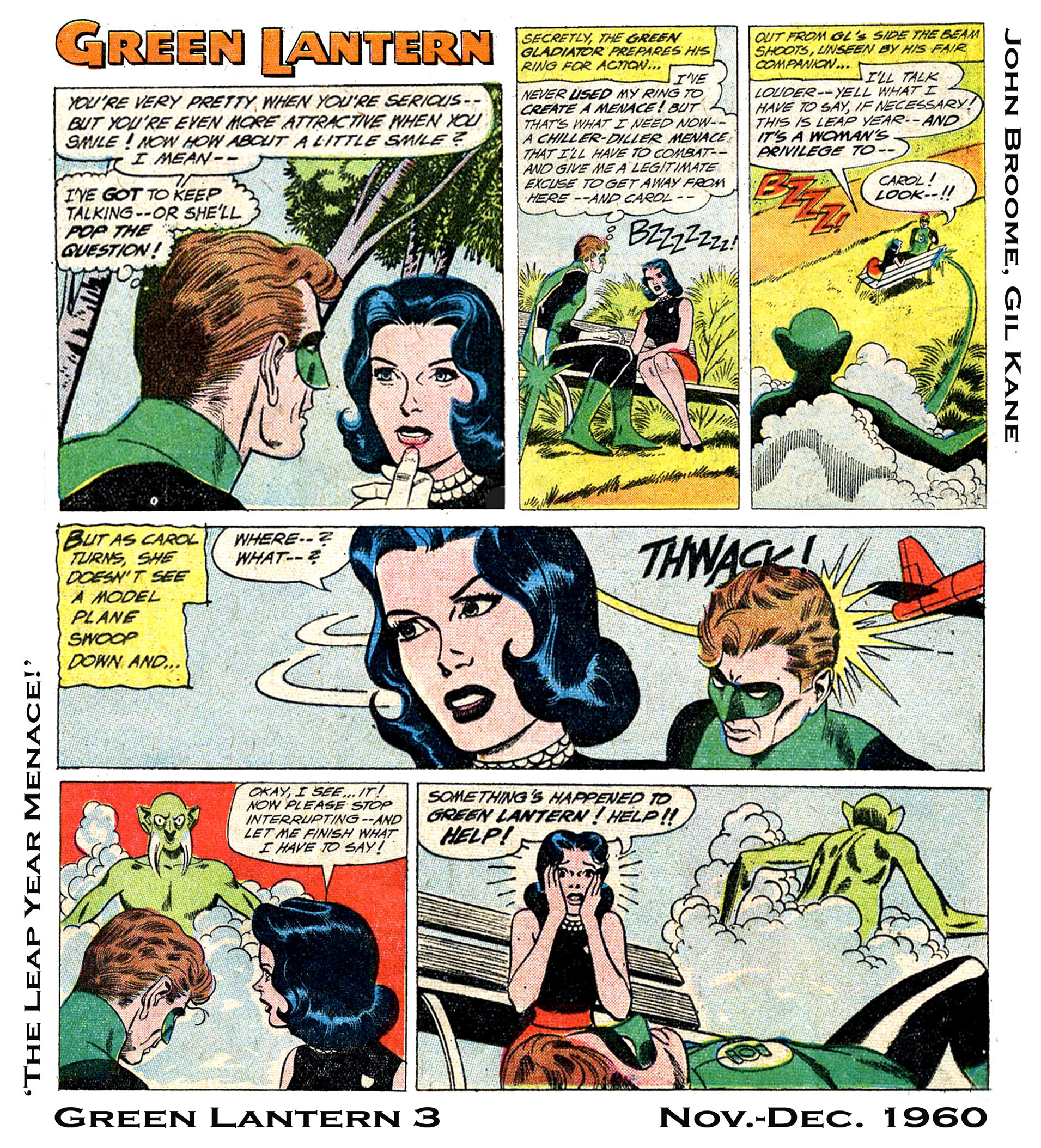
 The superhero himself created another such threat in The Leap Year Menace (Green Lantern 3, Nov.-Dec. 1960). To avoid having to respond to Carol Ferris’s proposal of marriage at a charity event, Green Lantern wills his power ring to create a giant “chiller diller” of a monster as a distraction — and is immediately knocked unconscious by a random model airplane.
The green monster, meanwhile, wanders through the city, damaging things.
“As soon as they see me, they run away — as if they don’t like me,” the childish menace thinks. “Well, if they won’t like me, I won’t like them!”
After the revived Green Lantern dissolves the creature, he’s thanked by the military and Coast City citizens, and thinks, “I feel a little funny accepting all these congratulations … for destroying something that I myself created.”
As well he should — Green Lantern has created and destroyed a sentient being just to get out of an awkward social situation! Hal Jordan isn’t given to much self-reflection, however.
In the next issue, Green Lantern has another of his adventures in the antimatter universe of Qward, where moral polarities are reversed (The Diabolical Missile from Qward, Green Lantern 4, Jan.-Feb. 1961).
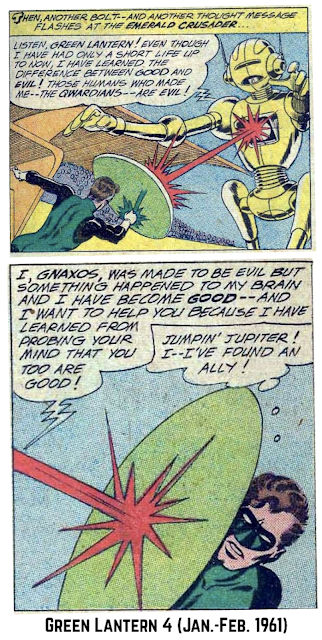
This time, his sobriquet of “Emerald Gladiator” becomes literal when he is trapped in an arena with Gnaxos, a towering robot whose array of powers includes the chameleon ability to turn yellow and thwart GL’s power beam.
The cosmic crusader, who’d been forced into this battle by a threat against the life of his pal Pieface, is up against it until he discovers he has an unexpected ally.
“Green Lantern, listen,” the robot telepathically messages him as they fight. “Even though I have had only a short life up to now, I have learned the difference between good and evil. Those humans who made me — the Qwardians — are evil!”
“I want to help you because I have learned from probing your mind that you, too, are good!”
Together, Gnaxos and Green Lantern turn the tables on the Qwardians, but the robot is destroyed in the rebellion.
Green Lantern is saddened, but only momentarily. “I feel like I’ve lost a friend,” he thinks. “But I can’t mourn for him any longer — I have another friend to think about — and enemies here to settle with!”
John Broome devised a colorful and endlessly entertaining puzzle box of science fiction mythology for his Green Lantern stories. But these subtle touches of satisfying emotional surprise at the end of his tales became another reason why a new Broome was always welcome.
About Author
