 Regular followers of these reviews will know two things about Trevor and me as members of our little Meeple Guild.
First, we love abstract strategy games. Perhaps that is because, as we turn a little grayer each year, we appreciate that these games are excellent exercise for the brain. They make you think.
Second, as fans of abstract strategy games, we hold game designer Dieter Stein in particular high regard.
As noted in previous reviews, Stein has created some of the finest abstract strategy games of this millennium, with titles such as Ordo, Urbino, and Fendo immediately coming to mind. You can explore more of his work at spielstein.com.
To that distinguished list, add Volo.
While not a new game, having originally been released in 2010, Volo has received a new edition thanks to Kanare Abstract.
Over the years, Volo has seen several editions, appearing and disappearing from small-run production, which is often the fate of abstract strategy games. The genre remains something of an acquired taste, limiting its audience despite its many strengths.
According to Stein, Volo was inspired by the beauty of birds flying in flocks, an intriguing source of inspiration that becomes evident once the game is underway.
At its heart, Volo is a fascinating blend of placement, movement, connection, and territory-control mechanics.
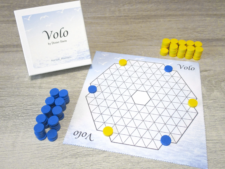
The game is played on a hexagonal board consisting of 120 spaces. Players take turns either placing a bird or moving one or more birds already on the board, with the ultimate goal of connecting all of their birds into a single contiguous flock.
The Kanare Abstract edition is particularly attractive. It features a cloth game board and beautifully crafted wooden pieces in blue and yellow. The result is a visually striking presentation that stands out on the table despite requiring only a modest amount of space. Everything packs neatly into a small, portable box, making it easy to take anywhere.
The movement rules are elegantly restrictive. Birds may not be placed directly adjacent to friendly birds, and they may only fly toward other birds if doing so enlarges an existing friendly flock. Once a flock has been formed, it cannot be split apart.
These restrictions force players to continually introduce new birds to the board, and it is within this tension that the game’s strategic depth truly emerges.
If an opponent’s birds become isolated and blocked from joining another flock of the same color, those trapped birds are removed from the board. This creates a fascinating dilemma because the winner is simply the first player to form one contiguous flock, regardless of its size. Removing your own birds is often undesirable, but removing an opponent’s birds can sometimes bring them closer to victory.
There is a tremendous amount to consider when planning a strategy in Volo.
Players must place birds where they can eventually connect to other flocks while simultaneously limiting their opponent’s opportunities. At times, slowing an opponent’s progress may require making moves that also hinder your own plans. Success requires a careful balance of expansion, positioning, and territorial control as players manage multiple developing flocks across the board.
Among the many excellent games Dieter Stein has designed, Volo easily ranks among his top three in this reviewer’s opinion. For fans of abstract strategy games, it is an essential addition to the collection.
It is well worth seeking out from Kanare Abstract.
About Author
Calvin Daniels is a Saskatchewan-born, self-taught journalist. He is currently Editor of Yorkton This Week, with 35-years in the newspaper business.

Volo an elite game for abstract strategy fans
First, we love abstract strategy games. Perhaps that is because, as we turn a little grayer each year, we appreciate that these games are excellent exercise for the brain. They make you think.
Second, as fans of abstract strategy games, we hold game designer Dieter Stein in particular high regard.
As noted in previous reviews, Stein has created some of the finest abstract strategy games of this millennium, with titles such as Ordo, Urbino, and Fendo immediately coming to mind. You can explore more of his work at spielstein.com.
To that distinguished list, add Volo.
While not a new game, having originally been released in 2010, Volo has received a new edition thanks to Kanare Abstract.
Over the years, Volo has seen several editions, appearing and disappearing from small-run production, which is often the fate of abstract strategy games. The genre remains something of an acquired taste, limiting its audience despite its many strengths.
According to Stein, Volo was inspired by the beauty of birds flying in flocks, an intriguing source of inspiration that becomes evident once the game is underway.
At its heart, Volo is a fascinating blend of placement, movement, connection, and territory-control mechanics.
The game is played on a hexagonal board consisting of 120 spaces. Players take turns either placing a bird or moving one or more birds already on the board, with the ultimate goal of connecting all of their birds into a single contiguous flock.
The Kanare Abstract edition is particularly attractive. It features a cloth game board and beautifully crafted wooden pieces in blue and yellow. The result is a visually striking presentation that stands out on the table despite requiring only a modest amount of space. Everything packs neatly into a small, portable box, making it easy to take anywhere.
The movement rules are elegantly restrictive. Birds may not be placed directly adjacent to friendly birds, and they may only fly toward other birds if doing so enlarges an existing friendly flock. Once a flock has been formed, it cannot be split apart.
These restrictions force players to continually introduce new birds to the board, and it is within this tension that the game’s strategic depth truly emerges.
If an opponent’s birds become isolated and blocked from joining another flock of the same color, those trapped birds are removed from the board. This creates a fascinating dilemma because the winner is simply the first player to form one contiguous flock, regardless of its size. Removing your own birds is often undesirable, but removing an opponent’s birds can sometimes bring them closer to victory.
There is a tremendous amount to consider when planning a strategy in Volo.
Players must place birds where they can eventually connect to other flocks while simultaneously limiting their opponent’s opportunities. At times, slowing an opponent’s progress may require making moves that also hinder your own plans. Success requires a careful balance of expansion, positioning, and territorial control as players manage multiple developing flocks across the board.
Among the many excellent games Dieter Stein has designed, Volo easily ranks among his top three in this reviewer’s opinion. For fans of abstract strategy games, it is an essential addition to the collection.
It is well worth seeking out from Kanare Abstract.
About Author
Calvin Daniels
Calvin Daniels is a Saskatchewan-born, self-taught journalist. He is currently Editor of Yorkton This Week, with 35-years in the newspaper business.
See author's posts