
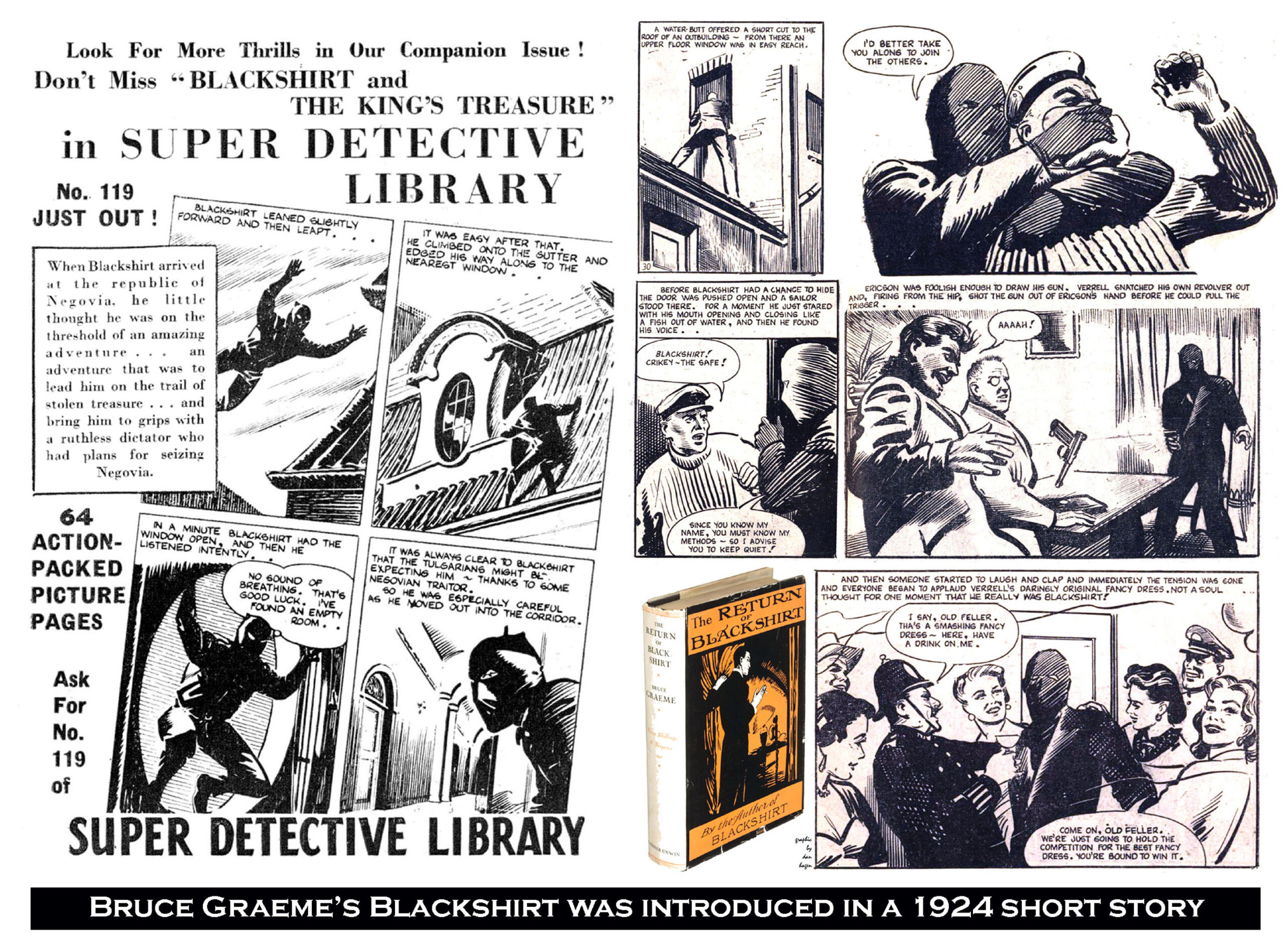
From D.W. Griffith’s 1915 film Birth of a Nation on, we’ve sometimes seen an unsettling association between mystery-man protagonists and fascism.
One such character was Bruce Graeme’s Blackshirt, a dashing masked burglar introduced in a 1924 short story. Graeme was the pen name of Graham Jefferies.
“Richard Verrell is known as Blackshirt because of the costume he affects when on a job,” noted Chris Steinbrunner and Otto Penzler in their Encyclopedia of Mystery and Detection. “He dresses entirely in black and even wears a black mask. During the day, he is a wealthy member of society; at night, he is an audacious burglar.”
Beginning in 1919, the term “Blackshirts” was also the nickname for the armed squads of Italian Fascists under Benito Mussolini.
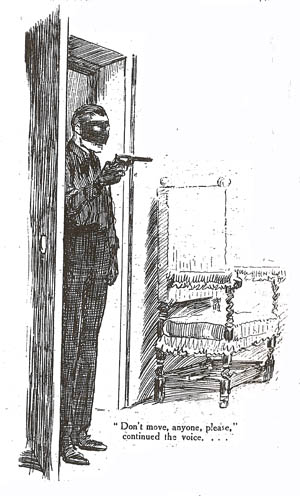 “By the end of 1920, the Blackshirts were attacking and destroying the organizations not only of socialists but also of communists, republicans, Catholics, trade unionists, and those in cooperatives, and hundreds of people were killed as the Fascist squads expanded in number,” noted the Encyclopedia Britannica.
Despite that history and those methods, Mussolini was admired by a significant number of people in England and America during the 1920s and 1930s. Time magazine and the New York Times sang his praises.
In Graeme’s many books about his character, Verrell is an orphan who was originally found wandering the streets and became a best-selling author. He commits his crimes for thrills rather than profit, and sometimes even surreptitiously returns the stolen items to their owners. But his identity is discovered by a beautiful and anonymous young woman who blackmails him into acting as a Robin Hood figure.
That “blackmailed by a mysterious beauty” business was also employed earlier by Frank L. Packard in his stories about another heroic criminal mystery-man — the Gray Seal, Jimmie Dale. Interesting to see women portrayed as the “conscience” of raffish, ruthless men.
Graeme claimed that he’d been “…resting in the garden when he was startled by the approach of his mother,” wrote William L. DeAndrea in his book Encyclopedia Mysteriosa. “He hadn’t heard her footsteps in the grass and hadn’t seen her in the dusk because she was dressed in all black. He decided that the all-black outfit would be an excellent gimmick for a romantic thief.”
Graeme — whose main series included such titles as Alias Blackshirt, Blackshirt the Audacious, and Blackshirt the Adventurer — also chronicled the 17th-century adventures of his character’s ancestor, Monsieur Blackshirt.
He retired his aging protagonist in World War II, replacing him with Verrell’s son, RAF pilot Anthony Verrell, as the new Blackshirt.
In the 1950s, Graeme turned the character over to his own son, Roderic Jefferies, who continued the series as Roderic Graeme.
Those two generations produced new Blackshirt adventures over a period of 46 years – a longer run than Mussolini had, as it turned out.
A jumped-up peasant with a bully-boy know-nothing disdain for human rights and the rule of law, Mussolini owed his early successes, such as the draining of the Pontine marshes, to the fact that he turned the problems over entirely to experts.
But once his own personality cult began to convince Mussolini that he was, in fact, a superman, the “Duce” repeatedly tripped over his own ego, proving himself to be a military joke.
He finished hanging upside down on a meat hook at an Esso gas station in the Piazzale Loreto in 1945.
Graeme winked at the connection to the fascists, describing Verrell as wearing “no coat, only a soft black shirt and black tie, not unlike the Fascists wear.”
In the first story, one character says, “Blackshirt! Sounds to me like a Fascist!” A police officer replies: “You are on the wrong track, I am afraid, sir, for whereas the Fascisti stand for law and order, Blackshirt is responsible for many mysterious affairs which are decidedly against the law.”
Yet somehow, I’m not reassured.
About Author
