
If it’s Monday—it’s generally time to talk about Archie Comics. I wish I could devote a day to other publishers, but with Archie– it’s about something different. Think of all the publishers over the years that have come and gone—yet, there’s still Archie. Going back further, it’s one of three publishers that have been putting out comics since it all began. I often think Archie doesn’t get enough credit for the comics it has put out over the years.
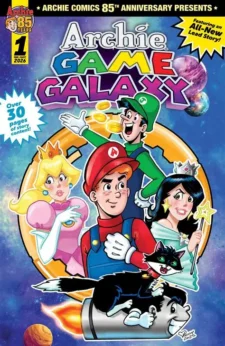 Take Archie’s 85th‑anniversary one‑shot, which leans into a familiar Archie trick—take a cultural moment, filter it through Riverdale logic, and let the cast bounce off the concept until it becomes something unmistakably Archie. What makes Game Galaxy work is that Holly G. doesn’t treat the gaming hook as a gimmick; she treats it as a playground. The lead story has the looseness and charm of a Saturday‑morning cartoon, but it’s anchored by the cast’s personalities rather than the novelty of the premise. Jughead powering up on golden burgers is exactly the kind of character‑driven absurdity that keeps these anniversary books from feeling like brand exercises.
The art lineup is a time capsule of Archie’s visual identity. Holly G.’s lead story has a buoyant, rounded energy that fits the cosmic‑game setting, while the reprints from Dan Parent, Samm Schwartz, Dan DeCarlo, and Adrian Ropp create a curated tour of Archie’s comedic rhythms across decades. The shifts in linework—from Schwartz’s elastic slapstick to DeCarlo’s clean, iconic staging—don’t clash; they reinforce the anthology’s thesis that Archie’s house style is less a single look and more a shared comedic language. Glenn Whitmore and Matt Herms keep the colors bright and readable, giving even the older material a unified feel.
What stands out is how naturally the book ties gaming culture to classic Archie dynamics. Whether it’s Reggie turning tabletop RPGs into ego theater, or Betty and Veronica waging war against VR‑obsessed boys, the stories treat technology as another way for the cast to annoy, outsmart, or rescue each other. Even the Cosmo Go! piece—Archie’s riff on Pokémon GO—lands because it’s rooted in Riverdale chaos rather than trend‑chasing. The result is a collection that feels celebratory without being nostalgic for nostalgia’s sake.
As an anniversary piece, Game Galaxy succeeds by showing how adaptable the Archie formula remains. The lead story is light, funny, and visually playful, and the supporting tales remind you how many different comedic gears this universe can shift into. It’s a showcase of Archie’s longevity not through reverence, but through the simple fact that these characters still work wherever you drop them—even inside a retro console with a magical cat as their guide.
About Author
