
 First Comics News: How did you break into the comic book business?
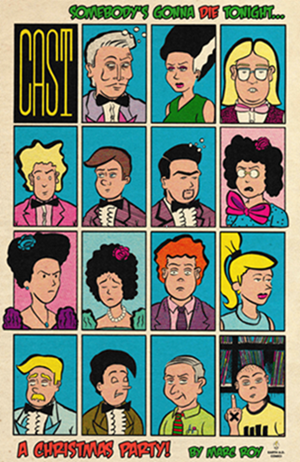
Marc Roy: I’m a self-published author, so I guess I broke into the business by publishing my own stuff. First came The Misfits: 3 Strips for Hell in October 2021, which was nominated for a Bedelys Award at the 2022 Montreal Comic Arts Festival. Then I did the Trümpf miniseries from July 2022 to February 2025. And in May 2025 came A Christmas Party, my first take on coloring my interior art.
1st: Which comic book that you worked on are you most proud of?
Marc: The Misfits is where I learned how to draw, but the Trümpf miniseries is the one project where I had to
establish my art style and my creative stamina. I had already written Trümpf as a 4-part war comedy for an artist who decided to pass on the project, so I decided to draw it myself. I consider myself more a writer than an artist, but I guess I can do both now! I can now ink too, which has become my favourite part of the creative process. That’s where things really get done. There’s no turning back once you ink a full page of pencils!
1st: What is Trümpf about?
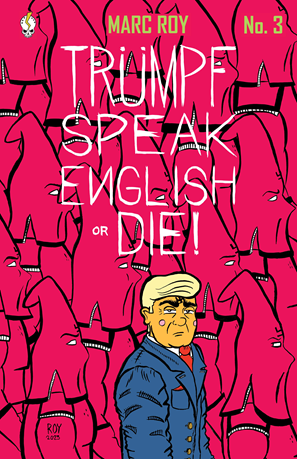
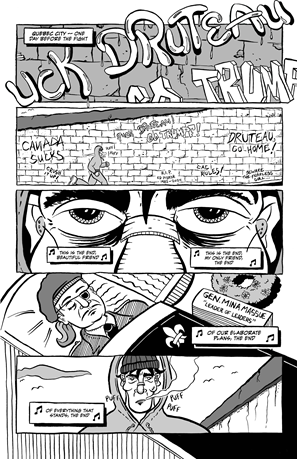
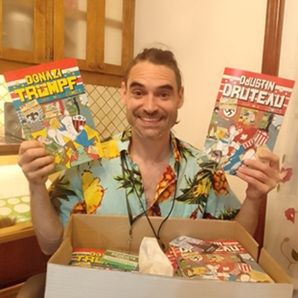
Marc: Storywise, Trümpf is about a fictitious fascist US president invading Canada and the Republic of Quebec to track down and kill Djustin Druteau, the Canadian PM. Written as a comedy, Trümpf is about defusing the Donald Trump problem by putting power back into the reader’s hands in order to have fun with the seriousness of today’s politics. I’m not telling you what to think. I just want you to have a good time while reading my comic!
1st: How do you try to make Trümpf look in the comic?
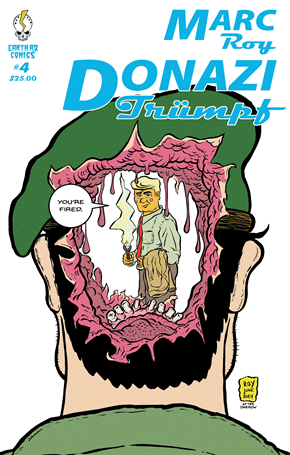
Marc: Well, my readers say that the real-life model isn’t far from my own version!
1st: Does Trümpf interact with any interesting characters?
Marc: He’s a man at war, and his main focus in the story is defeating Djustin Druteau, the guy who embodies all that he hates. He interacts mostly with his underlings.
1st: Can you tell us what the storyline is in Misfits?
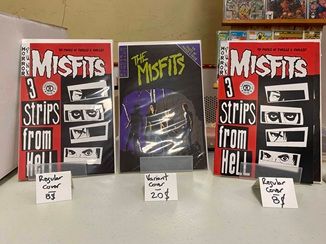
Marc: The book presents three separate stories of horror and humor based on actual Misfits songs. With the Misfits : 3 Strips From Hell, I’m just trying to practice my art and storytelling chops while having fun putting the band members in uncomfortable situations (especially Glenn Danzig, the band’s first singer from 1977 to 1983). In ”Vampira”, I’m addressing an old Misfits story, where beer bottles were once thrown at the band while performing on stage. One bottle apparently hit one of the band’s roadies in the head, and glass from broken bottles wound up wounding people who were in attendance. With ”Hollywood Babylon”, I’m imagining Danzig going to an audition for a minor role in a big-time movie and failing his attempt to recycle his career as an actor.
Although ”Halloween” is the first tale of the book, it is the last one I drew, and my art had gotten a bit better compared to the other two stories. I had learned how to ink with a Japanese nib pen, and the results were a step above the Micron pens I had been using since ”Vampira”. In ”Halloween”, a young Glenn Danzig tries to survive his Halloween night by being forced to take refuge in a big abandoned house in his neighborhood while being chased around by the big brother of a guy he stole candy from.
I’m not reinventing the wheel with my Misfits stories; I’m just trying to have fun exploring the tropes of the horror genre, while sprinkling them with a good dose of humor.
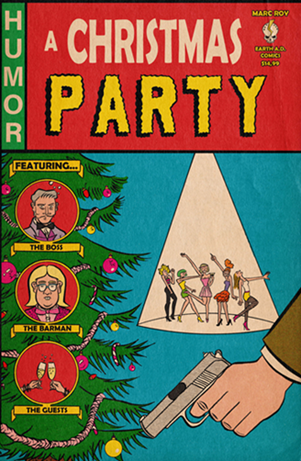
1st: What genre is A Christmas Party?
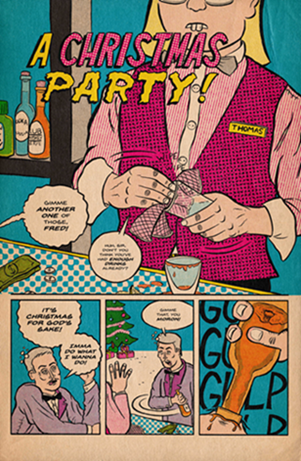
Marc: A good buddy of mine wanted me to write a horror story for another artist he had in mind, but when the script was completed, I thought it’d be best if I were to do the art. I ditched the horror angle and went for a whodunit murder storyline centered around a company boss whom everyone hates.
1st: Do you think coming up with ideas for comic books requires a certain mindset?
Marc: A good writer will always think about story ideas. And they can come from any life situation. You just need to write those ideas down for future use. Anybody can write if you put in the effort to develop your style.
1st: How do you go about starting to write and draw a comic book?
Marc: Stephen King once said (in his book On Writing) there are two kinds of writers: 1) planners, and 2) those who write from the edge of their seat, which means making stuff up as you go along. I’m more of a planner than the other way around. I’ll write a full script, then I’ll divide the action panel by panel, trying to plan what I call the ”Oh, shit!” moments to surprise the readers. As for the art, just do it in any style you think will fit the story. If you write for another artist, try to write to their strengths.
1st: What are the pros and cons of color or black and white comics?
Marc: Read Sin City or any Love and Rockets issue, and you’ll feel the power of those pages. Mood, texture, and emotions will burst out of a black and white page. Every comic starts in B&W and is, in my opinion, the best way to read one. Color is cool too, but I prefer the flat colors from an Archie comic from the 50s/60s over modern techniques used by the Big Two. I like the watercolor techniques used in MIND MGMT (Matt Kindt, Dark Horse Comics) or how Michel Fiffe uses them in COPRA (Image Comics/Bergen Street Press).
1st: Do you have any formal art training?
Marc: I always wanted to be a writer, so I went to college for a while to study scriptwriting, cinema, and literature. Dropped my PhD in postapocalyptic fiction to write comics full-time, which I did for two years before trying my hand at drawing, inking, and lettering my own stuff since I couldn’t find a suitable artist to team up with. I learned how to publish a book on my own. You don’t need ANY formal training to write or draw comic books, though. Crude art doesn’t matter as long as you have something clever (or funny or whatever) to say. In my opinion, it’s not what you say that works, but HOW you say it that moves the reader. But remember that the best way is always YOUR way.
1st: What other artists do you admire and that have influenced you?
Marc: Man, there are so many. I started reading comics in the early 90s, so Jim Lee, Todd McFarlane, and Marc Silvestri were THE guys for me. I loved the mutant universe (especially the girls: Rogue, Storm, and Jean Grey were/are my favorites), so I went back to explore the Uncanny X-Men’s backlog from the Chris Claremont years and discovered Paul Smith, John Byrne, and JRJR.
I also had different reading phases (the 1st one is 1991-1997), and in my second stint with comics (2002-2010), I became aware of Ed Brubaker, Greg Rucka, Bendis, and Grant Morrison, and I was focused more on the writers. I was having fun exploring the DC universe (which I thought sucked big time in the 90s) and was now reading Batman, Catwoman, Gotham Central, and Wonder Woman. I followed Brubaker everywhere he went: Sleeper (in my Top 10 all-time), Daredevil, and Captain America were great books. Then, in 2006, half of my comics collection (5 long boxes) was stolen from me. My interest in the medium waned. I wanted to read novels and more mature stuff.
I was now in college (2006-2017) and was obsessed with cinema and literature. I became really passionate about the strength of B&W storytelling and the structure of movie-making through Russian, French, German, Italian, and early American movies: Eisenstein, Godard, Truffaut, Fritz Lang, Fellini, Antonioni, and Orson Welles are great stuff to study. I was reading Russian literature (Dostoïevski, Tolstoï), discovering classic authors such as Vladimir Nabokov, Gérard de Nerval, Louis-Ferdinand Céline, but also the pulp guys like Lovecraft, Robert E. Howard and the 50s/60s sci-fi era. I ended up doing my Master’s Thesis on Philip K. Dick (with a focus on Martian Time-Slip, We Can Build You, and VALIS), which took me about 6 years to write.
In 2020, I came back to comics for a third time after finding out about Ed Piskor and Jim Rugg’s Cartoonist Kayfabe YouTube channel by accident. I saw them read a written interview of Kevin Eastman from the Comics Journal and decided to explore the rest of the site’s content. The next video I watched was on the Hernandez Bros. and Love and Rockets, and I was hooked on B&W indie comics from then on! I fell in love with Maggie, Hopey, and their friends, and still can’t have enough of Jaime’s style. I think he’s the best of the best. I learned that Jaime was influenced a lot by Dan DeCarlo and Harry Lucey, so I went back and read more Archie Comics/Betty and Veronica, and something clicked with their style, too. I was laughing so hard while reading those old funny books that I knew I had something there. Since I’m integrating a lot of humor in my own writing, I thought I could learn tricks from them about comedy and rhythm. But let’s not forget about Dan Clowes (Eightball), Chester Brown (Yummy Fur), and Michel Fiffe (COPRA), who are also big influences on my art style.
1st: What is a day in the life of a cartoonist like?
Marc: It depends on where I’m at in the creative phase of a project.
I need a full script to work with first, and I don’t have any real deadline because I’m self-publishing. It also depends if you’re doing comics full-time versus part-time. So I’ll talk a bit about my method here before tackling what would be a day in my crazy, creative head.
Let’s say I’m in it full-time like I was with my Trümpf series. It took me a full year to write the 4-part series. I wrote the action in French, the dialogue in English, then translated everything back into English. I also wrote the story as a 4-part series to be published in an American comic book format, which is around 22-24 pages. I knew Trümpf #4 would be bigger since it was the conclusion of the series. It would be either a Double-Sized or Giant-Sized issue. The script had 40 pages, but it ended up being a 54-pager when I reread the script. I had too many 7-8 panels per page, even with the fight scenes. So to make the story breathe (particularly the fight scenes), I added more pages.
After writing the series, it took me 4 years of working non-stop on the art side of it. Trumpf #1 is 24 pages, #2 and #3 are 22 pages each, and #4 is 54 pages. By the way, if anybody is serious about wanting to make it in the comics business as a self-published author, they should read Dave Sim’s The Cerebus Guide to Self-Publishing (1997). It’s a real eye-opener.
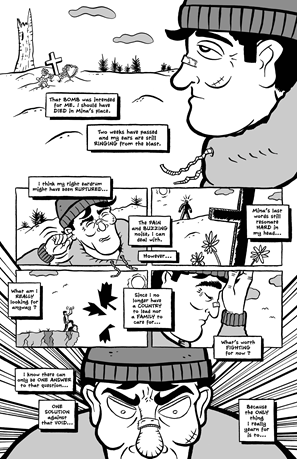
So let’s say the scripts are done (like in the case of my Trümpf series), and I’m in the drawing phase and need a new page done. Well, first of all, I don’t do layouts of my script in its entirety when I draw my story. I like to keep my ideas for art fresh when I’m attacking a panel. I follow the script to the T, because the strength is usually in the story. I start with page one, panel one. I don’t try to do the ”cool” scene first from page 16 or anything like that. I draw with the story, not against it.
But let’s say I’ve finished page 8 the day before, and now I start the day with page 9. I tape the printed pages on the drawing board for page 9, read the scene, and — like a movie director — I’ll try to imagine what would be the most exciting way for the reader to enjoy reading that new page. So, depending on the tone of the scene, I’ll then break down how the panels of the page will look.
Since I’m doing mostly comedy, I’ll use simple panel shapes. Then I draw panel one, first with basic geometric shapes so I can spatially position the characters, then with more details, starting with the face. I’ll try to draw as many panels as I can during the day, between 9 am and 5 pm. I may come back on the page after dinner time if I know the last panel I did was incomplete, but I usually don’t want to extend the work hours, because I want to renew my creative energy for the next day. When I’m drawing a story, I draw it in its entirety. I do not ink anything until I’m finished (not the case with Trumpf #4, though. Since I knew it was a 54-pager, I got bored with drawing by page 21, so I inked those pages before going at it again with page 22.
If I’m in an inking phase, I’ll ink 2-3 pages at a time because the ink has to dry. I’ll do all the lettering first, then I’ll go with a panel on the right side of the page because I’m a lefty. And when I dip my nib pen in the inkwell, I know I only have 3-4 good lines in it before I run out and have to dip it again. On top of that, one of those lines is lost by starting the flow of the pen on my ink cardboard. I don’t ink the panels in order as I do in the drawing phase. I’ll ink what I want, and usually I’ll start with the girls. If I ink a face, I’ll start with the nose.
My inking phase has 3 stages: 1) I ink all the lines of all the panels with the nib pen, then I erase the pencils. 2) I spot my blacks (which have already been determined in the drawing phase) with a brush. 3) I do texture mainly on clothes, buildings, and background objects. I also buff up lines with the brush, mostly on objects or characters who are in the foreground.
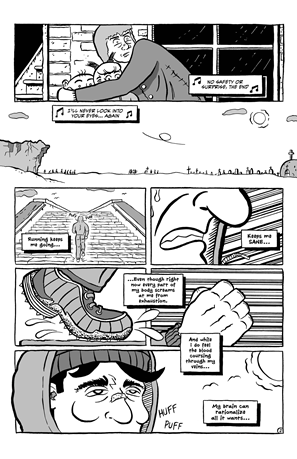
When all the pages are done with the inking, I go scan them at my local printer, then load them on Photoshop to clean them of all the impurities (un-erased pencil marks or whatever it is that doesn’t belong on the finished art) one at a time. I crank up the blacks to make them solid, then add 3-4 different levels of gray and use them as colors.
Step by step, your comic will get made into a finished product, sellable to readers. Don’t give up!
1st: What does CAC stand for?
Marc: A play on the track ”Caca the Kick” by the Infectious Grooves.
1st: Any last words for the fans of your work?
Marc: Thanks for reading my books. More to come in the near future. So stick around, dear readers! Follow my Instagram page for more updates!
About Author
