
Some sequences simply stick with you.
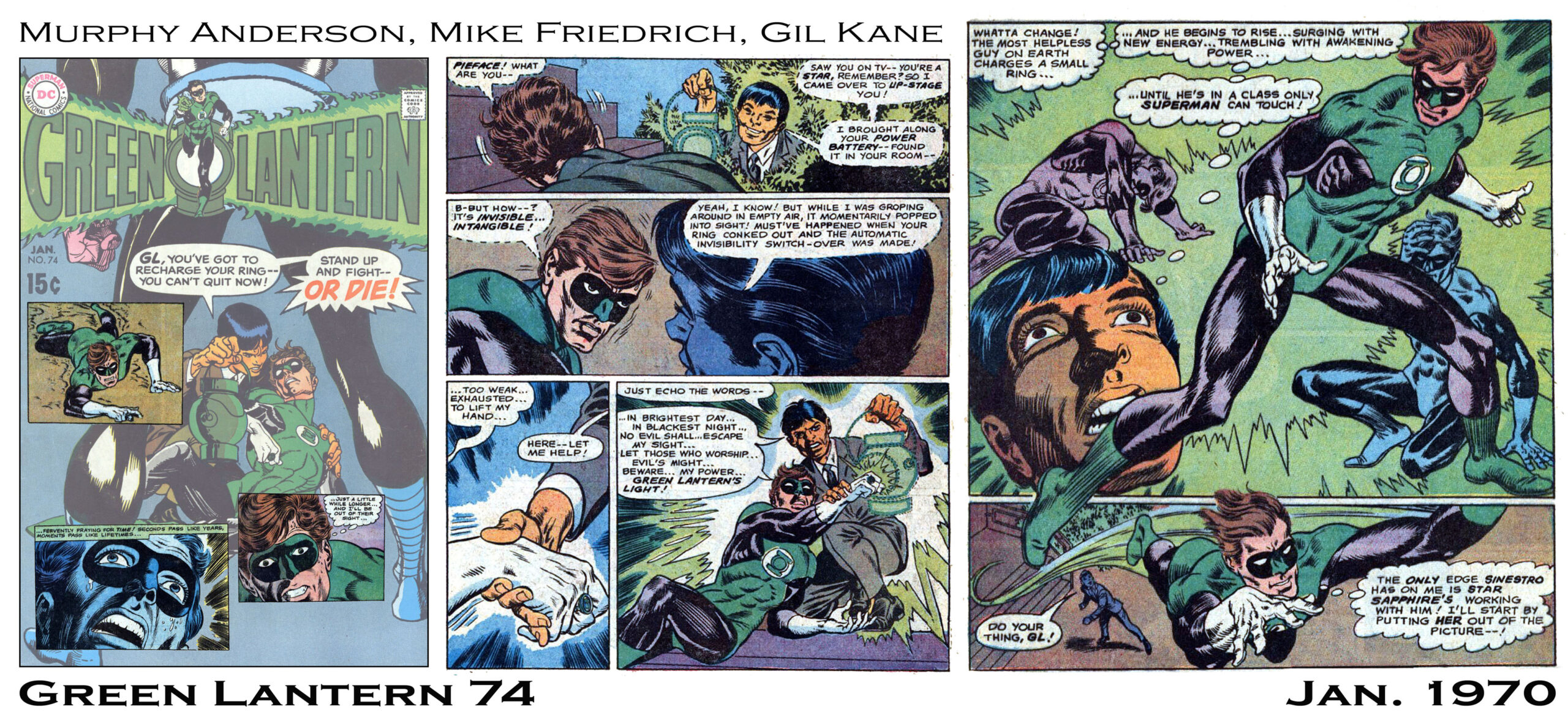
And for me, that was the case with Gil Kane’s climax for Green Lantern 74 (Jan. 1970).
Battles with Star Sapphire and Sinestro have left the Emerald Gladiator in a state of collapse, barely able to crawl, with the last of his ring’s reserve power exhausted. Luckily, his old pal Tom Kalmaku is handy (“I bet nobody calls him ‘Pieface’ anymore,” GL thinks). Tom finds and brings Green Lantern his invisible power battery.
In a beautiful, carefully constructed, dramatic sequence, Kane shows us Green Lantern’s restoration from a state of abject defeat to a literal world-beater, with his pal’s admiration underlining the effects.
 “(T)he stuff that I like to draw has nothing to do with any individual character,” Gil Kane once explained. “What I like to draw is some idea of power gathering itself, and all of a sudden the power is blocked, and the power has to assert itself and strain itself, and there’s an enormous resistance to it,t and all of a sudden the power breaks through and leaps free. That’s what I like to draw. That, in effect, is the essence behind my personality.”
And Kane’s favorite example of that concept? The Amazing Spider-Man 33 (Feb. 1966), that much-celebrated story in which Steve Ditko has Spidey strain and heave to throw off the impossibly huge piece of machinery that has him trapped.
“I thought that what he did, the way he paced the story, is one of the most powerful things I’ve ever seen in comics,” Kane said.
The issue was the second part of a two-part tale that had the kind of exhilarating cliffhanger I love, penned by Mike Friedrich.
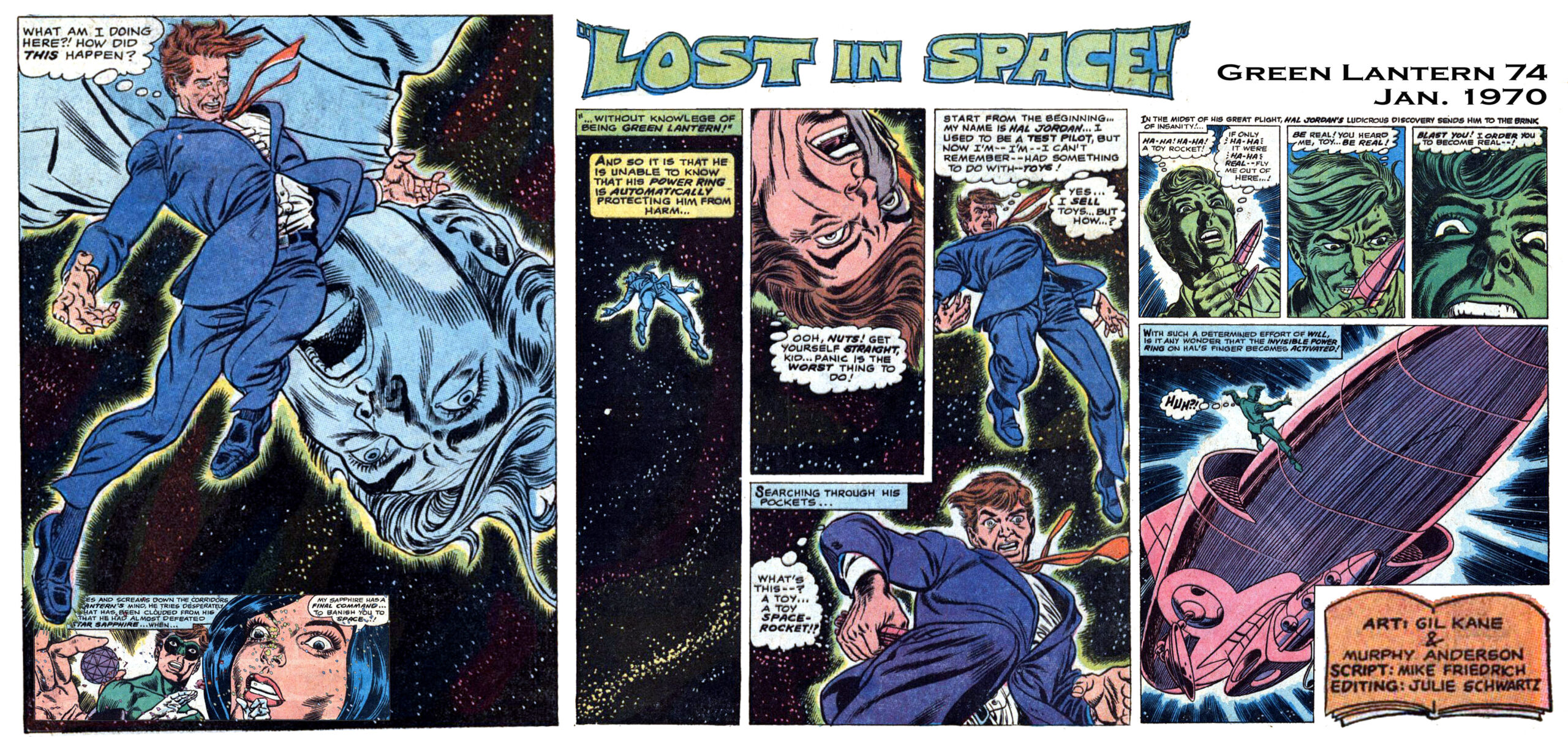
In Green Lantern 73, our hero’s erstwhile lady love, Carol Ferris, deranged by her Star Sapphire powers, transforms him into his other identity of toy salesman Hal Jordan with no knowledge of his superhero self (both friends and enemies messed with Hal’s mind a lot during the run of the series). Simultaneously, she banishes him into outer space!
The panicked Hal, unaware that his ring is automatically protecting him, is certain he’ll die within seconds. In the pocket of his suit jacket, he feels the toy spaceship he’d planned to give Tom’s children. Hysterically, he wishes it were real — and it becomes so! The shock reminds Hal that he is, in fact, Green Lantern. So he zooms back to Earth and has a battle with both Star Sapphire and Sinestro.
“Kane had a remarkable gift for flying sequences,” observed Michael E. Grost. “Green Lantern always seems poised in space. He almost seems to be swimming in air. He can convey a sense of fast motion if he wishes, but more often, there is a sense of extreme comfort and maneuverability of his hero through space. This is unlike the flying sequences of any other comic book superhero.”
So here we see Gil Kane at the peak of his powers during his long run on Green Lantern — ironically, only an issue away from when he left the title.
About Author
