
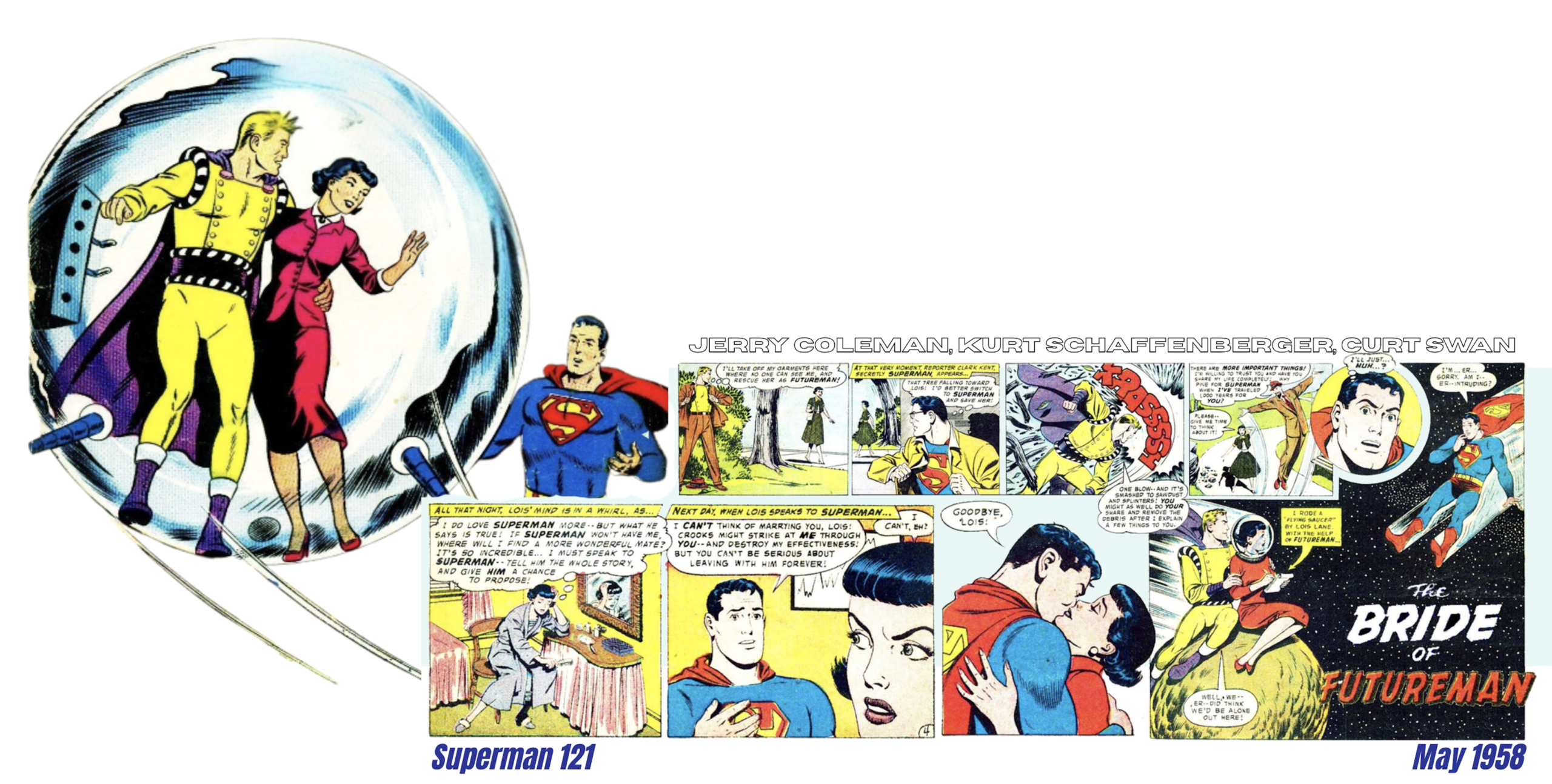
In the 1950s and 1960s, every reader of DC Comics knew exactly what a time machine would look like — a transparent flying sphere.
The “time bubbles” that popped up throughout the Superman titles were undoubtedly more convenient for storytelling than for temporal navigation. On covers and splash pages, they permitted readers and characters alike to get a good look at who was arriving or departing an era, and register an appropriate emotional reaction.
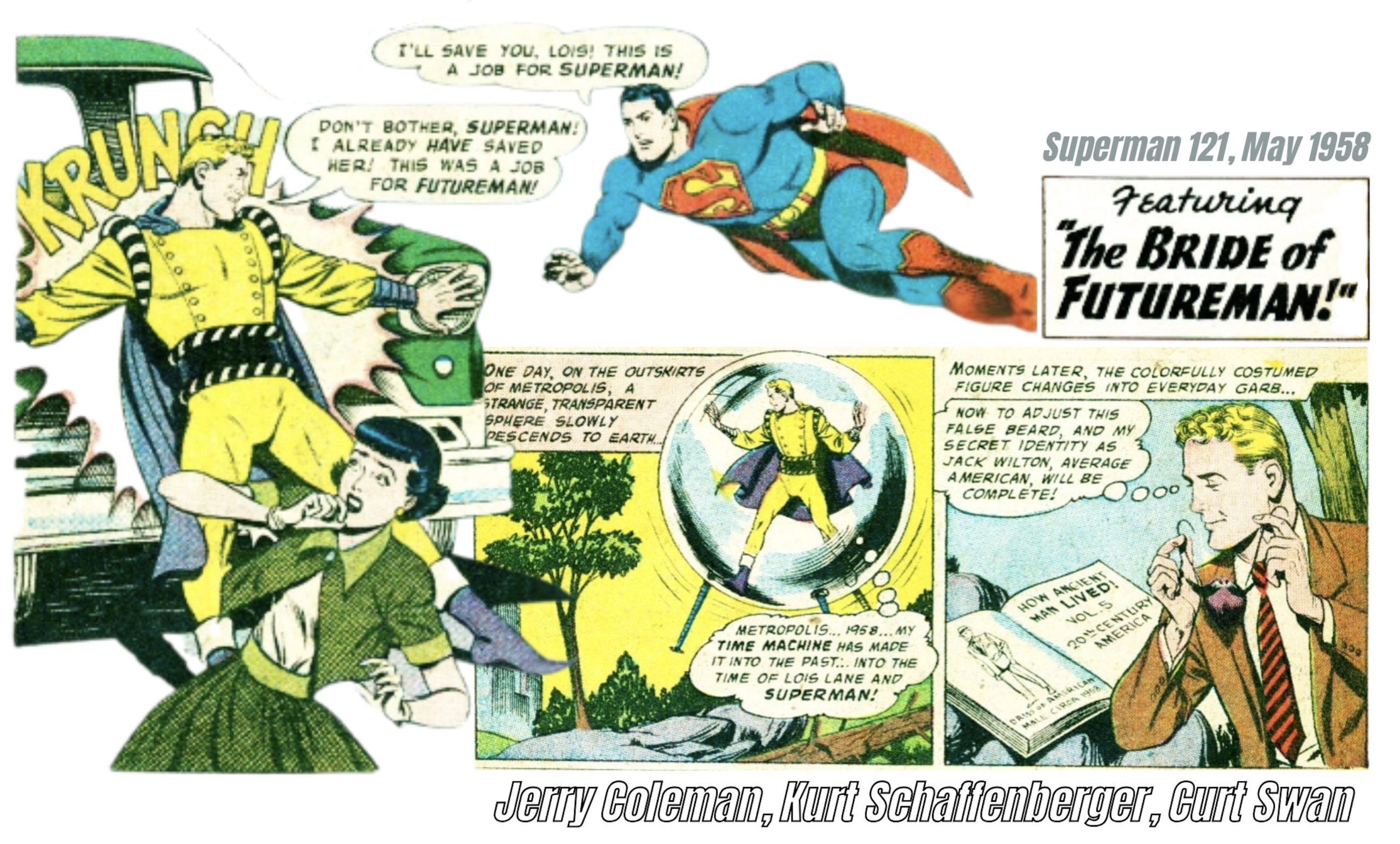
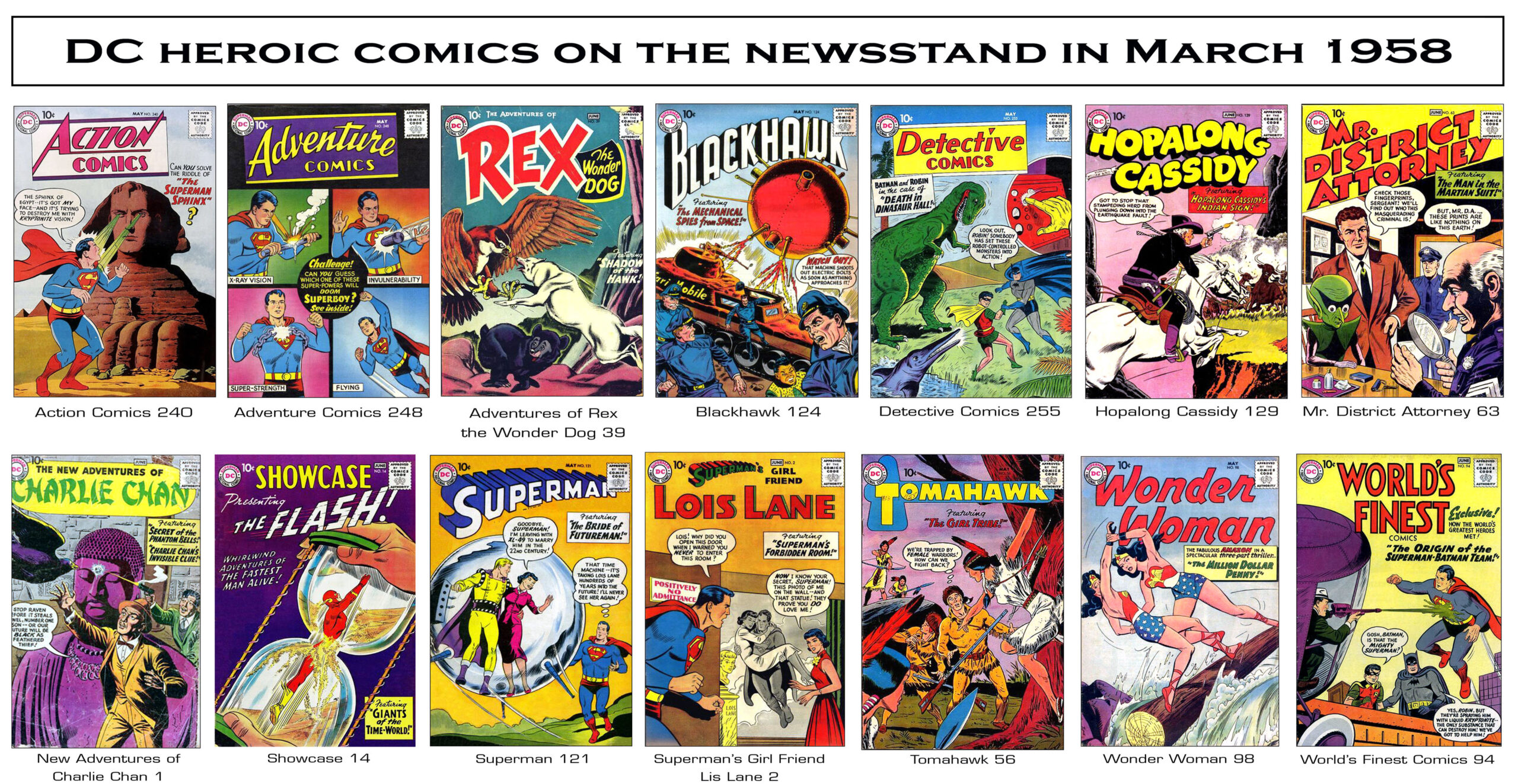
And in Superman 121 (May 1958), one of those transparent bubbles delivered XL-49, a/k/a Futureman, to the middle of the 20th century. A month earlier, in Adventure 247, the Legion of Super-Heroes had made its first appearance, using its own transparent time bubble to fetch Superboy into the future.
Written by Jerry Coleman, The Bride of Futureman features a caped, blond man clad in yellow and purple who adopts the “average American” secret identity of Jack Wilton.
Superhero comics often reflect a doppelgänger theme, and Futureman is one of numerous “alternate Supermen” that appeared throughout the 1950s and 1960s — caped, colorful figures who could fly and toss cars around just like the original.
Earlier, however, DC had been less than thrilled when one of them, Fawcett’s Captain Marvel, proved to be more popular than Superman. Hounded by DC’s lawsuit, the Big Red Cheese had vanished in 1954.
Captain Marvel’s loss was Superman’s gain, because one of Fawcett’s best artists, Kurt Schaffenberger, came over to DC. The clean and sunny precision of his art is on display in The Bride of Futureman.
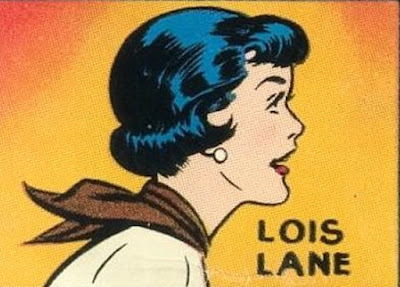 The mysterious XL-49’s next action in the 20th century is to arrange an accident from which he can rescue Lois Lane. Introducing himself to Superman and Lois, Futureman explains, “Scientists in my day were able to give me all your super powers to use in my own time for good.”
Immediately beginning to court Lois, he reveals his secret identity to her.
“Why pine for Superman when I’ve traveled 1,000 years for you?” he asks.
Lois is frequently criticized for her erratic behavior during this era, but this time she faces her situation squarely. Would Superman only ever be her Man of Tomorrow? Would she waste her entire life waiting for him?
“I do love Superman more — but what he says is true!” she thinks. “If Superman won’t have me, where will I find a more wonderful mate? It’s so incredible … I must speak to Superman – Tell him the whole story, and give him a chance to propose!”
Superman gives her the usual song-and-dance about how their marriage would “destroy my effectiveness,” but adds, “You can’t be serious about leaving with him forever!”
“I can’t, eh?” she replies, firing Superman a sharp look.
Lois accepts Futureman’s proposal, and leaves Superman with one final, passionate kiss. “I – I’ve often dreamed of his kissing me like this!,” Lois thinks. “But not (sob) as a farewell … forever!”
As the time bubble dwindles in the distance, Superman muses. “Life without Lois just won’t be the same. Everything feels so empty. I – I never realized how much she meant to me before!”
And then she’s back.
Lois proclaims that she has figured out the secret message in the farewell plaque Superman gave her, and points out how the names of Daily Planet staffers on it have been manipulated to spell “I love you.” Superman denies leaving the message, but Lois laughingly refuses to believe him.
“But I didn’t,” Superman thinks. “Or – I wonder – did I — unconsciously – because I won’t admit that that’s the way I feel.”
Meanwhile, in the far future, XL-49 is being debriefed about his mission to fill in missing historical knowledge concerning Superman. Did Superman marry Lois?
“No, but I think I’ve put him on the right path,” XL-49 replies. “Before I left here for the year 1958, I made up my mind that if they weren’t planning to get married, I’d play Cupid.”
So he doctored the plaque, of course.
It’s the usual contrived contraption of a story common to the Weisinger era, but fun if taken in the right spirit. The tale looks a lot like a cover feature intended for Superman’s Girl Friend Lois Lane, and probably was.
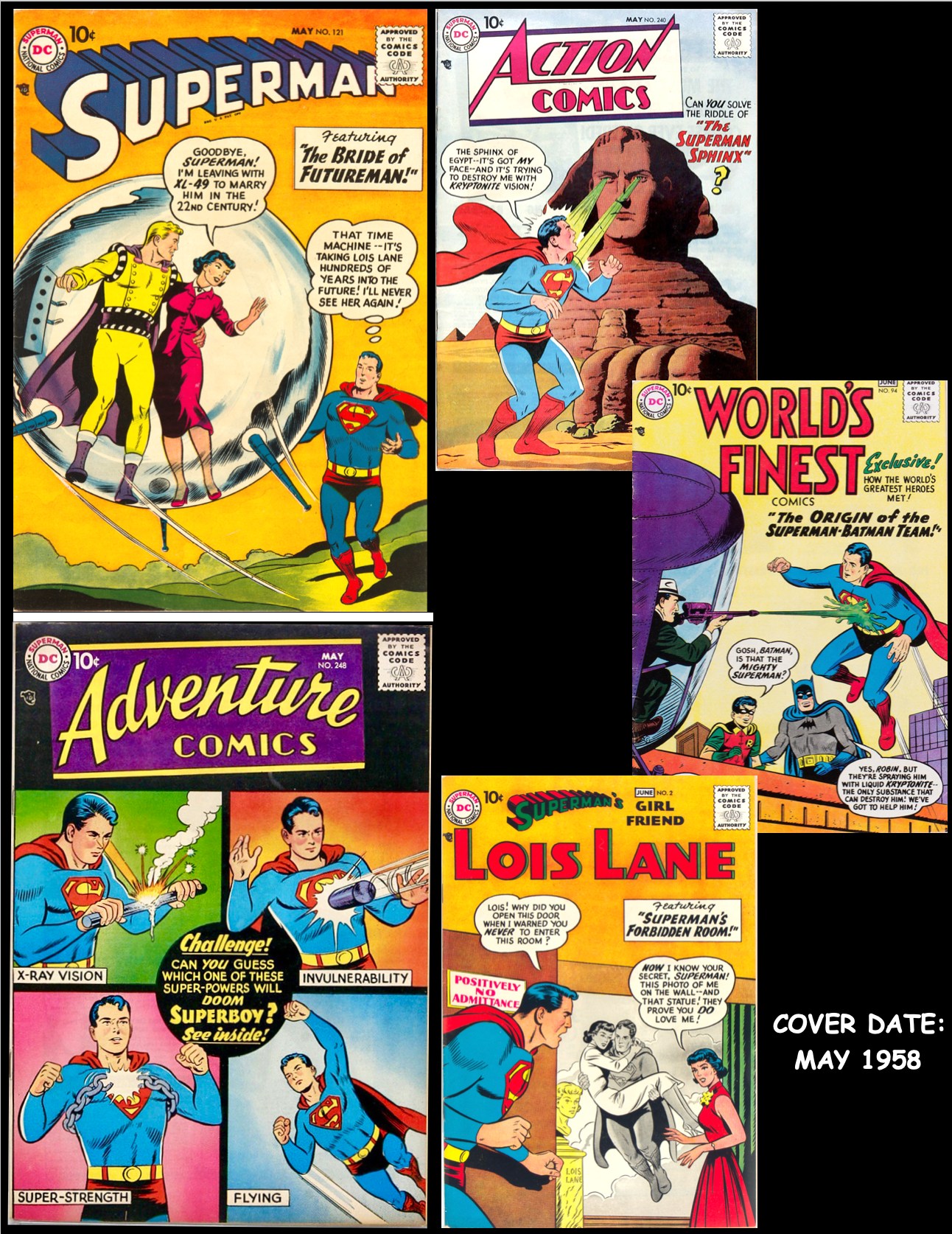
By 1958, Superman was appearing in no less than seven comic book titles — Action Comics, Superman, Lois Lane, Jimmy Olsen, World’s Finest and (as his younger self) Superboy and Adventure Comics.
That meant that any given month, editor Mort Weisinger had a wealth of material from which to choose, and could mix and match as he liked.
The Bride of Superman is drawn by Lois’ regular artist, and elsewhere in the issue we find Jimmy Hits the Jackpot, a story drawn by Curt Swan that appears to have been intended for Jimmy Olsen’s title.
“Futureman is part of a Coleman tradition, the good hearted, powerful character who takes over Superman’s life, shakes him up in ways that make Superman uncomfortable, and who does it for the sake of Superman’s psychological well being,” observed comics historian Michael E. Grost. “Often Batman has this role in other Coleman tales. The beings in these tales are Superman’s social peers: heroic characters who have as much social status and prestige as Superman himself. They tend not to be authority figures; rather, they are Superman’s social equals. These men think nothing of hoaxing Superman, and they tend to be very confident about what they are doing. The structure of the Superman mythos sets up Superman as an all-powerful character. Superman probably needs something like this to keep him challenged, and to let him have growth experiences.”
And only seven issues later, in Superman 128 (April 1959), Superman would battle the unrelated menace of the “Futuremen.”
Things were certainly forward-looking in the jet age.
About Author
