
Someone who poses as a superhero for sketchy ulterior motives can serve as the springboard for an interesting storyline.
Among those who spring to mind are the Kree Captain Marvel, the Thunderbolts, the Superior Spider-Man — and the Red Dart!
Who?
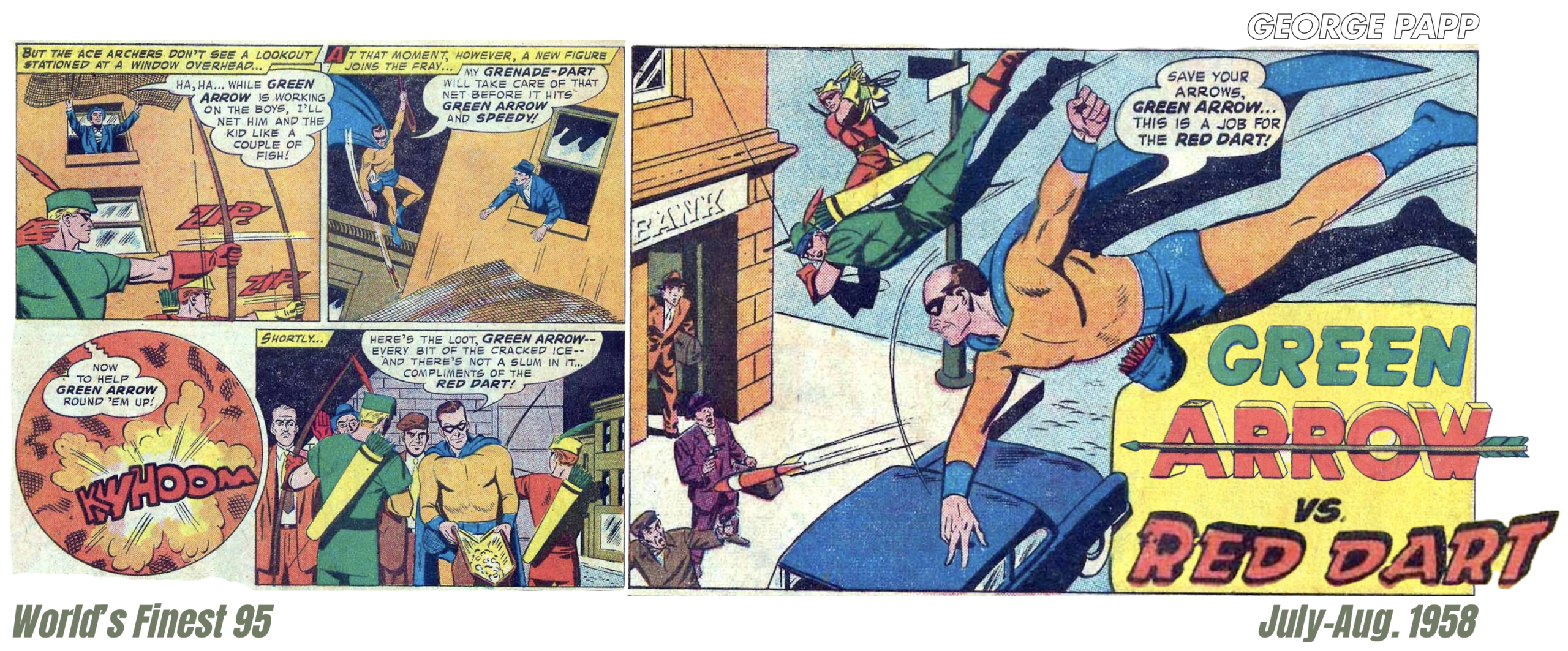
The Red Dart was one of those ubiquitous mirror-image foes that superheroes inevitably encounter — in this case, his colorful counterpart, the crimefighter known as the Green Arrow.
The Dart debuted in World’s Finest Comics 95 (July-Aug. 1958), penciled by George Papp.
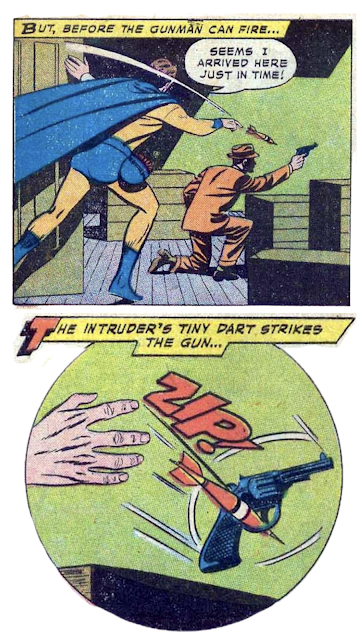 “Red Dart was actually John ‘The Midas’ Mallory, a crook who pretended to be a superhero to gain the superhero’s trust — and be at his side to foul him up when his own gang committed a crime,” noted comics historian Jeff Rovin.
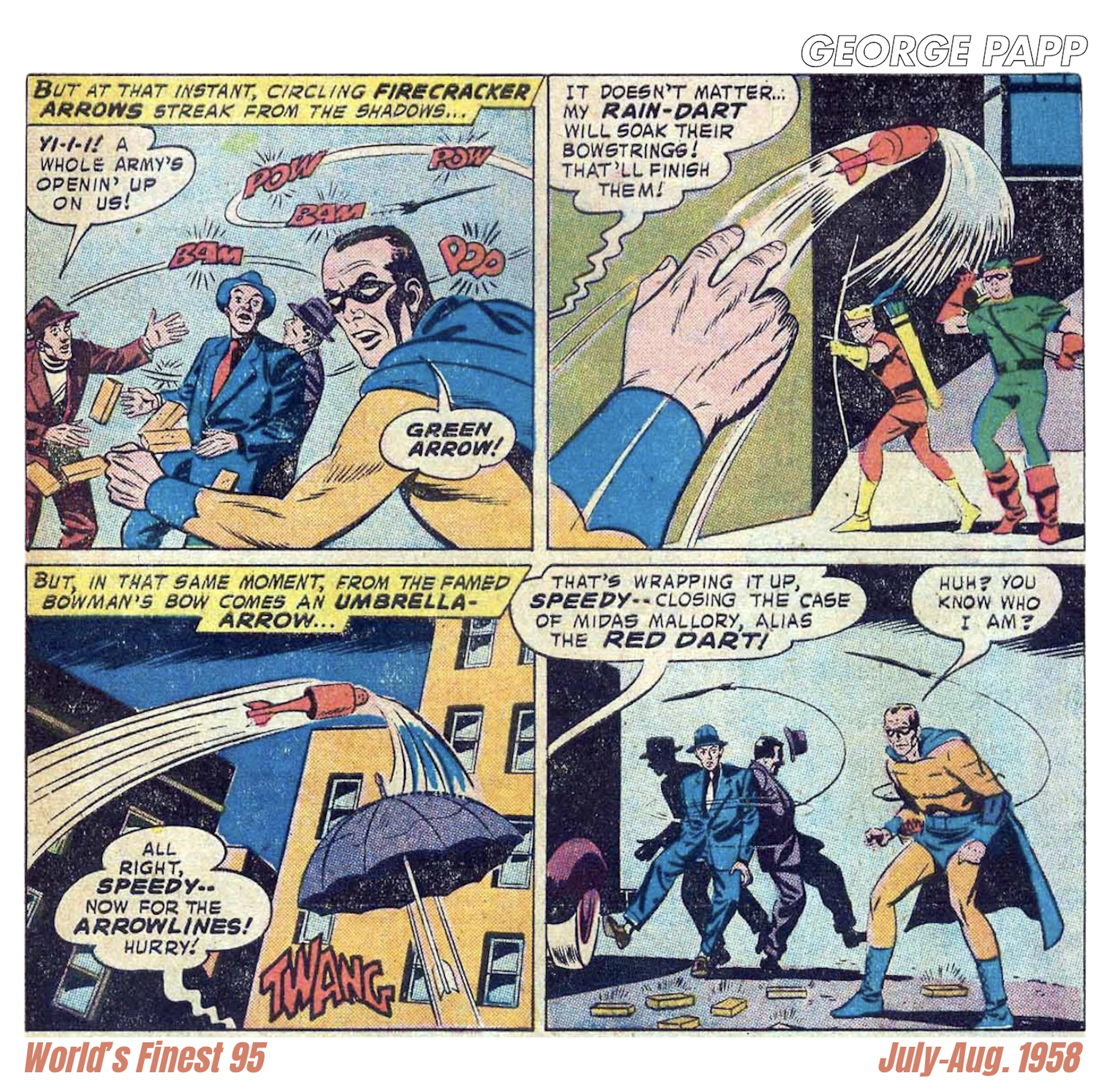
“Armed with various darts — including fog-darts, grenade-darts and rain-darts — the villain dressed in a golden bodysuit with blue trunks, boots and a cape.”
Somewhat unusually for such characters, he was also balding.
Like Green Arrow, the Red Dart was a skill-based costumed adventurer.
“Unlike most comic book heroes, he seems quite willing to share his skills with others,” noted comics historian Michael E. Grost. “His generosity of spirit reflects his wholesome personality and a lack of ego needs. It also seems related to the fact that Green Arrow has a set of specific, well-defined skills, unlike many comic book heroes. I’ve often found that real-life experts in some subject were equally willing to train others and share their expertise. Green Arrow’s generous psychology here mirrors that of real-world experts.”
Of course, the Green Arrow and Speedy ultimately saw through the Dart’s disguise, in part because of his use of prison slang terms like “slum,” “cracked ice,” and “bush patrol.”
Another giveaway was the Red Dart’s yellow hands.
“Anyone who fences for gold thieves is also an expert assayer!” Green Arrow explained. “And all assayers have yellow acid stains on their hands, which come from testing gold with aqua regia!”
In retrospect, it’s kind of amazing how many DC superheroes’ exploits involved the acid aqua regia, i.e., “royal water.”
About Author
