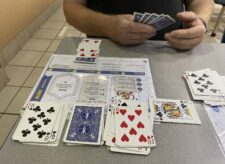
 I shuffled my deck of cards with a rather high level of expectation as Trevor and I put 52 Duels on the table for the first time.
52 Duels is a print-and-play game that can be played solo, but—as with most games—it’s more fun with someone else at the table. This one, in particular, really feels like it shines as a two-player experience.
The game comes from designers Matthew Dunstan and Rory Muldoon, and publisher Postmark Games.
Printing is super simple: just a few pages of rules and a game sheet for each player. That’s it. This is my favorite kind of print-and-play game—clean, minimal, and once slipped into a common plastic sheet, well protected for long-term use.
Each player also needs a standard 52-card poker deck, and you’re ready to go.
Muldoon said simplicity was a goal from the outset.
“We were trying to achieve a fast-paced, simple-to-play, but deep and variable duelling game—one as good as the best ones on the market—while only needing a character sheet per player and a deck of cards,” he said via email. “Deep, but minimal.”
This is a fantasy battler that will immediately feel familiar to anyone who’s played Magic: The Gathering, which it clearly echoes as a venerable predecessor.
That said, 52 Duels is far simpler—no booster packs to buy or competitive deck construction just to get started—but the gameplay rhythm is similar. Players take turns launching attacks, blocking damage, using items, and leveling up their hero’s unique skills. The version we played included two characters: a barbarian and a rogue.
At first, the two didn’t seem particularly well balanced, but after three plays their relative strengths became clearer. The barbarian can hit hard and quickly strip cards from an opponent’s deck, while the rogue excels at defense and survivability.
The promise of a more diverse character pool is especially intriguing, and Muldoon confirmed more are on the way.
“I love the characters and how different they are,” he said. “For me, that’s always the most fun part of duelling games—trying out different characters and their abilities, and figuring out the best way to use them.
“At launch we’ll have four characters available, and we plan to reach a total of 10 in the first wave over time. The Postmark model means we can always release new content, and people who already own the game can download new material completely for free.”
You’ll also quickly discover that not everything you can do is necessarily worth doing. Leveling up is usually a no-brainer in role-playing games, but here the resource cost sometimes made us question whether it was worth it—or whether there were simply better in-game options available.
The deck of cards is used to power all of the game’s actions, but it’s also your lifeforce. When you take damage, cards are removed from your deck. When the deck is gone, so are you—you’ve lost.
Balancing the need to commit cards to the playmat against the need to keep cards in your deck is, frankly, brilliant.
Turn-by-turn choices are varied, though naturally constrained by the five-card hand limit. You won’t always be able to do exactly what you want, but it’s rare to have a turn where you can’t do something. Adaptability is key.
Muldoon explained that the game’s roots lie in a “sister” design.
“After the success of 52 Realms: Adventures, our first game that used playing cards, I was inspired to see what other styles of games we could make using cards as well,” he said.
“Another major inspiration was Dice Throne, and the huge variety among characters achieved with a minimal amount of components.
“Put the two together and you have 52 Duels.”
The result is a great marriage of ideas. 52 Duels is an easy recommendation—and it just might land in my top five two-player games by year’s end.
About Author
Calvin Daniels is a Saskatchewan-born, self-taught journalist. He is currently Editor of Yorkton This Week, with 35-years in the newspaper business.

Awesome Card Battler Using a Standard Deck of Cards
52 Duels is a print-and-play game that can be played solo, but—as with most games—it’s more fun with someone else at the table. This one, in particular, really feels like it shines as a two-player experience.
The game comes from designers Matthew Dunstan and Rory Muldoon, and publisher Postmark Games.
Printing is super simple: just a few pages of rules and a game sheet for each player. That’s it. This is my favorite kind of print-and-play game—clean, minimal, and once slipped into a common plastic sheet, well protected for long-term use.
Each player also needs a standard 52-card poker deck, and you’re ready to go.
Muldoon said simplicity was a goal from the outset.
This is a fantasy battler that will immediately feel familiar to anyone who’s played Magic: The Gathering, which it clearly echoes as a venerable predecessor.
That said, 52 Duels is far simpler—no booster packs to buy or competitive deck construction just to get started—but the gameplay rhythm is similar. Players take turns launching attacks, blocking damage, using items, and leveling up their hero’s unique skills. The version we played included two characters: a barbarian and a rogue.
At first, the two didn’t seem particularly well balanced, but after three plays their relative strengths became clearer. The barbarian can hit hard and quickly strip cards from an opponent’s deck, while the rogue excels at defense and survivability.
The promise of a more diverse character pool is especially intriguing, and Muldoon confirmed more are on the way.
You’ll also quickly discover that not everything you can do is necessarily worth doing. Leveling up is usually a no-brainer in role-playing games, but here the resource cost sometimes made us question whether it was worth it—or whether there were simply better in-game options available.
The deck of cards is used to power all of the game’s actions, but it’s also your lifeforce. When you take damage, cards are removed from your deck. When the deck is gone, so are you—you’ve lost.
Balancing the need to commit cards to the playmat against the need to keep cards in your deck is, frankly, brilliant.
Turn-by-turn choices are varied, though naturally constrained by the five-card hand limit. You won’t always be able to do exactly what you want, but it’s rare to have a turn where you can’t do something. Adaptability is key.
Muldoon explained that the game’s roots lie in a “sister” design.
The result is a great marriage of ideas. 52 Duels is an easy recommendation—and it just might land in my top five two-player games by year’s end.
About Author
Calvin Daniels
Calvin Daniels is a Saskatchewan-born, self-taught journalist. He is currently Editor of Yorkton This Week, with 35-years in the newspaper business.
See author's posts